Lavernator
New Member
Hi everyone, long time lurker first time poster here.
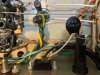
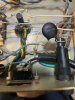
I had acquired a pair of W-5Ms a few years ago and finally got around to start my rebuild of them. This is my first project on a tube amplifier so I am learning as I go. I worked on only one so far. The power cord was cracked so I replaced it with a 3-prong cord and grounded it to the chassis. I installed a power switch in place of the convenience outlet and removed the second convenience outlet completely. I installed a new fuse holder, fuse, and thermistor. I also replaced all of the capacitors. I removing the can caps from the circuit and installed the replacement capacitors under the chassis.
Now here is where the problem is.
When I plug in the amplifier into my dim bulb tester the bulb lights up immediately indicating a short somewhere. If i turn on the amp, the bulb dims and I can get sound. I used the amp through the DBT for about 15-20 min and it sounded fine. No hum, no crackles, really good sound but a bit quiet. I used a Schitt Magni headphone amp as the preamp so that may be why the sound was a bit quiet. The fuse does not blow. So the amp works, kind of. I have studied my soldering and have not found any obvious places where I may have crossed wires or anything. I have undone and resoldered a few connections which I though may have been a cause but no change.
Because I get clear sound, I assume that the transformers are all fine and the the tubes are all fine. Is this a safe assumption?
Would any of you have suggestions of how I should go about troubleshooting this and narrow down where the short may be?
I had acquired a pair of W-5Ms a few years ago and finally got around to start my rebuild of them. This is my first project on a tube amplifier so I am learning as I go. I worked on only one so far. The power cord was cracked so I replaced it with a 3-prong cord and grounded it to the chassis. I installed a power switch in place of the convenience outlet and removed the second convenience outlet completely. I installed a new fuse holder, fuse, and thermistor. I also replaced all of the capacitors. I removing the can caps from the circuit and installed the replacement capacitors under the chassis.
Now here is where the problem is.
When I plug in the amplifier into my dim bulb tester the bulb lights up immediately indicating a short somewhere. If i turn on the amp, the bulb dims and I can get sound. I used the amp through the DBT for about 15-20 min and it sounded fine. No hum, no crackles, really good sound but a bit quiet. I used a Schitt Magni headphone amp as the preamp so that may be why the sound was a bit quiet. The fuse does not blow. So the amp works, kind of. I have studied my soldering and have not found any obvious places where I may have crossed wires or anything. I have undone and resoldered a few connections which I though may have been a cause but no change.
Because I get clear sound, I assume that the transformers are all fine and the the tubes are all fine. Is this a safe assumption?
Would any of you have suggestions of how I should go about troubleshooting this and narrow down where the short may be?
Last edited: