• The move to the new server is done. There are some software and database maintenance updates in process. This has us passing the hat around to help out. We appreciate any donations. Seriously, even a dollar helps. The payment page may be found here - https://www.audiokarma.org/support.html

Heathkit WA-P2 Clone - simple question

6l6gmike

Active Member
Hello

I am looking to build a clone of the Heathkit WA-P2 this winter for in the main system in the house. This one will be a stereo preamp with phono and an on board power supply unlike the factory units. Last winter I built an HF-85 clone but without the phono. I liked how it sounds but wow way to much gain. Its a daily driver in my garage workshop, driving a diy 6l6gc amp, where I work on my cars and other fabrication projects and I need it loud to over come the air compressor and power tools.

So my question is, I am reading through the manuals and schematics and I can't find where it tells me what taper the tone control pots are. I have a feeling they are log but I haven't been able to find any supporting documents that tells me otherwise. Am I also correct in thinking its a passive and not active tone controls?

So please let me know what taper pots I should use and if it's passive or active tone controls.

Thank you
Mike
 
Register to hide this ad
If I may, linear controls are ONLY used with ACTIVE tone control circuits, while passive tone control circuits MUST use log taper controls if flat response is to occur at the center of rotation. The design of the Heathkit WA-P2 preamp -- a near direct copy of the original Fisher 50C preamp -- employs a passive tone control design, and therefore must use log taper controls for the tone control functions.

Dave
 
... Am I also correct in thinking its a passive and not active tone controls?

So please let me know what taper pots I should use and if it's passive or active tone controls.
Yes, passive tone controls with log taper tone control pots, just as Dave said. I just measured the tone control pots on one of my WA-P2 preamps to verify that they are indeed audio taper.
 
...I am looking to build a clone of the Heathkit WA-P2 this winter for in the main system in the house. This one will be a stereo preamp with phono and an on board power supply unlike the factory units.
This looks like a fun project. Are you going to keep the switchable phono EQ options or are you going to go with a fixed RIAA?
 
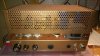
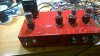
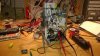
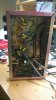
Thanks for the answers. I was going to go with a multiple choice RIAA. where there is different loads to pick from. I have about 4 different turntables and I think it would be fun to experiment with loading the cartridges differently to see how different they sound. I was 90% sure the tone control was passive and needed log controls but I just wanted to make sure. Dave, thanks for the Fisher 50C suggestion. I was not aware of that model and will also look at that design when I have a chance. Also thanks for all the Magnavox work you have done on here. I have built the 8604 series from scratch with your posts and schematic and also will be be building the 9302 this winter with 6v6's. Since everybody likes pictures, here are a few. The 8604 I have grafted in a tone control system from the website "fun with tubes" The red ones is HF-85 minus phone and a big selector switch. The brown one is the 8600 and the case is from a recycled solid state amp.
thumbnail_WP_20160511_06_58_01_Pro.jpg WP_20160510_06_47_23_Pro.jpg WP_20160302_20_44_15_Pro.jpg WP_20160510_06_47_11_Pro.jpg
 
Thanks for the answers. I was going to go with a multiple choice RIAA. where there is different loads to pick from. I have about 4 different turntables and I think it would be fun to experiment with loading the cartridges differently to see how different they sound. I was 90% sure the tone control was passive and needed log controls but I just wanted to make sure. Dave, thanks for the Fisher 50C suggestion. I was not aware of that model and will also look at that design when I have a chance....
Although it is true that there are uncanny similarities between the Heathkit WA-P2 and the Fisher 50-C, there are some significant differences. If I was building a preamp from scratch, I would base my build on the Fisher rather than the Heathkit schematic. The Fisher 50-C SAMS photofact can be found here on the AudioKarma website. The Sams is an early version of the 50-C so you will have to make some capacitor and/or resistor adjustments in the phono EQ sections to obtain accurate RIAA frequency response.
 
Last edited:
There are some differences, although they are more feature based than anything else. As for the rest of the design, the similarities go beyond uncanny, to the point that there was likely an agreement between Fisher and Heathkit, allowing Heath to offer a stripped down version of the original 50C offering, minus a power supply of course. It was very typical of Heath back at that time to tap into existing knowledge banks, rather than reinvent the wheel. They simply did not have the resources to do that at that time. On the other hand, a Fisher engineer could have come up with a modified 50C design for the WA-P2 while waiting for lunch to be served........

Dave
 
...passive tone control circuits MUST use log taper controls if flat response is to occur at the center of rotation.

Dave or anyone who might know, I'd love to know why this is true. I haven't studied tone circuits much, other than knowing they implement low and high pass analog filters. Does it depend on the design of the specific tone circuit? Maybe Fisher designed them to use logarithmic controls on purpose for some reason? Or is this a common trait to all passive tone circuits?
 
Almost all passive tone circuits use log pots, and this was one of the primary driving forces behind the development of feedback tone controls. It's pretty common, where passive controls are used, to find that flattest response occurs somewhere other than the top dead center settings because log pot accuracy is generally poor. One example is the Dynaco SCA-35, where the kit assembly instructions call for deliberate off-center bass and treble knob installation to compensate for this issue.
 
Tcdriver. Please explain your preference to build the fisher rather the heathkit one. I am learning this hobby as I go so I would like to hear your thoughts.
Although it is true that there are uncanny similarities between the Heathkit WA-P2 and the Fisher 50-C, there are some significant differences. If I was building a preamp from scratch, I would base my build on the Fisher rather than the Heathkit schematic
 
There are some differences, although they are more feature based than anything else. As for the rest of the design, the similarities go beyond uncanny, to the point that there was likely an agreement between Fisher and Heathkit, allowing Heath to offer a stripped down version of the original 50C offering, minus a power supply of course. …
No argument here. In most respects the schematics are identical.

Tcdriver. Please explain your preference to build the fisher rather the heathkit one. I am learning this hobby as I go so I would like to hear your thoughts.
I too am still learning. This year I started looking into refurbishing some of the Heathkit WA-P2 preamps that I have. In the course of my work, I discovered that there are some things that can be done to improve the performance of these preamps. I also learned from dcgillespie, in another thread, that the Fisher 50-C and the Heathkit are nearly identical. While that is indeed true, there are some differences that I feel are significant and some differences that are not so significant.

Significant differences:

1. The Fisher includes the power supply on the preamp chassis while the Heathkit gets its power from either a compatible amplifier or stand-alone power supply. In my opinion, this is an advantage for the Heathkit.

2. The Fisher unit uses DC on the filaments. The Heathkit uses AC. If one is only going to use high level inputs, this is not a significant issue, however; for the phono circuit, this is a significant difference because it is near impossible to be hum free with AC on the filaments.

3. The Fisher uses a compound volume control whereas the Heathkit uses a volume control placed after the tone controls. The advantage of the Fisher circuit is that it minimizes distortion and the possibility of the tone control section being overdriven. The Heathkit can be operated without overloading the tone control section, it is just that the operator needs to be well aware of the potential overload problem and adjust the input level controls to make sure the Volume control is always adjusted to near maximum.

4. The Fisher B+ voltage for the phono section is 180V whereas the Heathkit is 140V. This may seem like a small difference but it can be significant. The phono stage, on both units, uses no loop feedback which makes the performance of the phono circuit very dependent on the characteristics of the tube used. While one would like to think that all 12AX7 tubes have identical characteristics, it turns out that there are significant variations tube to tube, particularly when operated at low currents and lower B+ voltages, as in these preamp designs. As one raises the B+ voltage, the variations between tubes tend to diminish, yielding more consistent results tube to tube.

Not so significant difference:

1. The Fisher has a loudness switch, the Heathkit does not.

Please, do not get me wrong. I like and have been using my Heathkit WA-P2 for months and I am very happy with it, however, I have modified it to yield improved performance. My modifications include DC filaments, higher B+ voltage, eliminating the tone controls and adjusted resistor / capacitors values to yield accurate RIAA performance. I hope this helps.

TCD

p.s. My power supply thread: http://audiokarma.org/forums/index.php?threads/heathkit-preamplifier-model-wa-p2-–-power-supply-–-what-are-you-using.721788/
 
Last edited:
Back
Top Bottom