• The move to the new server is done. There are some software and database maintenance updates in process. This has us passing the hat around to help out. We appreciate any donations. Seriously, even a dollar helps. The payment page may be found here - https://www.audiokarma.org/support.html

Help Authenticating Rogers LS3/5a (video)

Jonmustang

Active Member
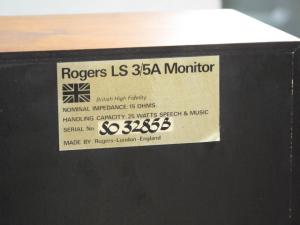
Howdy everybody! I go Rogers LS3/5a speakers a while ago and (quite understandably) there was a little concern because no serial numbers on them. No idea why that is.

So, I shot and edited a video showing the internal parts and also added some nice music to enjoy. The first 4 minutes show the parts and condition, after that it's just some songs. Here's the vid:


I'm hoping the shots of the crossovers and drivers are helpful. Can anyone help me confirm anything about them or venture a guess as to why seemingly legit Rogers perhaps wouldn't have serial numbers? Any red flags pop out in the video to anyone who is familiar with these?

Thanks and enjoy!
 
Last edited by a moderator:
Register to hide this ad
I have never seen Rogers LS3/5a up close and inside so can't comment on the crossover and cabinet, but it certainly doesn't look like a DIY loudspeaker.
What is concerning is that at least the one B110 you showed is a constructor series driver which is not correct for an LS3/5a of any vintage. According to KEF, the SP1003 drivers originally used were hand selected out of production and belonged to the edge of specs within the production spread. It is also believed that the constructor series were the "lesser" performing drivers with the better ones retained to be used in final KEF products.
 
I have never seen Rogers LS3/5a up close and inside so can't comment on the crossover and cabinet, but it certainly doesn't look like a DIY loudspeaker.
What is concerning is that at least the one B110 you showed is a constructor series driver which is not correct for an LS3/5a of any vintage. According to KEF, the SP1003 drivers originally used were hand selected out of production and belonged to the edge of specs within the production spread. It is also believed that the constructor series were the "lesser" performing drivers with the better ones retained to be used in final KEF products.

Now that's very interesting! The plot thickens. Thanks for the info!
 
I have never seen Rogers LS3/5a up close and inside so can't comment on the crossover and cabinet, but it certainly doesn't look like a DIY loudspeaker.
What is concerning is that at least the one B110 you showed is a constructor series driver which is not correct for an LS3/5a of any vintage. According to KEF, the SP1003 drivers originally used were hand selected out of production and belonged to the edge of specs within the production spread. It is also believed that the constructor series were the "lesser" performing drivers with the better ones retained to be used in final KEF products.

Say, thanks to your observation, I did a Google search and came up with this from a KEF history page:

"In 1981 KEF introduced the Constructor Series CS1A, a kit that included the B110 (SP1003) and T27 (SP1032) drivers and a crossover designed to match the subjective balance of the LS3/5A but in a simpler form than FL6/23"

https://us.kef.com/explore-kef/about-kef/kef-bbc-and-ls35a

I wonder if that's a partial explanation for why there are no serial numbers and why it has a Constructor series driver. Hmm, very interesting stuff.
 
I have a pair of original Chartwell LS3/5As and also an extra KEF woofer (new old stock). This is the proper woofer:
DSC_00024.JPG


DSC_00017.JPG

DSC_00036.JPG

DSC_00053.JPG


DSC_000514.JPG

DSC_000615.JPG

DSC_000416.JPG
 
I have a pair of original Chartwell LS3/5As and also an extra KEF woofer (new old stock). This is the proper woofer:

Interesting, yes, the SP1003 is said to be the right one. I shall probably open up the other speaker and check which woofer is in there. Thank you for your reply.
 
I used a constructor B110 in one of mine for a while before Falcon replacements drivers were available. I didn't think I could hear any difference compared to the stock woofer. Just sayin, they're both older woofers. If you want a matched new pair, I can recommend the Falcons.
 
I used a constructor B110 in one of mine for a while before Falcon replacements drivers were available. I didn't think I could hear any difference compared to the stock woofer. Just sayin, they're both older woofers. If you want a matched new pair, I can recommend the Falcons.

Thank you! I think if I can answer the mystery of the missing serial numbers and if it then seems worth making everything "correct," I might get the Falcons. Or, hey, maybe just let them be. I appreciate your comment!
 
Is it possible that someone at the factory cobbled a pair together with a back door delivery? I know that could happen where I worked at Thomas Organ/Vox.
 
I have a pair of Rogers BBC Monitors and the crossover, wiring and cabinet interior of the the OP's speakers seems very similar.
I would lean towards these being original with a woofer replacement though they could be original since Rogers suffered from supply issues from time to time and occasionally switched up parts based on availability.

Here is a link to the thread on my speakers which has some internal pictures as well for comparison.

https://audiokarma.org/forums/index.php?threads/rogers-bbc-studio-monitor-find-help.501735/page-2
 
Hi Jon, thanks for the ping and shout out. I've reviewed your video a few times and have some comments. As usual with vintage gear, there's some good and some not so good news. Here goes:

a. Question - how old are these to you, where and when and from who did you get them from? What provenance or history did the seller give you, if any? Were they used at home or in a work setting, any BBC usage, and did you get them here in the US or from England where most of the LS3/5a's resided? This will help flesh out my analysis.

1. These are genuine Rogers (made by Greaves & Sons) LS3/5a cabinets, circa around 1976-77 or so. They appear to be teak wood veneer to me. This ID is from the short black on silver label on the back but made from plastic film, not glued paper as in the very early versions. The labels DID have serial numbers on them - the first one I can faintly see the outlines of a number and possibly the end letter (of an AB pair). The second speaker in the video has the typical specks of semi-permanent ink laid down at the ends or direction shifts when the fellow who wrote them in a angular cursive style pushed harder then on the strokes. It is not uncommon when people try to "clean" the labels that the serial numbers wipe off or fade. Sadly, this diminishes them somewhat because you can't really get any read on the actual age via serial number. In some cases, people will redo the faded numbers IF they can see them. Failing that, we will have to try a few other methods to see them.

One idea is to use polarized light held overhead or at a shallow angle and see if anything shows up. Same with using a black light source and if any shadow shows up. I'm not confident UV light would help but you could try that if you have a source. Also, taking some digital pictures with a very good smartphone and then importing them into a picture editor might reveal something using effects. I would try natural light, not too bright, taken directly overhead and at various angles.

You would be looking for SO or SM followed by 4 numbers and 1 letter for the particular era these look to be. The pic below has the same label and characteristic numbers and slight wear at the back panel glue joints. The serial numbers look to have been redone with a narrow type pen marker. I'll show another with the normal script.

Illustrative pics from here:
https://www.canuckaudiomart.com/details/649142326-early-rogers-bbc-ls35a-monitors/


800034-4cb2dbee-early-rogers-bbc-ls35a-monitors.jpg
17l.jpg


These are replacement stickers. Here is a later sticker showing the black dotting that occurs with some of the labels. Yours second speakers has some of this.
aCW7V1xRazRk3eKTqzUELYqf1iMf2_Ne8CxrngRSt10qZWSgPVrfwOBDPNHg4QADOtMIhlkbBaiiYtZTj_IvCs2-ArwfT2jN2V1RFbIVb8qFGp3sM3Qx6uFQdFdvkjRpL5mZOwo_40BE
o0908054614406813278.jpg


2. Examine the labels carefully. Do they look weathered or a little tattered? Or do they look relatively and incongruously newer? Do the fonts on each one match? Is there evidence of masking off and paint edging surrounding the label, indicating the back was refinished or repainted but maybe the original label was conserved? Reason being is reproduction labels of early Rogers style are around and unscrupulous folks have been putting these on "Moldavia" sourced cabinets and trying to pass them off as real or originals. There are also various original looking crossover boards so one could even rebuild or create kinda old looking crossovers (more on that later).

3. The input terminals look similar to originals but appear to be disc shaped with a rounded over corner - these look a bit more rounded than the originals which were almost flat with a very small radius. Internally, they will be about 3/4" long. Its not unusual for them to be replaced because the outer plastic collar becomes brittle and breaks off.
 
Last edited:
4. Additional cabinet info - The exterior and interior of the cabinets look correctly done with the tapered beech wood battens (support braces). Examine the interior foam carefully. It is actually unusual for it to be a nice whitish yellow color, indicating new or completely sealed and unmolested. More commonly, there is, for a 45 year old speaker, some darker yellowing along the edges, particularly in front. Some speakers were damaged by being overdriven, would show some scorching or burning along sides next to the resistors on the left side of the crossover. Lift the edges of the foam pieces and see if there is any date stamp on the inner cabinet walls or battens. The Greaves sticker is usually not seen but under the foam insulation if present, so should not be anywhere near the baffle seal. It should be moved back to under the bottom foam. There should also be thin bituminous damping pads on the back wall and sides, and top/bottom. These help to control cabinet resonances while the foam absorbs standing waves. I noticed a couple of the screw holes in the battens appear to have been screwed into twice and not in the same place, suggesting the screw was replaced and screwed in off axis from the original hole, or the baffle was mounted upside down and did not align correctly. I don't see any evidence of the thin inner baffle gasket that should interface between the battens and baffle board, sealing the baffle. That should be reviewed and sourced.

800036-a9c5cc9d-early-rogers-bbc-ls35a-monitors.jpg


5. Baffle board - Most but not all Rogers had serial numbers written on the back inside bottom of the board below the woofer. The board should be a 9 ply baltic birch plywood. It should look slightly crude because it was cut with rough machinery back then, not precision CNC stuff like today. It is possible someone had replaced the baffle board in the past if these identifiers don't show here or you just didn't get one that had it written on.

6. Drivers - Woofers - On the one woofer that you show (and mentioned that both are KEF Constructor versions), I'm sad but not surprised to say these are replacements for the original, selected, KEF B110 SP1003, circa 1975-77. Todd's pic shows the front of the SP1003 showing the bextrene cone with front outer painted on plastiflex PVA damping coating and thicker, short inner attachment Neoprene surround, black chassis, and narrow rectangular ID label with SP1003 and usually another with a cryptic date code. A glimpse of yours clearly shows the B110B SP1057 designation, a later midwoofer designed and used in the KEF R101 and as a midrange for the KEF 105 series and a few other floor standers. This woofer is identified by the smooth rounded magnet pole piece/back, the smooth bare bextrene front (coating now on the back) and slightly flattened and wider inner attachment PVC roll surround - it is a bit more compliant. The SP1057 has different frequency and Thiele/Small characteristics compared to the original SP1003, and also benefits from newer voice coil adhesives and materials. A lot of LS3/5a's have had their woofers replaced like this because folks did not realize the difference, or felt buyers would not know the difference either. The woofer appears to have the correct, possibly reused PVC channel gasket around the frame edge to decouple it from the baffle. The bolts and nuts and felt washers appear correct.

816416-55ce0ea2-early-rogers-bbc-ls35a-monitors.jpg


This is not to say the speakers wouldn't sound good, or even a bit similar. However, the crossover is specifically designed for the SP1003 and using the SP1057 is not going to adhere nor give the correct BBC LS3/5a specific frequency response. It can sound good, even pretty good, but not accurately correct. The Constructor series versions, as mentioned above, were outliers or non-matches when produced, and not used in KEF's stringent computer grading and selection process of the day. KEF put them to DIY market use where builders did not necessarily have ways to get down to the nth +/- 0.5db adherence to spec, so had pleasant sounding speakers with the character of if not the exact frequency response of DIY designs prevalent of the era.

The good thing is both speakers, if having the same SP1057, will sound reasonably matched in character. If one was SP1003 and the other SP1057, there probably would be some deviation that you could more readily hear.

7. Drivers - Tweeters. Sad to see one of your original tweeters was poked in. Was the perforated cover missing from it? Does the date code on the side or back of the original tweeter reasonably match the other tweeter that has the cover? IF so, you may want to try to salvage the dented tweeter just for fun, assuming it still has continuity across its terminals when check for DC resistance. To pull it out, you need to wipe the faceplate clean with a moist cloth. Avoid any solvents. Dry your mouth and place rounded and pursed lips over the entire tweeter circumference, creating a seal. Then gently but firmly create vacuum with your cheeks and tongue - trying to suck out the dome. You will have to vary the suction and see what happens or works. If you are persistent and a bit lucky, the dome will pop back up and out. However, its likely there will be a couple of dimples on the dome which are hard to fully remove. It will be unknown if it works properly till you test the tweeter with a HF signal (3K and higher) and low power amp, preferably with a blocking cap. The voice coil can get canted or tilted unless the roll surround looks even height all around. You can also use a vacuum wand from a vacuum cleaner that can seal around the entire tweeter dome but it must have some way to crudely adjust the vacuum AND be easy to hold in place. You may need some help by someone else turning the vacuum on and off while you manipulate the hose or attachment. Avoid brushes for obvious reasons.

That said, replacing the T27's is not uncommon and I'm unaware that they varied too much in frequency response or were selected to any degree. If upon listening they sound pretty symmetrically similar in quality and HF loudness and timbre, I'd leave well enough alone. OTOH, if the T27's came as a pair from a pair of KEF speakers, they might be more matched to each other (particularly if their date codes are similar) than one old and one "new used". Your ears or test instrumentation would be able to tell better.

There should be a very thin circular foam gasket under the tweeter to seal against the baffle. On the back of the tweeter should be a 1/4" thick square felt pad that helps to damp the crossover when mounted behind the tweeter on the 4 standoffs. The tweeters should be mounted so that the visible wires are horizontal. The perforated protection grille should be in placed and glued down to the tweeter as it assists the HF response. The 4 outer felt damping strips that form a dam around the tweeter prevent cabinet and grille edge diffraction. Yours appear original, as does the (sometimes poorly) stapled velcro baffle strips.

8. Grilles - your grilles appear to be the correct woven Tygan grilles. They have the slightly later short rectangular silver letter on black background badges. Earlier units had bronze metal badges. I think yours are correct. One grille appears to have a fabric pull tab, can't tell about the other. This help getting the grille off of the velcro mounting which is pretty firm or tight. In the future, if you need to pull the grilles and don't have the tab, insert a thick plastic credit card and use it to gently pry top or bottom out till you can get the grille started. Most grilles were made from a plywood or later MDF frame.

 
Last edited:
9. Crossover - Here's where there needs to be a bit more work done. The crossover "looks" like an early crossover, mint green fiberglass, correctly marked, staked, and soldered. The capacitors, most of them are rectangular, globular, and rainbow color code marked, the so-called Philips "fish" capacitors. Some prize this type of cap combo. The inductors and autotransformer seem to have a heavier and browner varnish than I usually see with that era, plus are missing the typical black type on white sticker Draker transformer labels on top, they only have hand written numbers although the correct numbers. See below: These are the same internals for the SO3561AB cabinets pictured above, you can see the back baffle seals, the handwritten serials on the bottom and the correct appearance of the SP1003 driver and labels. You can also see the crossover board is slightly yellowish green. The caps have a fairly uniform color banding. The 3 resistors are usually all the same make with a greenish vitreous enamal coating. Your's has the far left replaced with a larger red resistor, possibly a replacement, maybe not - there are no scorch marks under its mounting suggesting no overheating.

Normally, the genuine Rogers crossover will have an Etched Rogers name and FL6/23 crossover model number on it, visible mostly from the solder etch side, so you'd have to dismount the crossover to see it. So I'm a little unsure as to whether the crossover is genuine and original, or a faithful rebuild using a new board and relevant parts. At first glance it does look good.

800037-f502e080-early-rogers-bbc-ls35a-monitors.jpg


Thanks for bearing with me, I tend to write a lot. Let me know if you have other questions. Time for me to get a little sleep now!

Regards,

Bart
Groups.IO LS3/5a newsgroup moderator and owner.
https://groups.io/g/LS35A
 
The speakers are authentic. The B110 woofer(s) have been replaced with Constructor Series which probably don't meet BBC specs (considering 90% of the original, submitted, drive units were rejected). Having said that, most, if not all of the original SP1003 B110s in authentic LS3/5As are now out of spec! T27's were pretty consistent so you need have no worries about those replacements.

Enjoy them and don't fret!
 
Back
Top Bottom