• The move to the new server is done. There are some software and database maintenance updates in process. This has us passing the hat around to help out. We appreciate any donations. Seriously, even a dollar helps. The payment page may be found here - https://www.audiokarma.org/support.html

Help deciphering a 2-way outdoor subwoofer crossover network, TIC B50

jtatknox

New Member
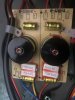
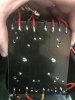
I have a passive outdoor subwoofer with the crossover set too high (TIC B50), claims to be around 200 Hz. I think that's too high, but on top of that the rolloff seems very slow. Lots of vocals and guitar coming through. I am good w/ a soldering iron but don't quite understand the design of this crossover network. Does it look like a possibility to set the crossover lower and steeper? Unfortunately, the inductors aren't marked.

DSP and separate amp not an option on this install, unfortunately.

Thanks all for your wisdom!
 

Attachments

  • IMG_3131.jpg
    IMG_3131.jpg
    87.4 KB · Views: 23
  • IMG_3132.jpg
    IMG_3132.jpg
    88 KB · Views: 23
Register to hide this ad
Can you draw a schematic or a sketch of the connections?

Usually larger capacitors in parallel with the woofer will shunt the higher freqs to ground.

It looks like a 2nd order low pass filter, the input signal goes to the inductor, and from the inductor to the woofer, with a 10uF capacitor in parallel with the woofer. Fitting a larger capacitor or adding another capacitor in parallel should filter more high freqs.

The woofer and 10uF capacitor should be connected to the same terminals.
 
Last edited:
Thanks this is really helpful and I apologize that I was so lazy in not tracing. I think that the 2nd order filter makes sense given how high this crossover goes. It seems 6dB/octave or less.

I think I got extremely lucky in finding a very affordable drop-in replacement from Parasound (discontinued) for <$50 right after posting. 120 Hz and 12dB/octave. Amazingly, NO ONE makes anything like this new anymore that I can find:

https://www.audioadvisor.com/prodinfo.asp?number=PACX1002

I will update with pictures of the install and my listening impressions. I think with this crossover and the TIC B50, I might end up having a nice little passive outdoor sub that crosses over lower than anything I could find new (mostly crossovers at 250Hz or higher) for under $200 and some labor. YMMV!
 
A 2nd order crossover slope is 12dB/octave. Increasing the 10uF capacitor on your board (if your woofer is wired correctly , on the same tabs that capacitor is), you should send more high freqs to ground.
 
Agreed. Increasing the shunt capacitor would be the thing to do, certainly cheaper than adding larger inductors.
 
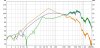
I measured the frequency response w/ a UMIK-2 at 90º, close mic'd (blue trace). It seems like it doesn't filter the highs from the sub at all!

After replacing w/ the Parasound crossover mentioned above (it's a chonker!), I measured the low pass (orange) and high pass (green) outputs. It measures (and sounds!) much better. I know my mic technique was totally wrong here, but is that the cause of the 50-60hz peak in the bass?
 

Attachments

  • crossoverpic.jpg
    crossoverpic.jpg
    102.9 KB · Views: 7
  • 2-way crossovers.jpg
    2-way crossovers.jpg
    81.4 KB · Views: 7
Last edited:
I measured again at distance. Definite proximity effect.

However, I ran into a new problem: the sub sounds fine in free air, but when I put the sealed top back together it makes a chirping sound with every hit. Just by cracking the lid 1 mm or so, it gos away. Is this caused by an air leak? I'm thinking maybe some RTV silicon would do the job, if so.
 
could be a leak, hard to say without knowing the construction but if the top is meant to be sealed, it has to use gasket or something to get that done. Damage to that seal could make it chirp whenever air pushes past. If they didn't actually seal it and just relied on it fitting fairly close together some RTV ought to do it, just expect it to be more difficult to open up later on.
 
The inductor on the new crossover looks larger, probably more inductance...

Anyway, I wonder if your 1st crossover was wired correctly ...
 
Last edited:
It was indeed an air leak. Sounds great, now. Thanks, all, for your ideas and just being a sounding board. Great community.
 
Back
Top Bottom