
• The move to the new server is done. There are some software and database maintenance updates in process. This has us passing the hat around to help out. We appreciate any donations. Seriously, even a dollar helps. The payment page may be found here - https://www.audiokarma.org/support.html

Help ID signal coupling vs filtering caps in preamp schematic

AudioModern

AK Subscriber
Subscriber
I'm preparing to recap my NAD 1000 and am putting together a spreadsheet of parts to order. I'm trying to stick to Nichicon PW for PSU and power filtering caps. For signal I'm going with Nichicon ES/KZ (WIMA films for really small values).

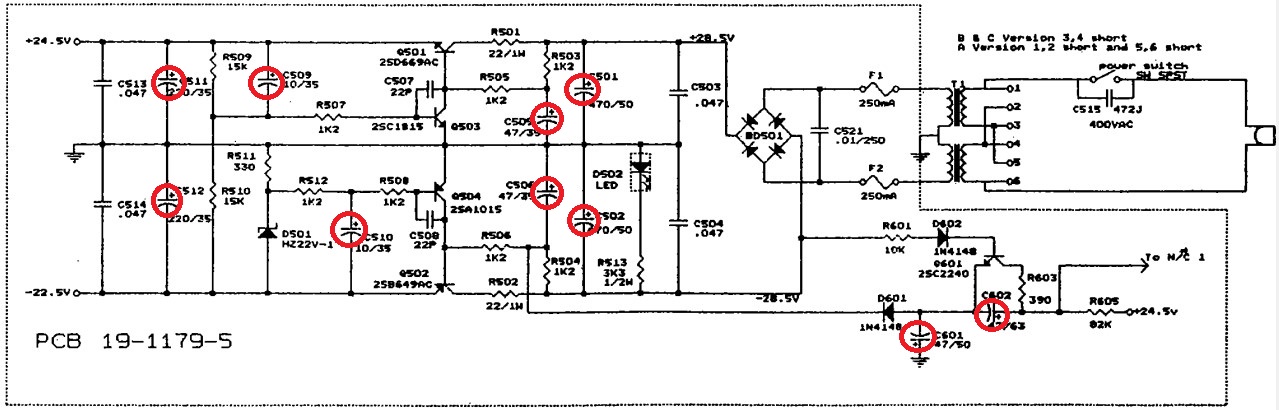
The PSU is fairly straightforward, all the electrolytics (circled in red) will be replaced with Nichicon PW.
psu.jpg


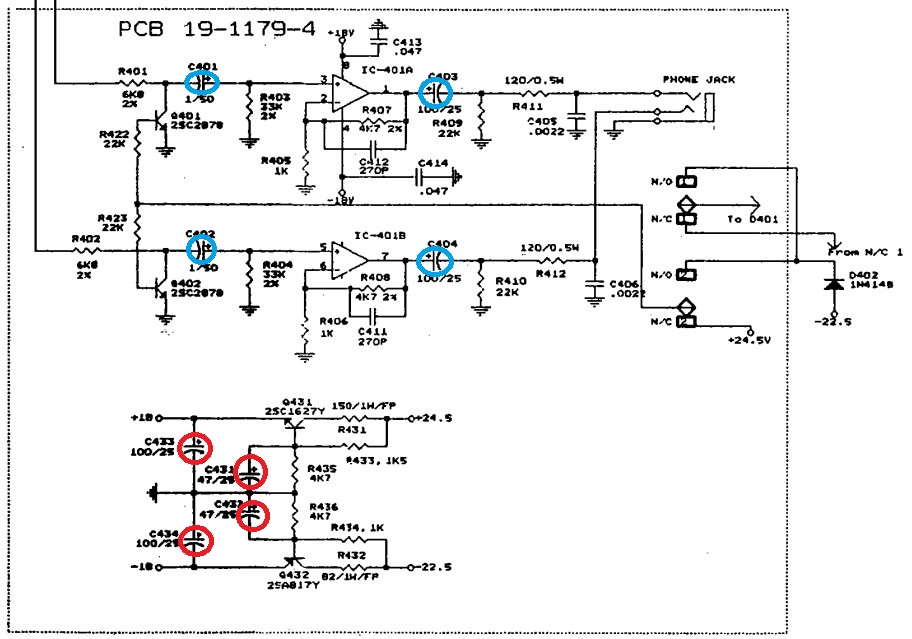
The headphone amp is also pretty straightforward (I hope):
headphone.jpg

The bottom half appears to change the rail voltages from +24.5/-22.5 to +18V/-18V to supply the circuitry in the top half, so the red circled caps would be Nichicon PW. The blue circled caps in the top half I think are all signal path, so Nichicon ES/KZ.

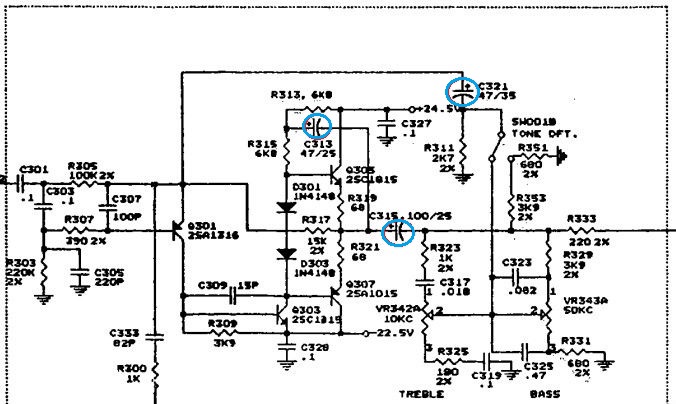
The preamp section only has three electrolytics per side (circled in red), and seem to me like they're all part of the signal path:
preamp.jpg

Does that seem correct?

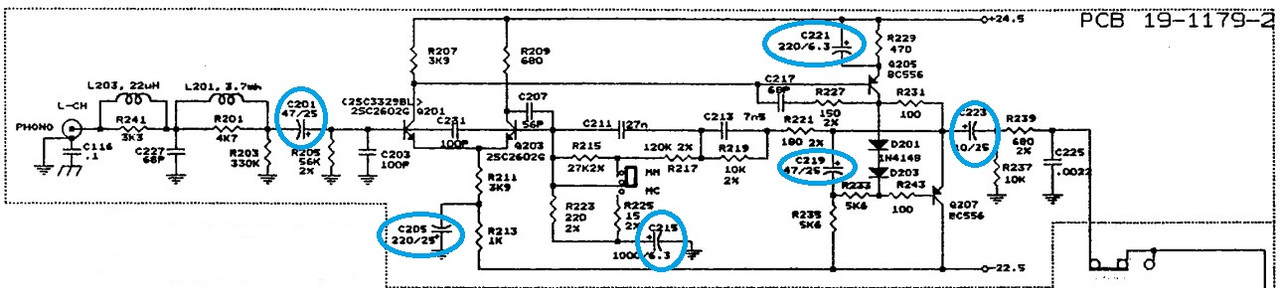
The phono preamp has a few that I'm confused about:
Screenshot-2023-02-01-193353.jpg

C201 and C223 look to me like signal path.
C221 seems like it is probably power filtering(?)
C205 is maybe power filtering(?)
C215 seems like it could be considered signal path since it looks like it's attenuating the phono input based on MM/MC switch position(?).
C219 seems like signal path but I really don't know.

Can someone have a quick look and see if I've got any of this close to right? I won't be ordering for a few days but any help in the mean time any help is appreciated. Explanations are extra appreciated but not necessary.

Also, am I overcomplicating? Should I just use PW in the PSU and headphone voltage change sections, and ES/KZ everywhere else?

Thanks in advance!
 
Last edited:
Register to hide this ad
@crv00: I think that your analysis is correct; some additional information follows. Generally, the DC filtering capacitors can be increased in size. In the headphone amp, the 100uF output capacitors can be upgraded to bi-polar types, e.g., Nichicon ES. In the line stage, the 47uF and 100uF capacitors can be replaced with bi-polar types; the 0.1uF capacitors at C301 and C303 can be upgraded to MKP film types. In the phono stage signal path, C201 can be upgraded to a 1uF or 2.2uF stacked film type. The C215 capacitor is part of the high-pass filter for the RIAA equalization and can be upgraded to a bi-polar type, same for C223. The capacitors C205, C219 and C221 are decoupling or noise filters and can be replaced with low ESR types. NAD may have installed polystyrene film types for the pF capacitors in the signal path at C203, C217, C227, C305, C307, C333 and C411, if not, they can be upgraded to MKP film or C0G types.

IMO, the NAD 1000 is an excellent design that if carefully restored/upgraded is capable of superlative performance. Although this model was superseded by the 1000S and 106, they retained essentially the same topology, and hence the NAD 106 Preamp Restoration/Upgrade Project thread may be helpful.
 
To respect your color code, the capacitors in the (tone) preamp section should be circled in blue. They must be polarized, as shown in the schematic.

In the phono preamp C221 is a degeneration capacitor. The purpose of this capacitor is to increase the voltage gain of Q205 in the audio band. It should be considered a signal capacitor (blue) and should be polarized. Capacitor C219 is a bootstrap capacitor. It should be polarized and is also in the signal path. This capacitor also contributes to increase the voltage gain of Q205. C205 is a power supply filter and should be red circled.
 
Mea culpa, missed the bootstrap capacitor(C219) and the emitter by-pass capacitor (C221); recommend a low-leakage type for the latter.
 
Thanks so much @Leestereo and @ecluser for your input. I have a lot to learn but you’ve helped not only with this project, but given me some terms to look up so that I can try to understand these circuits better.

I didn’t realize there were circumstances where signal path caps needed to be polarized. Likewise I didn’t know changing to a non-polar cap in other cases was beneficial (e.g. ES over KZ). So much to learn just to understand circuits (much less create them)!
 
Last edited:
...I didn’t realize there were circumstances where signal path caps needed to be polarized. Likewise I didn’t know changing to a non-polar cap in other cases was beneficial (e.g. ES over KZ). So much to learn just to understand circuits (much less create them)!

There has been much discussion as to what is "the signal path" on AK and elsewhere; it is not simply a matter of identifying the coupling capacitors; there are many more to consider, e.g., the low-pass filter (capacitor to ground), the emitter degeneration feedback by-pass (capacitor parallel to emitter resistor), the global feedback high-pass filter (capacitor to ground); the Vbe multiplier by-pass (capacitor across the collector and emitter of transistor)...etc...

https://audiokarma.org/forums/index.php?threads/components-in-the”-signal-path”.942257/
https://audiokarma.org/forums/index.php?threads/is-a-capacitor-in-the-signal-path-if-it-has.512097/
https://audiokarma.org/forums/index.php?threads/signal-path-capacitors-how-to-tell.855144/
https://www.diyaudio.com/community/threads/determine-the-signal-path.90100/
 
Two quick questions regarding capacitor advice given so far:

@ecluser: You mentioned at least two capacitors should be polarized. I thought bipolar could stand in for polar, even if not necessary. Why would a cap need to be polarized?

@Leestereo: You mentioned some caps could be upgraded to bipolar. If an existing cap is polarized (as all electrolytics in the NAD 1000 seem to be), is there an advantage to select bipolar over polar, even if both caps are quality audio caps (e.g. ES vs KZ)? I thought bipolar would only be advised when replacing bipolar (or two polarized caps used in a bipolar configuration).

Thanks for the help!
 
If you measure the ESR of a bipolar electrolytic capacitor, like a Nichicon Muse, you will find it is much higher than a polar capacitor of the same value. For me, a bipolar electrolytic capacitor is not an upgrade to a polar capacitor and should be used with reserve. When there is a DC voltage on a capacitor, it is preferable to use a polar capacitor, unless this is a low capacitance that can be replaced by a film cap. On the tone preamp board for instance, there is a positive voltage (of the order of +0.7V) at the emitter of Q301. The voltage at the junction of R319 and R321 is positive, this is the voltage that provides the bias current to Q301. This is why C315 and C321 have their positive side toward Q301. There is approximately +13V at the junction of R313 and R315, that is why the positive side of C313 is connected at this point.

On the phono preamplifier, there is an error in the schematic. C201 and C215 are badly oriented because the voltage at the base of Q201 and Q203 is negative. For C223, the situation is less foreseeable because the exact DC voltage at the emitter of Q207 depends on many factors. It's like the output offset voltage of an amplifier, that can be positive or negative. It would be preferable to install a bipolar capacitor at C223.
 
...@Leestereo: You mentioned some caps could be upgraded to bipolar. If an existing cap is polarized (as all electrolytics in the NAD 1000 seem to be), is there an advantage to select bipolar over polar, even if both caps are quality audio caps (e.g. ES vs KZ)? I thought bipolar would only be advised when replacing bipolar (or two polarized caps used in a bipolar configuration)...

In the signal path, my preference is to use film capacitors (which are inherently non-polar/bi-polar) whenever possible, i.e., for capacitors that are ≤4.7µF. For larger values I will typically install Nichicon ES bi-polar types. This approach is largely derived from the work of Cyril Bateman who examined the impact of capacitors on sound quality: https://linearaudio.nl/cyril-batemans-capacitor-sound-articles. He tested electrolytic capacitors extensively and demonstrated that in AC coupling, bipolar electrolytic capacitors have the lowest distortion/noise of all the electrolytic types (even the presence of a polarizing voltage) and that film capacitors are generally lower distortion/noise than electrolytic capacitors of any type.
 
If you measure the ESR of a bipolar electrolytic capacitor, like a Nichicon Muse, you will find it is much higher than a polar capacitor of the same value.
And why is ESR a problem? An ideal capacitor in series with an ideal resistor of a few ohms wouldn't be a problem.
 
Series parallel duality. High equivalent series resistor also means low equivalent parallel resistor, and a resistor in parallel with a capacitor is leakage. The lower that parallel resistor, the higher the leakage. Not good.
 
Back
Top Bottom