• The move to the new server is done. There are some software and database maintenance updates in process. This has us passing the hat around to help out. We appreciate any donations. Seriously, even a dollar helps. The payment page may be found here - https://www.audiokarma.org/support.html

Help identify this radio

sillyradios

New Member
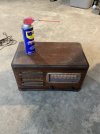
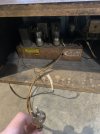
I picked this radio up from an antique store for 22 bucks. From what i can see on the back it is an RCA. The reason i’m trying to identify it is because it’s battery powered and i don’t know the voltages. It has a 4 pin connector on the back.image.jpgimage.jpg
 
Register to hide this ad
I picked this radio up from an antique store for 22 bucks. From what i can see on the back it is an RCA. The reason i’m trying to identify it is because it’s battery powered and i don’t know the voltages. It has a 4 pin connector on the back.View attachment 3172028View attachment 3172033
My grandfather had something like that at his Oklahoma farm. Six volts for filaments supplied by the car battery he'd switch around for farm reports and ball games. Plate voltage supplied by big B battery that seemed to last a long time, a carbon pile affair with similar plug. I was fascinated by it, or course.
 
Last edited:
Thats a battery radio of some flavor. Usually they had a combo battery with a 6v and maybe a 90v section. Some were 1.5v and 45 or 90, depends on the tubes inside.

looks like a brand name on the front but I can't quite make it out. Thats probably a pretty good clue where to start.

Every radio had laundry lists of RCA patent numbers on the back. RCA basically owned all of the patents needed to build a radio.
 
I would not recommend Old English, or any other material that has silicone in it.
That's good to know. We used OE in our service centers back in the '70s and '80s, and it was perfect for making speaker and amplifier cabinets look brand new. I don't think it had silicone back then, but maybe I'm wrong. As a woodworker myself, I do understand the problem with silicone. Even plumber's grease gets a special place in the garage so it won't migrate to the tools.
 
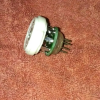
Do not put 6 volts to those tubes, they're 1.5 volt filaments. Here's a pic of an old filament supply I made years ago, note my markings on the socket that the radio power plug connects with. 90vdc for b+, 1.5vdc filaments for my Silverstone table radio. Yours is likely same.
 

Attachments

  • 20240409_140059.jpg
    20240409_140059.jpg
    53.1 KB · Views: 21
Do not put 6 volts to those tubes, they're 1.5 volt filaments. Here's a pic of an old filament supply I made years ago, note my markings on the socket that the radio power plug connects with. 90vdc for b+, 1.5vdc filaments for my Silverstone table radio. Yours is likely same.
If there is any doubt look it up by tube number. Your Silver Tone, are the tubes miniatures, seven pin affairs or full sized like ones in the OP's pictures?
 
If there is any doubt look it up by tube number. Your Silver Tone, are the tubes miniatures, seven pin affairs or full sized like ones in the OP's pictures?
As his pic shows, they're octal with grid caps. 1A6,1A7, 1H6, that sort of 1.5 voltage filament tubes in all likelihood. Same as in mine. ( farm radio, that is.) All my later battery/AC portables also use 1.5 volt tubes (7 pin minis) with exception of the 3v4 output tubes. As for trying to battery- power those things, forget it. Some required an A battery, a B battery & sometimes a C. Voltage requirements for these were all over the map. They also have a line cord so no need to use unobtainium battery packs which in some cases doubled the weight of the radio.

 
As his pic shows, they're octal with grid caps. 1A6,1A7, 1H6, that sort of 1.5 voltage filament tubes in all likelihood. Same as in mine. ( farm radio, that is.) All my later battery/AC portables also use 1.5 volt tubes (7 pin minis) with exception of the 3v4 output tubes. As for trying to battery- power those things, forget it. Some required an A battery, a B battery & sometimes a C. Voltage requirements for these were all over the map. They also have a line cord so no need to use unobtainium battery packs which in some cases doubled the weight of the radio.
Am familiar with later seven pin minis being 1.5 volt for battery sets. I have Silver tone with that arrangement plus 90 B battery, had to do some work but it plays fine. Am not familiar with 1.5 volt octal tubes. Farm radio I am familiar with had six volt filaments and no C battery. The 3v4 tube has a center tap for the filament allowing for 1.5 volt operation if the tap is used. I think my Silver Tone has a 3v4 output, quite sure of it. The radio uses 1.5 battery for filaments. Thinking farm radios and tube designs, filament voltage, 1.5 volt battery was common in telephone talk circuits as well as model engine glow plug use, number six was the number I believe, had screw terminals on top. A great big D battery.
 
RCA owned the patents that everyone used, so a label mentioning RCA patents doesn't tell you much. I think there's a name at the bottom of the dial. Brands on the tubes sometimes point to the actual brand name. Sometimes there's a a label inside or on the bottom.
 
Yep. Got two sets of spares for my TO. They're not cheap, but they're out there.
The only $$$ tube in the later tube T-Os is the 1L6, very limited number of battery portables besides Zeniths used those. There exists a modern-day solid-state replacement for it, bur it ain't cheap either. The rest of the tube complement were extensively used in a myriad of battery portables from late 1940s- late 1950s & easy & cheap to find at least in my tube stash & other's I've seen.
 
Last edited:
The only $$$ tube in the later tube T-Os is the 1L6, very limited number of battery portables besides Zeniths used those. There exists a modern-day solid-state replacement for it, bur it ain't cheap either. The rest of the tube complement were extensively used in a myriad of battery portables from late 1940s- late 1950s & easy & cheap to find at least in my tube stash & other's I've seen.
Lat time I bought one about 10 years ago they were in the $40 price range. Probably more like $100 now....
 
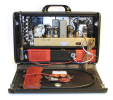
There are socket adapters specifically created to use the Loctal 1LA6 tube in place of the more expensive 1L6. I haven't needed one because my T/O is a model 8G005 that uses the Loctals :)

1712793082368.png
 
Back
Top Bottom