• The move to the new server is done. There are some software and database maintenance updates in process. This has us passing the hat around to help out. We appreciate any donations. Seriously, even a dollar helps. The payment page may be found here - https://www.audiokarma.org/support.html

Help identifying tube amp

rostinaldo

New Member
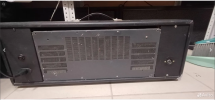
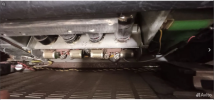
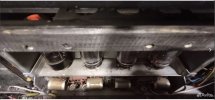
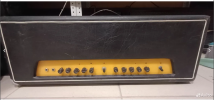
Hi, i'm about to buy this diy amp, and since it has no labels (gain, volume, e.t.c), in order to check it, i tried to find what amp it was based on, but didn't found similar one. Does it resemble any amplifier you know ? And any advice on how to check it will be appreciated. These are all the pictures the seller has and all he knows about the amp is that it lights up when turned on.
 

Attachments

  • 1.PNG
    1.PNG
    326.9 KB · Views: 50
  • 2.PNG
    2.PNG
    383.1 KB · Views: 50
  • 3.PNG
    3.PNG
    382.7 KB · Views: 49
  • 4.PNG
    4.PNG
    344.7 KB · Views: 48
  • 5.PNG
    5.PNG
    401.4 KB · Views: 50
Register to hide this ad
Also it might help if you post the tube numbers used and how many of each, along with what every control is for. It looks like a two channel amp maybe? With two sets of controls for each of the two channels? Some guitar amps have two channels, some even though there are two inputs the amp is still a single channel amp. You use either one or the other input. Usually marked normal and high input or something similar. That's what I've seen so far working on them and building a few.
 
You'll probably need to trace out the input wiring first in order to determine whether it's a copy of the Marshall (with cascade 12AX7 stages for High and Low inputs) or if it's something else. If it's something else, the circuit will need to be traced further into the amplifier to identify it as a different type of Marshall, a Fender, or another brand. Like @Lavane said, knowing the tube types is a big help. It would also help to know if it has tremolo, and if so, how it's implemented.

Jack
 
I know it's a pain sometimes, but removing the amp itself from the cab and posting good pictures of the top and the bottom of the chassis may help being able to see more of the circuit itself, and maybe see how it's wired.
Several pictures of the different areas of underside could he helpful too.
Just looking at the front panel it does appear to be a two channel amp though. Maybe you'll get lucky and the builder tucked some notes or even a schematic or description of what the amp is inside somewhere.
 
thanks for replies. Unfortunately, as i mentioned above i dont have access to the amp yet, so it is impossible to disassemble and review it. But you gave me the information i needed, that it probably 2 inputs high/low with independent sets of controls. If it is in working condition and i ended up buying it, i'll definetly disassemble it and most likely post pictures here, unless i figure out what it's based on by myself, which is unlikely. I thinking of bringing speaker, guitar and cables with me, in order to check it, but since there's no labeles i'm not sure what impendance and wattage speaker should be, any ideas about that ?
 
thanks for replies. Unfortunately, as i mentioned above i dont have access to the amp yet, so it is impossible to disassemble and review it. But you gave me the information i needed, that it probably 2 inputs high/low with independent sets of controls. If it is in working condition and i ended up buying it, i'll definetly disassemble it and most likely post pictures here, unless i figure out what it's based on by myself, which is unlikely. I thinking of bringing speaker, guitar and cables with me, in order to check it, but since there's no labeles i'm not sure what impendance and wattage speaker should be, any ideas about that ?
Usually it's 4, 8, and 16 ohm from left to right. If it has three speaker jacks just pick the middle one for testing. It's most likely 8 ohm. And using a 16 ohm speaker if that's what you have will work just fine on an 8 ohm tap.
Even using the 4 ohm tap with a 16 or 8 ohm speaker is fine.
That's a good idea auditioning it first.
 
Back
Top Bottom