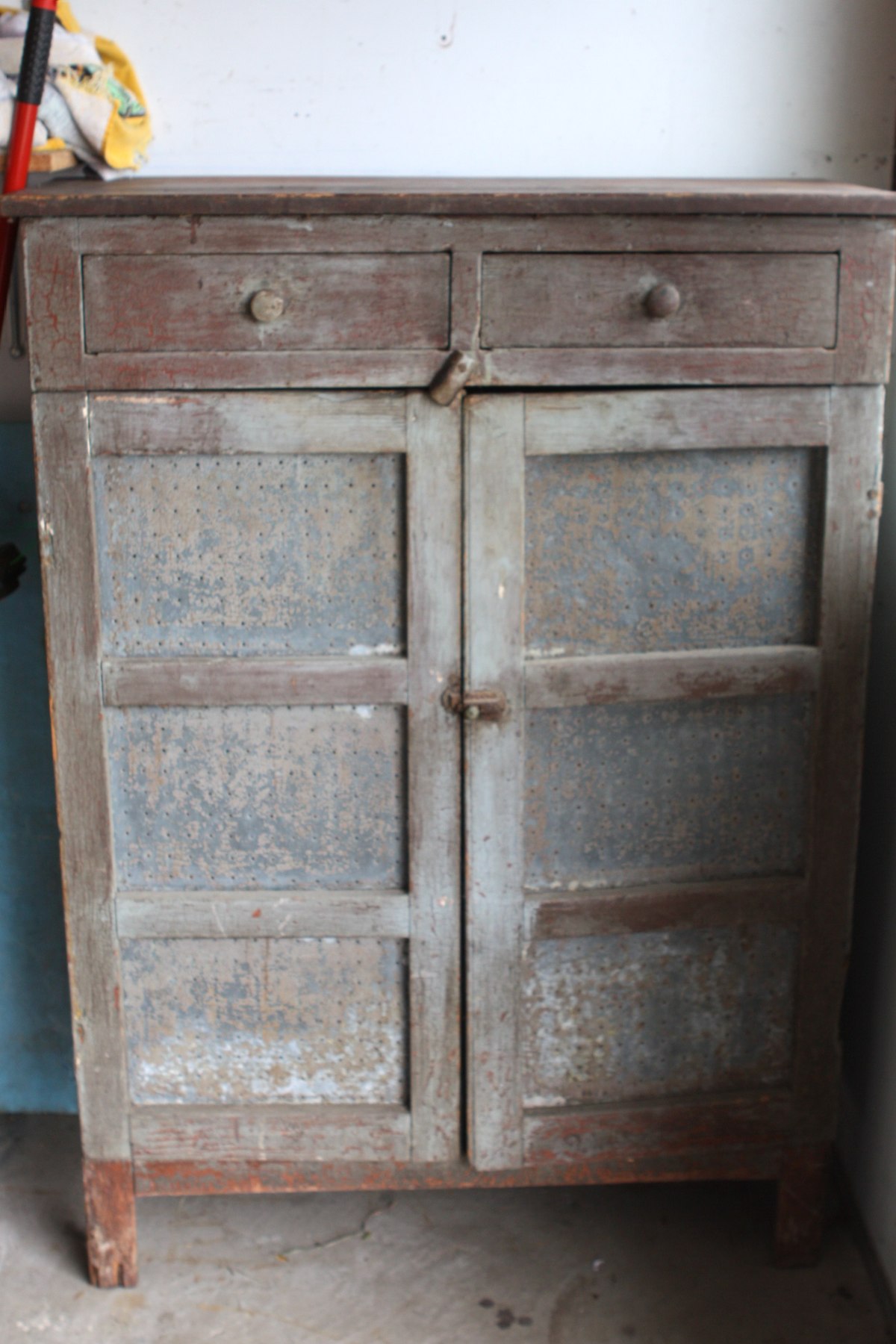
One way would be to see the construction of the bottom cabinet doors since the top ones have been clearly rebuilt.
What leads you to assume the top doors have been rebuilt? While I agree that proportionally this is taller than many pie safes and yes, more "cupboard like", I have seen more than a few unadulterated pie safes with these proportions. I've also seen many conversions - it was a thing around the turn of the last century (and still is). Without examining the piece in person, I'm not sold either way.
1860's-1890's craftsmen were still using chisels to create paneled doors.
Many craftsmen in 2021 use chisels to make panel doors as well. Wanna see some 1870s machine made panel doors? Check out early Eastlake pieces for example, thousands of them all over the country.
The verticals mortised and the top and bottoms had tendons fitted into them.
You got that backwards. Stiles (what you call "verticals") have tenons (not tendons) and rails ( "top and bottoms") are morticed. What type of joinery are you seeing that leads you to believe otherwise?
By the 1900's electricity made machining possible
There are thousands of examples of machine made furniture built prior to 1900 floating around this country. I have had many 1870s machine made pieces come through my shop. Long before electricity became commonplace, water and steam were used to power
machinery in furniture factories.
The op's piece has clearly been refinished and it looks to be a competent job, apart from the finish application to the metal hardware. As I mentioned earlier, dating these pieces can be difficult. I have seen a pie safe nearly identical to the op's with a known provenance of 1874. I have also seen similar examples from the 1920s. The fact that there is no maker's mark on the op's piece combined with the very narrow pins of the dovetailing on the drawer joinery are typical pre 1900 identifiers, as well as the lapping of the back boards and the lower door
interior lock. I wasn't clear about the upper exterior latch earlier. While not original to the piece, it is not a reproduction and could very well be from the 1920s. Finally, the particular style and proportion of the op's piece suggest a form which was most prevalent in the 1880s and 1890s.
I stand by my previous assessment. And I could be wrong. In spite of being in the business for many years and dealing with many, many appraisers, I'm no expert. I do feel qualified to make an educated guess and have done so. Enjoy your pie safe Filmboydoug, she's a fine piece of furniture!