• The move to the new server is done. There are some software and database maintenance updates in process. This has us passing the hat around to help out. We appreciate any donations. Seriously, even a dollar helps. The payment page may be found here - https://www.audiokarma.org/support.html

Help need info on Seas speakers

moediggz

Member
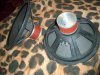
I picked up these Seas 12" extended range alnico speakers. Does anyone have any information about them? I can find next to nothing online. I figure I should either sell them or try to figure out how I can build a speaker using them. Only problem is I have no idea how to build a speaker. Any help is greatly appreciated. 20160421_115946.jpg 009.JPG
 

Attachments

  • 011.JPG
    011.JPG
    108.8 KB · Views: 17
Register to hide this ad
Look like decent drivers. You can measure resonance with just an 8 ohm resistor, a multimeter, and sine wave generator app for your phone, put the resistor in series then measure the voltage around the speaker terminals as you vary the frequency between about 30 and 100hz, resonance is where the voltage reading is highest. Go easy on the volume.

Making a speaker cab is a harder part, but basically you have two routes, an open baffle (just a piece of wood) or a cabinet of a certain size. With the cabinet there are two basic options, a sealed box or a sealed box but with pipes in it, called a bass reflex enclosure, which usually offers more bass output.

You will need a tweeter or possibly mid and tweeter to get a full range sound. Lookup parts express, lots of parts on there. Obviously getting the parameters will be the best place to start as you can use online designer pages to come up with some box simulations, or we can do it for you, but failing that just stick them in a 2cu.ft box or there abouts and see how they run :-)
 
Yah there's a sticker on the back that says 8ohm. What about crossovers? How do I figure out what crossovers to use and where to get them.
 
Well, that's a question. Likely 2kHz will work, the problem is we don't know the impedance (like resistance) at that frequency nor how big it's peak is (likely 3-6dB) nor its general sensitivity (likely about 90dB).

You could design the low pass filter part of the crossover for it based on 1500Hz and 12 ohms as a starting point, and use 8 ohms and 2kHz second-order for the mid. But hopefully someone will enlighten us with some specs at some point ;-)
 
I have seen a lot of odd duck Seas over the years, but never those. See if you can find a woofer tester and get the T/S parameters. Could be a fun speaker to play with.
 
Agreed - open baffle is also very easy to build (at least a quick and dirty one) if you have no experience. 2' x 4' sheet of plywood, cut a hole the size of the woofer opening just slightly off center laterally and about 3' off the ground vertically, a couple of supports so it doesn't fall over, hook it up, and go.
 
For OB I'd cut the hole 2' up centered and use a full range driver 13" higher (center point to center point) offset by 1.5" (this gets to normal seating height). These are a great candidate for the full range speakers:http://www.parts-express.com/tymphany-tc9fd18-08-3-1-2-full-range-paper-cone-woofer--264-1062 You'll need a crossover, but that should be fairly simple to design if you have a smart phone or laptop (better). Free software to help you get an idea what the drivers output looks like. We're here to help.
 
Last edited:
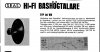
Nice find! So it's a 12" sub basically for use in 2-3cu.ft sealed box with very limited midrange coverage.
 
Nice find! So it's a 12" sub basically for use in 2-3cu.ft sealed box with very limited midrange coverage.

Looks like it's made to be used as a 3-way system woofer. Range up to 700 Hz. Use that with a 5" or larger mid/high driver, and you're in business.

Regards,
Gordon.
 
You need to measure them. Invest $99 in DATSv2 from parts express and never guess again. Those are great drivers.
 
Tandberg Hifi system 15 had this woofer.
And in the late 60's there was a Seas kit called 95K that had this woofer together with two mids and three tweeters.
 
Hi guys,

I'm way overdue adding to this thread, but for those that are interested, here are the factory specs of the Seas 30WK:
  • Size: 12"
  • Recommended frequency range: 30-500 Hz in 60 l closed box
  • Recommended closed box volume: 45-90 l
  • Free air resonance: 18-22 Hz
  • Impedance: 8 Ω
  • Nominal power: 50 W
  • Peak power: 100 W
  • Operating power: 3,2 W (96 dB/1 m)
  • Characteristic sensitivity: 91 dB
  • Flux density: 11000 Gauss
  • Gap energy: 570 mWb
  • Voice coil diameter: 39 mm
  • Voice coil height: 18 mm
  • Gap height: 8 mm
  • Force factor (BL): 11 Tm
  • Piston area: 490 cm²
  • Moving mass, incl. air: 70 g
  • Diameter: 303 mm
  • Mounting depth: 150 mm
  • Net weight: 2,4 kg

Also, here are my own T/S measurements for the 8 Ohm version (average of four units dated 43/70):
  • Sensitivity (2,83 V, 1 m): 93,1 dB
  • BL: 11,2 Tm
  • Re: 5,4 Ω
  • Zmin: 6,08 Ω
  • Zmax: 128,5 Ω
  • L1k: 0,73 mH
  • L10k: 0,40 mH
  • Mms: 49,3 g
  • Cms: 1,04 mm/N
  • Rms: 1,03 Ns/m
  • Fs: 22,3 Hz
  • Qms: 6,725
  • Qes: 0,298
  • Qts: 0,285
  • Vas: 347 l
For those who want to build a speaker with these drivers, you should note that they have very soft rubber suspensions and a center spring/spider of quite small diameter. Therefore, when these woofers approach their maximum mechanical excurdion, the limit is reached rather suddenly. When driven beyond this point, the tiny spider will stretch and deform, often resulting in a voice coil that starts to rub against the steel poles.

For the very same reason, the 30WK should not be used in bass reflex enclosures. While a closed box acts as a pneumatic spring, aiding the suspension in controlling excursion, bass reflex boxes don't: A reflex box will only control excursion near the actual tuning frequency. Above and below this frequency, it is essentially without acoustic resistance.

- H -

 
Last edited:
Back
Top Bottom