Avogadro33
Member
Need Help From Tube Amplifier Gurus
First, the bottom line: I would like to know the bias set point for 6V6GT tubes in a Bogen DB212 amplifier.
Some background: I acquired a fine old Bogen DB212, but it has the wrong output tubes. Will do a typical cap-job as needed and purchase a set of used 6V6GT tubes.
What seems clear: I found the formula for bias point: I = X/100 x P/V.
P ---- We will assume the plate dissipation is 12 watts (I am aware that a few sources say 14 watts, but most go with 12 watts).
X ---- We will assume the preferred bias percentage is no more than 70%.
The issue: What to use for power tube plate voltage (“V”) in the formula?
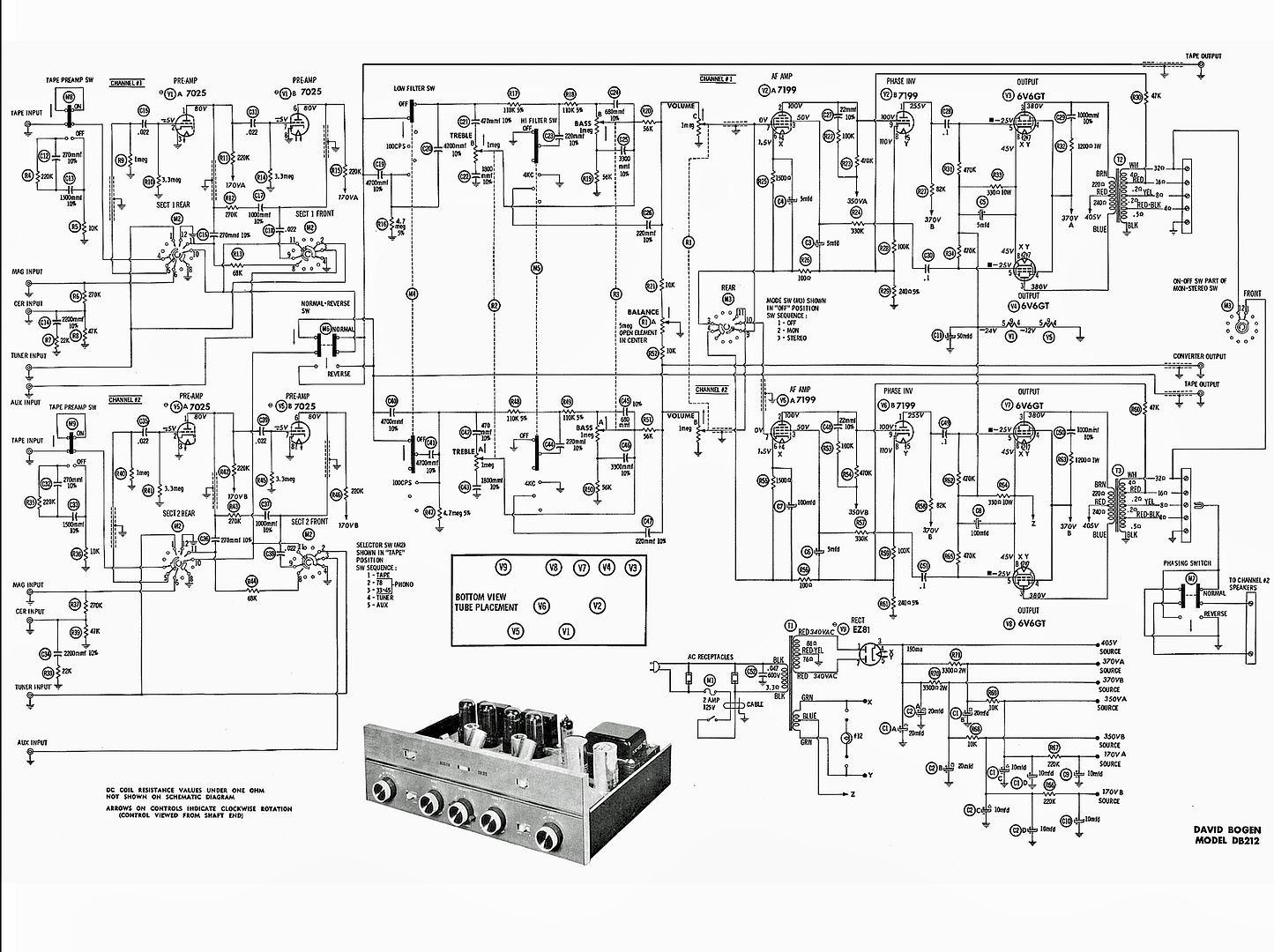
A look at the schematic:
The schematic for the DB212 shows the 6V6GT with a 380V output. But I am informed that this is a cathode bias amp (beyond my knowledge) and therefore such voltage must be subtracted from the 380V figure in order to arrive at the value for plate voltage, “V”. If wrong, please feel free to correct this.
The schematic has another connection to the 6V6GT with designation 45V. And there is yet another connection to the 6V6GT with designation –25V.
So, if either, would I use 380 - 45 = 335, or 380 - 25 = 355 for plate voltage (“V”) in the formula to derive the bias point (“I”)? Maybe neither!
Again, I would like to know the bias set point for 6V6GT tubes in a Bogen DB212 amplifier, under the parameters of 12 watts plate dissipation and maximum 70% bias percentage.
Any help?
Thank you.
First, the bottom line: I would like to know the bias set point for 6V6GT tubes in a Bogen DB212 amplifier.
Some background: I acquired a fine old Bogen DB212, but it has the wrong output tubes. Will do a typical cap-job as needed and purchase a set of used 6V6GT tubes.
What seems clear: I found the formula for bias point: I = X/100 x P/V.
P ---- We will assume the plate dissipation is 12 watts (I am aware that a few sources say 14 watts, but most go with 12 watts).
X ---- We will assume the preferred bias percentage is no more than 70%.
The issue: What to use for power tube plate voltage (“V”) in the formula?
A look at the schematic:
The schematic for the DB212 shows the 6V6GT with a 380V output. But I am informed that this is a cathode bias amp (beyond my knowledge) and therefore such voltage must be subtracted from the 380V figure in order to arrive at the value for plate voltage, “V”. If wrong, please feel free to correct this.
The schematic has another connection to the 6V6GT with designation 45V. And there is yet another connection to the 6V6GT with designation –25V.
So, if either, would I use 380 - 45 = 335, or 380 - 25 = 355 for plate voltage (“V”) in the formula to derive the bias point (“I”)? Maybe neither!
Again, I would like to know the bias set point for 6V6GT tubes in a Bogen DB212 amplifier, under the parameters of 12 watts plate dissipation and maximum 70% bias percentage.
Any help?
Thank you.