• The move to the new server is done. There are some software and database maintenance updates in process. This has us passing the hat around to help out. We appreciate any donations. Seriously, even a dollar helps. The payment page may be found here - https://www.audiokarma.org/support.html

pecata35

New Member
Hello, I want to know if someone have heard German amps like: Telefunken, Dual or Saba (I don't know if it's German but i can find it too)

Have someone heard:
DUAL - CV-1700 / 1600
TELEFUNKEN - TA 350 / 750, STM-1 / STP-1, RM 300/RP 300
SABA - VS2160, MI 215

I have heard Telefunken Ta 350 but I can't remember how it sounded.
If someone can tell if they sound like Pioneer, Marantz, Kenwood, Sansui or even better I strongly appreciate it
 
Register to hide this ad
I've heard several German amps like the Lowe-Opta, usually in consoles. They sound very good when working well but are a huge pain to work on if they break down. I would not buy one that needs work.

I should add that all the German amps I've ever worked on used EL84 tubes for the power section. Maybe that's why they sound good.
 
If someone can tell if they sound like Pioneer, Marantz, Kenwood, Sansui or even better I strongly appreciate it
Of course YMMV but I've never heard a Telefunken that I liked better than the Japanese amps I've listen to and John is right. They're a pain to service if needed ...
 
Most of the German amps I've heard sounded nice at low volumes because they were all very low powered (8 years in Germany living in small villages and medium size cities). It is against the law to make too much noise since most people live extrememly close together and they don't want to hear your musical selections. I was visited by the Polizei twice for violating the noise ordinances with my 200 Watt Onkyo M-508- they told me one more time and they would confiscate the offending equipment- I learned my lesson quickly !
 
Thank you for the answers!
I bought a Telefunken TA 350 because I found it for a reasonable price. It sounds amazing. And the loudness makes it more musical without bumping everything much.
 
I've heard several German amps like the Lowe-Opta, usually in consoles. They sound very good when working well but are a huge pain to work on if they break down. I would not buy one that needs work.

I should add that all the German amps I've ever worked on used EL84 tubes for the power section. Maybe that's why they sound good.
Also note they use very undersized transformers.
 
I drool over German Audio Equipment pre-80's; finding cool information in old mags over on archive.org. Outside of seeing a cool ultra-wide old Telefunken multi-band every once in a while, most are super rare around here.

I'd love to hear a matching component set-up, some would easily win design awards, the Germans seemed to like to have a million buttons on everything. In the boombox world, the Telefunken HiFi Studio 1 is claimed to be the best sounding boombox.

I think the voltage and hertz keep more vintage units from making their way over here, it's too much of a pain to power them up.
 
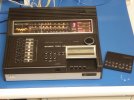
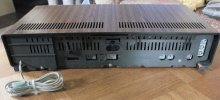
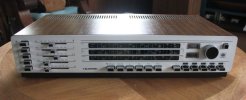
If you really like a challenge, buy a defective one of these. It is a 20 W receiver

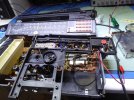
It main feature for repairs is that you can take off the tuning indicator movement by taking off the wheel from the tuning cap, rotate it a bit and put it on a piece of plastic perfectly aligned with the amount of rotation you did. NO HASSLE with the stupid tuning chord.

It even has a remote control.

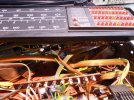
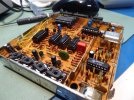
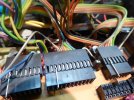
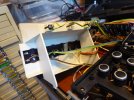
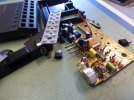
For the rest, it is easy peasy, look at the pictures :jump:

2022_0113_151704.JPG2022_0112_215107.JPG2021_0213_230956.JPG2021_0213_214124.JPG2021_0213_210053.JPG2021_0213_205254.JPG2021_0213_125016.JPG2021_0212_143219.JPG
 
Owww, this thing ! I hated it back then when it came into the workshop for repair! I had a Blaupunkt receiver Delta 6003 GD as first real HiFi - amp. It powered my Braun L710/1. That receiver was easy to work on. You took it backwards out of the housing like its japanese counterparts and had free access to the pcb´s. And it sounded good! Very good volume control with a linear and a loudness - pot that allowed to adjust the loudness effect just fitting to your needs. Much better than Yamaha or Kenwood Basic C1.
 
Big issues: Germans loved 4 ohms, and very low powered amplifiers. Due to their small living quarters in apartments. Plus many of these sets were complex designs.
 
I wonder if there were many Japanese receivers back then (1977), where you could select which of the fm presets to use using the remote controls, and control volume, loudness, tone and balance.

BTW for this ITT one, there is one totally useless "feature", which is the row of lamps next to the seven FM presets. All the figures are on at the same time (lit by the same lamp set) and it takes a lot of room in the receiver also. It was just an "eye-catcher"
 
I don't know how ITT did it but most Japanese Equipment had rotating pots to set the FM presets, that set-up lasted through early 80's VTRs.

Like I said, LOTS of BUTTONS! I count 36 on that reciever.

The English had import rules on electronics, some of the big Japanese set up finish-manufacturing there to avoid duty, I wonder what the German Import Laws were, they seemed to have produced high-quality equipment until the late 80's.
 
Big issues: Germans loved 4 ohms, and very low powered amplifiers. Due to their small living quarters in apartments. Plus many of these sets were complex designs.
Why do you regard it a problem our amps were constructed to power 4 Ohm speakers? The heat sinks were chosen accordingly as were the power transformers and stuff. I see amplifier that are limited to 8 Ohms upward as a problem.

The room size is smaller here. I would say our receivers and amplifiers had comparative wattages to similar American and Japanese devices as our closed design loudspeakers needed a bit more juice than the typical bass reflex construction.

What really was missing was the plethora of super receiver, and strong TotL amps were only built by professional companies like Klein und Hummel.

My old Blaupunkt for example had (according DIN 45500) 2 x 40 W continuous and 2 x 60 W impulse. In 1973.

In German with pictures: https://tonbandforum.de/showthread.php?tid=10054
 
I don't know how ITT did it but most Japanese Equipment had rotating pots to set the FM presets, that set-up lasted through early 80's VTRs.

Like I said, LOTS of BUTTONS! I count 36 on that reciever.

The English had import rules on electronics, some of the big Japanese set up finish-manufacturing there to avoid duty, I wonder what the German Import Laws were, they seemed to have produced high-quality equipment until the late 80's.
The import laws were easy: Devices had to fulfil our security rules, especially VDE and DIN. One example how that influenced the construction of a typical receiver: my Pioneer SX-550 had of course a badly burned mains switch. But it is a totally different switch compared to those that are described here in the well-known repair threads. The devices for Germany and several other EC countries switch both phases. The normal types for the US or Japan itself switch only one. Later the possibility to change the input voltage was forbidden in the EC.

The presets for FM in German tuners for radio and TV used variable capacity diodes for tuning, no rotating plate capacitors. It was cheaper! And presets were easy to implement. Of course as those things drifted with the temperature an AFC (automatic frequency control) had to be used. You find that button on a lot of German receivers.

Telefunken switched off the AFC when the tuning knob was touched. So the basic tuning could be done. As soon as the knob is released the AFC is on an can hold the tuning. Clever!
 
Last edited:
I am looking at a Blaupunkt Delta 609T that is rated for 80 watts. The guy is basically giving the stereo away so I was going to buy it for 35 bucks and also a Wharfdale/Rotel for $25. Thorsten's link on this thread that is in German is the only place I have seen any info but unfortunately I don't speak German. Does anyone know the sound characteristics of the Blaupunkt of this era? Or any other info I assume it is rated at 80 watts at 4 ohm resistance.
 

Attachments

  • 328439349_5613924968717838_6328485829263955851_n.jpg
    328439349_5613924968717838_6328485829263955851_n.jpg
    72.3 KB · Views: 8
  • 316096416_6107531729266974_6138264555459994725_n.jpg
    316096416_6107531729266974_6138264555459994725_n.jpg
    56.2 KB · Views: 8
  • ixgpegnc38y51.jpg
    ixgpegnc38y51.jpg
    58.2 KB · Views: 8
Much of the mainstream German stuff from the mid 70's onwards is actually Dutch. It was pretty much all Philips. Either just the components where from Philips, the entire PCB's/electronic designs or even the company itself. And yes, Philips stuff is not always that much fun to work on. They often featured cutting-edge technologie in their mid-price and upper models. The Philips company really was "a national pride" here at the time, and they did some exiting stuff. But I don't like the sound of'm much, or those plastic housings, or the build in general.. I take a Japanese unit over them any day! While in fact those tended to be cheaper at the time. Still, there are some interesting units around.
 
Much of the mainstream German stuff from the mid 70's onwards is actually Dutch. It was pretty much all Philips. Either just the components where from Philips, the entire PCB's/electronic designs or even the company itself. And yes, Philips stuff is not always that much fun to work on. They often featured cutting-edge technologie in their mid-price and upper models. The Philips company really was "a national pride" here at the time, and they did some exiting stuff. But I don't like the sound of'm much, or those plastic housings, or the build in general.. I take a Japanese unit over them any day! While in fact those tended to be cheaper at the time. Still, there are some interesting units around.

I bought a TELEFUNKEN - TA 350 and a Dual CV 1460. The telefunken is not plastic at all and sound better than most of japanese low and mid class. Dual sounds like japanese stuff.
 
Back
Top Bottom