• The move to the new server is done. There are some software and database maintenance updates in process. This has us passing the hat around to help out. We appreciate any donations. Seriously, even a dollar helps. The payment page may be found here - https://www.audiokarma.org/support.html

Help please... Can anyone identify these 1978 KEF-driver speakers ?

CoastinHome

Well-Known Member
Greetings all,

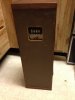
I'm usually pretty good at finding information but cannot identify this particular set of incomplete speakers which came from the estate of a high-end audio tinkerer. They definitely are not homemade unless they were made from a kit.

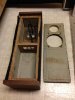
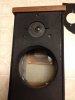
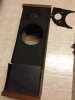
The 5" mid-woofers are missing. The tweeters are KEF T27 / SP1032 with Jan 4, 1978 date codes -- and appear original. The cabinets are very nicely machined and have removable baffle plates -- after one removes the two pieces (upper/lower) of thin self-adhesive die-cut neoprene which wrap three sides of the cabinet.

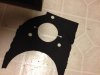
Whatever crossovers they may have once had are gone; they were last retrofitted for bi-amp use with terminal strips mounted to a clear Plexiglas filler panel.

The top and bottom panels are solid walnut. Everything else is 3/4" MDF.

They measure 21"H x 7"W x 5-3/4"D.

Thanks for any insight!

Bob
IMG_3648.JPG

IMG_3642.JPG

IMG_3639.JPG

IMG_3644.JPG

IMG_3647.JPG

IMG_3645.JPG
 
Register to hide this ad
They look homemade to me. The terminal plate and its cutout don't look of the quality one would expect from a speaker with KEF components, and the top of the speaker appears to be a solid hunk of wood, which I suspect would not be the choice of a manufacturer - too upredictable in appearance, and tending to warp over time. I know that Advent and AR used wood tops, but they were thinner, shallower, and I remember them being butcher block. And they warped and cracked anyway.
 
The 5" mid-woofers are missing. The tweeters are KEF T27 / SP1032 with Jan 4, 1978 date codes -- and appear original. The cabinets are very nicely machined and have removable baffle plates -- after one removes the two pieces (upper/lower) of thin self-adhesive die-cut neoprene which wrap three sides of the cabinet.

Whatever crossovers they may have once had are gone; they were last retrofitted for bi-amp use with terminal strips mounted to a clear Plexiglas filler panel.

I agree with the "homemade" comment as well. The missing woofer is most likely the B200-SP1014 woofer that was available to kit builders at the time, along with the T27 and a crossover. The woofer appears to have been mounted on the inside of the front baffle, which is kind of odd. So the drivers came with paper templates to mark out the router path on your baffle. If the tweeters are ok, then they are worth a few bucks. Many didn't survive, as they don't like to be driven hard. I'm guessing that they may be shot.

jeff
 
100% homemade kef kits. Tweeters are worth money on ebay and will sell fast. Bin the rest.
 
check the cut-out to determine whether the B110 or the B200 fits.

the T27 could be one of those used in the LS3/5a and worth hundreds. this t27 had
variations due to manufacturing changes and crossover adaptation to each to
BBC/KEF specs.

in any case, without the original crossover, simply finding replacement drivers
is not a worthwhile effort.

you're better off selling the T27s to someone who might need it to restore a
LS3/5a, then to use the funds to buy newer/modern drivers to fit
physically/electrically/acoustically inside these cabs. and work out a
crossover for the new drivers within the specs of this cab.
 
Thanks everyone for their input!

It's a pretty good guess that they were built from a quality kit manufactured on a production line -- given the neatly diecut self-adhesive neoprene face and interchangeability of the faceplates with mounting holes that align perfectly, etc. The rear panel terminal strip was more than likely a later hack to provide separate terminal connections to each driver for biamping. (The rear panel cutout is not the rough cut that it looks like; the brown rear panel paint was sanded around the rear panel cutout.)

And, yes... The solid walnut end caps are slightly warped.

I looked carefully at the KEF Museum offerings as well. Of course no match -- but that was a good education on KEF History.

I'd have to agree with you Jeff... The rear-mounted driver is rather odd. What you might not be able to see in the pictures is that the mid-bass baffle cutouts are tapered. On the interior side of the baffle plate the hole is around 4.875"; on the outside it is about 5.25". So it's just as likely that it was intended for dropping in a driver from the front (Though the diffraction edge is not as severe as it might seem by nature of being rear-mounted.)

Great advice from everyone -- and I wholeheartedly agree with West Coast Bob's advice about parting with the T27's and buying modern drivers if I wanted to restore these. But given their status following the information everyone has shared I think what I have here is simply one or perhaps a pair(?) of tweeters (and maybe four solid blocks of walnut for some future purpose)... I didn't yet mention that one of the tweeters needs repair.

Probably need to start another thread about that but one of the tweeters has the entire magnet assembly separated from the rest of the driver. The clear bonding material failed perhaps when one of the boxes was dropped(?) - unless these are failing from age etc. Everything is still in good shape with no damage to the voice coil -- but it doesn't appear that there would be any practical way to center the voice coil and re-bond the magnet structure if working from the back side. If you happen to know what to do with a separated magnet assembly and want to share -- I'm listening!

Thanks again everyone.

The other West Coast Bob
 
Last edited:
Magnets falling off is not as unusual as it should be. There are several threads on the subject here, at least one started by me. But my method is not as good as the other one I've seen. I removed the cone/voice coil and then used copper shimming to center the magnet when gluing. It works well, but requires cutting the side of the spider and regluing it, which is a compromise. The other method uses PVC pipe and threaded bolts to position the magnet - it's a hassle to build the equipment, but it can be reused, I think, and the result should be more reliable.
 
Back
Top Bottom