• The move to the new server is done. There are some software and database maintenance updates in process. This has us passing the hat around to help out. We appreciate any donations. Seriously, even a dollar helps. The payment page may be found here - https://www.audiokarma.org/support.html

Help with crossover!

fermaleb

New Member
Hello everyone,
I got a pair of vintage Electro Voice speakers (EV Saphir) they are not exceptional, but I want to repair them for entertainment.
They are 3 way.
The midrange speaker doesn't seem to work on either box (it doesn't make any sound) but taking them apart and testing them separately I see that they work. So the problem is in the crossover.

Can anyone give me a clue what to look for or how to measure any suspicious components?

Thank you!
Martin
EV Saphir.jpg
 
Register to hide this ad
In every case where I had a tweeter not working (I mostly have 2-ways), it was because of a bad capacitor in the crossover. After a recap, the drivers came back to life.

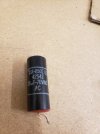
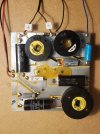
From the pic, it looks like at least one cap (on the lower left) is known for failing. The have a black body and red ends and often labeled as made by Temple. The cap in the mid circuit doesn't look the same, but all the caps appear to be the same vintage.

Considering the age of the components, I would recap. If you want to keep the original voicing and/or keep your costs low, you could recap with new non-polarized electrolytic caps. If you want to experiment or want to spend more money, you can replace the electrolytic caps with film caps. Some add a 0.3 to 1 ohm series resistor to account for the lower effective series resistance (ESR) of the film caps. I generally use metallized poly caps for my speakers.
 
My WAG is the 2.2 mfd (silver foil coming off the body) is the cap associated with the tweeter. There appears to be another, newer blue cap next to it.

You know, if that foil is conductive, it may be causing a short or bypass. :idea:
 
Thanks for the answers!
I already removed the capacitors and tested them with a multimeter. They don't hold charge well, the numbers drop very quickly.
2.2 uf isn't bridging, but it hardly works anymore.

I think I'll do a "low cost" recap.
What I can't find is 26 uf 70V AC.
I can only find 22 uf or 33 uf.
Does it make any difference if I put 33 instead of 26?
Another thing that confuses me is 70 V AC. I just see DC everywhere, or I'm not looking in the right places...

would something like this be ok?
https://secure.reichelt.com/ch/de/f...33-f-250-v-vis-folie-5435-p344345.html?&nbc=1

Another question, what is blue? it reads:
2.84 K 100V Ti "Mexico"

Thank you!
 
Thanks for the answers!
I already removed the capacitors and tested them with a multimeter. They don't hold charge well, the numbers drop very quickly.
2.2 uf isn't bridging, but it hardly works anymore.

I think I'll do a "low cost" recap.
What I can't find is 26 uf 70V AC.
I can only find 22 uf or 33 uf.
Does it make any difference if I put 33 instead of 26?
Another thing that confuses me is 70 V AC. I just see DC everywhere, or I'm not looking in the right places...

would something like this be ok?
https://secure.reichelt.com/ch/de/f...33-f-250-v-vis-folie-5435-p344345.html?&nbc=1

Another question, what is blue? it reads:
2.84 K 100V Ti "Mexico"

Thank you!

Use either the 22mfd (slightly higher cutoff) or the 33mfd (slightly lower). You prolly won't hear much difference with either.

VAC is rating for speaker crossover, since signal is AC. AC rating is 1.414 times higher than DC rating. A crossover using 70VAC rated caps will need 100VDC rated ones.

Using 250VDC rated non-polar caps in your crossovers will be fine.

I dunno about that blue Mexico component. Maybe, post a photo of the printing on the thing?
 
Last edited:
Thanks for the answers!
I already removed the capacitors and tested them with a multimeter. They don't hold charge well, the numbers drop very quickly.
2.2 uf isn't bridging, but it hardly works anymore.

I think I'll do a "low cost" recap.
What I can't find is 26 uf 70V AC.
I can only find 22 uf or 33 uf.
Does it make any difference if I put 33 instead of 26?
Another thing that confuses me is 70 V AC. I just see DC everywhere, or I'm not looking in the right places...

would something like this be ok?
https://secure.reichelt.com/ch/de/f...33-f-250-v-vis-folie-5435-p344345.html?&nbc=1

Another question, what is blue? it reads:
2.84 K 100V Ti "Mexico"

Thank you!

Unless your DMM has a capacitance test function, it will tell you nothing about caps. Even if it has a capacitance test function, it likely will not be able to test for ESR. Based on the apparent age of the caps, I would replace them all with at least equivalent type. Get as close as possible to capacitance value. Voltage rating needs to be equal to or greater than what is installed. Voltage rating (ac or dc) can be ignored because modern ratings are so much higher than vintage, and, unlike power supply caps, the voltage in crossovers is not a fixed value.

Best I can tell from your pic, the three black caps are non-polarized electrolytic caps, the silver 2.2 uF cap marked with "MKT" is a metalized polyester film cap (often called a Mylar cap), and the blue one I am not sure about.

I would replace the two 6.8 uF caps with an Audyn Q4, or you can use electrolytic caps and save a few dollars.

The 26 uF cap can be replace with two electrolytic caps wired in parallel (10 & 15 would be fine). Or if you want to spend some more money, 10 & 15 uF Audyn Q4 will work. Deviating by 1uF is only 4% difference, which is pretty much insignificant.

I would replace the silver 2.2 uF cap with a metalized polypropylene cap such as an Audyn Q4. I would not replace the MKT cap with an electrolytic cap.

For the blue cap, the "K" means it is 10% tolerance. "Mexico" means the cap was sourced from Mexico. The configuration reminds me of a Mylar cap. As for the rest of the markings, I won't guess because I am not sure. A picture showing the markings may offer more guidance.
 
audyn makes a 22uf and a 3.9uf.

janzten has 20uf and 5.6uf. (they also have .1uf)


plenty of ways to get to or as close to 26uf as you want.

I prefer to use caps with similar values when wiring them in parallel. I cannot really come up with a good reason, just a preference. It seems that once the second cap gets small enough, it is almost a bypass cap. :)

Thanks for the link to the crossover cap table. I did not know that was available. It is a great list.
 
I prefer to use caps with similar values when wiring them in parallel. I cannot really come up with a good reason, just a preference. It seems that once the second cap gets small enough, it is almost a bypass cap. :)

Thanks for the link to the crossover cap table. I did not know that was available. It is a great list.


note the selections above the table, same type of lists for inductors and resistors. :)

those lists are fairly new over the last couple years i think.
 
Could be a bad solder joint....you could just resolder every joint and see, but if the caps are old, it's prudent to just replace with equal or better quality (the SCR caps are actually decent grade and are a good bang for the buck). Regardless, if you're going to bother replacing the caps, I'd replace the sand cast resistors with non-inductive wirewounds as well. Depending on the level of the system and how for you want to take the speakers, you can upgrade the wires too. The inductors appear to be air core and are suitable quality. However, those that are in close proximity should have the axis 90 degrees from each other (stand the one on the upper right corner on edge to minimize the effects of the magnetic fields).

You should get the values as close as possible. 22uf or 33uf for a 26uf cap is a pretty big difference if the crossovers were well designed (the fact that they used SCR caps and air core inductors suggests they air). Whatever values you can get in parallel to reach 26uf should work.
 
From the pics, the caps look like film caps (mylar or polypropylene) definitely not the traditional aluminum canister electrolytic that are commonly used in cheaper priced speakers... but I could be wrong on that, hard to tell by just that one pic.

If they are indeed lytics then the cheapest cost route is to replace with the same type of caps and as close to the values as you can find, tolerance is 10% so the 2.2 for example can be +/- 2uf but its always best to keep the values as close to original as possible. The brand you use is up to you, I dont think there is any benefit to using higher end caps that cost $5-$10ea or more, a good budget film cap like dayton, audyn or ERSE will cost less than $5ea for polypropylene & a couple bucks each for mylar, electrolytics will usually be less than a dollar ea.

As mentioned, a lower cost regular multi meter probably wont measure capacitiance or especially ESR, checking voltage charge means nothing. You can buy a cheap LCR meter on amazon/ebay for $25-50 that will measure capacitance as well as ESR, the cap value is obviously important but ESR is will determine the condition of the cap if still within uf value tolerance. Checking all solder joints is a good idea too.

Dayton film caps are available at parts express as well as other budget brands & electrolytics, should be able to fully recap both crossovers with decent quality caps for $40-$50 total.
 
Again thank you very much everyone! especially for so much patience with a beginner, there are so many things to learn!

I am in Switzerland, the shipping costs of Parts Express are $70!
In Europe I only know Reichelt or Conrrad. Does anyone know of other options in Europe?
 
Again thank you very much everyone! especially for so much patience with a beginner, there are so many things to learn!

I am in Switzerland, the shipping costs of Parts Express are $70!
In Europe I only know Reichelt or Conrrad. Does anyone know of other options in Europe?

This is closer, but I have no experience with them - https://en.toutlehautparleur.com/loudspeaker-components/crossover-parts.html

Does anyone know if Troels Gravesen sells crossover parts?
 
I would first check for bad solder joints....


Then use a short strand of wire and try bypassing one by one each component that is in the Mid circuit of the crossover.
If you have a bad resistor it will suddenly start making sound when you branch across its two associated connections etc.


Simply play some pink noise at lowish volume and do this.

Out of curiosity are the RED/BLACK the input connections and the BLUE/BLACK the tweeter?
 
Again thank you very much everyone! especially for so much patience with a beginner, there are so many things to learn!

I am in Switzerland, the shipping costs of Parts Express are $70!
In Europe I only know Reichelt or Conrrad. Does anyone know of other options in Europe?
altho i can not speak for quality....

 
Again thank you very much everyone! especially for so much patience with a beginner, there are so many things to learn!

I am in Switzerland, the shipping costs of Parts Express are $70!
In Europe I only know Reichelt or Conrrad. Does anyone know of other options in Europe?

There are other sources for capacitors, even ebay sellls most brands of caps & will ship international for reasonably price.

There are all kinds of cap brands to choose from, I have used ERSE brand caps for many years with excellent results and they are priced very good, they offer polypropylene & mylar film caps as well as electrolytics. We arent supposed to post links here but you can just google or search for Crites speakers, they are a retailer of ERSE caps & can give you prices for ordering the individual caps you need as well as great technical advice, can ship for very reasonable cost via USPS priority or first class mail too.
 
If it were me , for a simple test I would unsolder the +ve wire for the midrange and place it on the other side of that 6.8uf capacitor and see if it works then. Turn the bass down on your amplifier. You could use a woofer to use as test . I suppose you could put that wire on the other side of the coil as well. Worth a try.
 
From the pics, the caps look like film caps (mylar or polypropylene) definitely not the traditional aluminum canister electrolytic that are commonly used in cheaper priced speakers... but I could be wrong on that, hard to tell by just that one pic.
1.jpg26 uf.jpg

This last one, the one with red edges (as Rally pointed out) I don't know if it's the same as the others.
 
Last edited:
Back
Top Bottom