• The move to the new server is done. There are some software and database maintenance updates in process. This has us passing the hat around to help out. We appreciate any donations. Seriously, even a dollar helps. The payment page may be found here - https://www.audiokarma.org/support.html

Help with static/him from Thoren TD 145

tdharmless

New Member
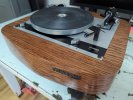
I recently restored and modded a TD 145. It has a hum or buzzing sound that is frustrating me. I've read through many of the other threads, none of the previously posted suggestions have fixed the problem.

Here's link to a video: PXL_20260130_231016621.TS.mp4

It's a noticable buzz, mostly from the tweeters, in both channels.

In the attached video, you can hear the buzzing sound. It's mainly noticable at higher listening volumes. So, it may have been present before the restoration and I didn't notice.

Here's what I know and have tried:
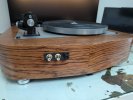
  • Removed the ground from the right channel (—) and soldered a new ground connector to the back of the turntable.
  • Separated the chassis ground and tonearm ground, attaching the tonearm ground to the new external connector and the chassis ground to the right channel (—), and vice versa.
  • Replaced the RCA cables with new connectors on the back.
  • Deoxit'd the headshell connectors and replaced the cartridge wires
  • Swapped cartridges
  • Test both channels and ground for shorts and continuity with a multimeter from the headshell to the RCA connectors.
  • The sound remains when I hold the tonearm. So, it seems grounded.
  • The sound remains when the turntable is unplugged. My previous turntable (Phillips AF 877), however, did not have this problem. So, I don't believe it's the amp (Denon PMA-1600NE) or power source.
  • The sound does get louder if I touch the tonearm wires inside the base. That may be expected though.
What else could it be? Is there anything else I can try?

Edit: I tried to edit the title, but I can't. It should be "hum", not "him".
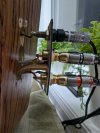
1000012877.jpg1000012878.jpg
1000012721.jpg1000012723.jpg
 
Register to hide this ad
I'm grasping at straws here, but the solder joints on the inner connector of the red RCA looks like it might be a cold joint. I'd reflow all those solder joints with extra flux -none of them look as smooth and shiny as is desireable. Yes, I know no lead solder isn't very shiny, but you should see more wetting.
 
I'm grasping at straws here, but the solder joints on the inner connector of the red RCA looks like it might be a cold joint. I'd reflow all those solder joints with extra flux -none of them look as smooth and shiny as is desireable. Yes, I know no lead solder isn't very shiny, but you should see more wetting.
You might be onto something. Resoldering is a good idea. While I'm at it, I'm going to run new wires from the block where the tonearm wires are soldered. Should I remove the wire block all together?
 
I'd start by reflowing the joints at the RCAs and ground. If that doesn't solve it, reflow the wire block. Theoretically, fewer transitions are better, but I don't see how you can get from the tonearm leads to the RCAs without extensions.
Another fix might be shielding - I can't see why the motor would suddenly cause buzzing when it didn't before, but do you have a TV or fluorescent lights near the table?
 
Separated the chassis ground and tonearm ground, attaching the tonearm ground to the new external connector and the chassis ground to the right channel (—), and vice versa.
You have created a ground loop by doing this. The right ground should be free from the chassis ground, They connect inside the preamp. The chassis and tonearm ground shound connect together.
 
It's hard to tell in the picture, but it looks to me like he did it right - the arm/chassis ground isn't tied into a signal ground (I thought it was the left, but I could be wrong).
But you are right - if the OP created a ground loop by adding a separate ground, there is the source of the hum.
 
I'd start by reflowing the joints at the RCAs and ground. If that doesn't solve it, reflow the wire block. Theoretically, fewer transitions are better, but I don't see how you can get from the tonearm leads to the RCAs without extensions.
Another fix might be shielding - I can't see why the motor would suddenly cause buzzing when it didn't before, but do you have a TV or fluorescent lights near the table?
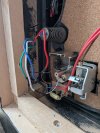
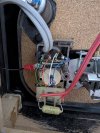
Update: I followed your advice by reflowing the RCA connectors. When that didn't help, I kept moving further up the lines. It seems to have been a problem at the wire block. One of the tone wires was brittle and falling off. One of the wires going to the RCA connectors was also loose. I ended up removing the block entirely and running new 22awg wire straight from the tone arm wires. The sound is almost entirely gone.

I can still hear a faint buzz at high listening volumes. As you mentioned interference, I decided to replace my Amazon RCA cables with some form a reputable source. They'll arrive in a week. So, we'll see. Let me know if you see anything concerning in the attached photo.

Thank you for the help!
 

Attachments

  • PXL_20260208_201706438.jpg
    PXL_20260208_201706438.jpg
    159.7 KB · Views: 4
Where is the wire that ran from chassis to subchassis?subclasses? That should be connected with the tonearm ground. There should be no connection between the signal ground and chassis ground if you have a ground lead added.
 
Where is the wire that ran from chassis to subchassis?subclasses? That should be connected with the tonearm ground. There should be no connection between the signal ground and chassis ground if you have a ground lead added.
The tone arm ground is soldered to a rear connector now, which connects to the amp. Since I removed the ground screw from the chassis, I ran another wire from the chassis to the rear connector as well. The wire connecting the subchassis and chassis is still in place.
 
Update: I followed your advice by reflowing the RCA connectors. When that didn't help, I kept moving further up the lines. It seems to have been a problem at the wire block. One of the tone wires was brittle and falling off. One of the wires going to the RCA connectors was also loose. I ended up removing the block entirely and running new 22awg wire straight from the tone arm wires. The sound is almost entirely gone.

I can still hear a faint buzz at high listening volumes. As you mentioned interference, I decided to replace my Amazon RCA cables with some form a reputable source. They'll arrive in a week. So, we'll see. Let me know if you see anything concerning in the attached photo.

Thank you for the help!
Looks like your on the right track! I would also ohm out each wire to chassis ground. I once had a slight hum on one channel only and found that one of the negative tonearm wires had rubbed at the pivot point over many years developing a partial (40 ohm) short to chassis ground. I ended up rewiring the arm.
 
I bet new connectors would fix the hum, but it is pretty common for most phono systems to have a very slight hum at high volumes.
 
Looks like your on the right track! I would also ohm out each wire to chassis ground. I once had a slight hum on one channel only and found that one of the negative tonearm wires had rubbed at the pivot point over many years developing a partial (40 ohm) short to chassis ground. I ended up rewiring the arm.
This is a smart idea. I ohm tested each wire from the cartridge wires to the RCA jacks. What's an acceptable ohm reading? Here's what I found L(+)=3.2, L(-)=1.1, R(+)=0.5, R(-)=0.6
 
The left channel readings look a bit high when compared to the right. It might just be that your probes aren't touching properly. Both sides L & R should read about the same and very close to zero.

That was not what I was suggesting you check. Measure from each wire to your tonearm ground. You should not see any connection.
 
The left channel readings look a bit high when compared to the right. It might just be that your probes aren't touching properly. Both sides L & R should read about the same and very close to zero.

That was not what I was suggesting you check. Measure from each wire to your tonearm ground. You should not see any connection.
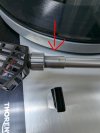
I finally found time to test this. There appears to be some connection. Using a multimeter, I tested each cartridge wire to the tonearm collar (see attached photo). Here's my readings: L(+)=90.3, L(-)=1.5, R(+)=88.5, R(-)=1.1.

When I run the same test from the cartridge wires to the rear ground, I get no connection. The collar has a good connection with the rear ground wire though. So, I'm confused.
 

Attachments

  • PXL_20260213_020941315~2.jpg
    PXL_20260213_020941315~2.jpg
    91.4 KB · Views: 2
what cartridge? some metal ear ones have a ground strap that can cause problems if they aren't mounted with insulating washers. It should read open circuit, and even with a tie strap only one channel should show connection to the headshell. Maybe pull the headshell and measure from that to the pins and see if whatever is going on is happening in the headshell or in the arm.

Do you get any reading from the arm to the rear ground? You should get very low resistance, if thats open have a look at the black wire coming out of the arm to make sure its properly connected.
 
what cartridge? some metal ear ones have a ground strap that can cause problems if they aren't mounted with insulating washers. It should read open circuit, and even with a tie strap only one channel should show connection to the headshell. Maybe pull the headshell and measure from that to the pins and see if whatever is going on is happening in the headshell or in the arm.

Do you get any reading from the arm to the rear ground? You should get very low resistance, if thats open have a look at the black wire coming out of the arm to make sure its properly connected.
It's a AT VM540ML. It doesn't appear to have metal ears. I pulled the headshell and measured from the pins. I get similar readings. Also, the connectivity from the tonearm collar to the rear ground is good, very low resistance.

Here's where it gets very confusing for me... If I remove the wire connecting the rear ground to the amp, the multimeter shows no connection between the cartridge/headshell and the tonearm collar. What could cause that change?

The hum increases significantly without the ground wire connected to the amp.
 

Attachments

  • PXL_20260213_205840267.jpg
    PXL_20260213_205840267.jpg
    146 KB · Views: 1
I'm thinking that you must have the turntable still connected to the amplifier. You are getting a reading close to zero from the negative cartridge pins to the chassis ground via the cable connections. The 90 ohm readings from the positives are that of the cartridge itself.

To be of any meaning disconnect the cables completely from the amplifier. Disconnect each wire from the cartridge and measure to the collar and as well to the turntable chassis ground, there should be no connection on the positive or the negative wire. My problem was a partial short to ground on one of the negative wires, enough to introduce a slight hum on one channel.
 
I'm thinking that you must have the turntable still connected to the amplifier. You are getting a reading close to zero from the negative cartridge pins to the chassis ground via the cable connections. The 90 ohm readings from the positives are that of the cartridge itself.

To be of any meaning disconnect the cables completely from the amplifier. Disconnect each wire from the cartridge and measure to the collar and as well to the turntable chassis ground, there should be no connection on the positive or the negative wire. My problem was a partial short to ground on one of the negative wires, enough to introduce a slight hum on one channel.
Ok, I did everything you suggested. There are no ohm readings with the amp disconnected. The positive and negative wires both have no connection to the collar. The collar still shows good connection with the rear ground terminal. So, I don't think there is a short.
 
Back
Top Bottom