


Hey Doc Brown, Let's go stereo shopping in the 70's - A comparo @ OctoberFrankenFest
Time to break out the restored classic in the museum and set them up at our New England "OctoberFrankenFest" on October 15th for a comparison.
My goal is to compare the early "Monsters" although the Kenwood is from ~1978. These are all in the 100-120 watt range.
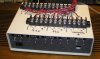
I built a simple switcher that allows me to connect 5 receivers to a single pair of speakers and one signal source for comparison.
What the switcher will do is allow for these to be all connected one at a time without shorting anything out nono.
nono.
Basically, the signal (speaker and line level) passes through the switches when they're not selected but diverts the signal when switched. If two or more switches are selected then the one with the lower number will be selected and the others will remain isolated.
Speaker leads and the receiver amplifier outputs are connected to the barrier strips on the top and the RCAs are plugged into the back.
To select a unit the 2 switches (side-by-side) must both be selected. One is a 4PDT for the speakers and the other is a DPDT for the signal source.
For speakers I'm thinking of either my Ohm Walsh2 or Polk Monitor-7 speakers.
I'm thinking of a questionnaire for people to fill out. Things like what do they like the sound of better, bass-mids-highs-detail, features, aesthetics, etc.
All of the "contestants" have been recapped and restored:
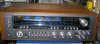
Kenwood KR-11000G
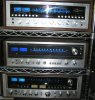
Marantz 2325
Pioneer SX-1010
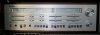
Sansui 9090DB
Yamaha CR-1000
Switcher:


Time to break out the restored classic in the museum and set them up at our New England "OctoberFrankenFest" on October 15th for a comparison.
My goal is to compare the early "Monsters" although the Kenwood is from ~1978. These are all in the 100-120 watt range.
I built a simple switcher that allows me to connect 5 receivers to a single pair of speakers and one signal source for comparison.
What the switcher will do is allow for these to be all connected one at a time without shorting anything out
nono.Basically, the signal (speaker and line level) passes through the switches when they're not selected but diverts the signal when switched. If two or more switches are selected then the one with the lower number will be selected and the others will remain isolated.
Speaker leads and the receiver amplifier outputs are connected to the barrier strips on the top and the RCAs are plugged into the back.
To select a unit the 2 switches (side-by-side) must both be selected. One is a 4PDT for the speakers and the other is a DPDT for the signal source.
For speakers I'm thinking of either my Ohm Walsh2 or Polk Monitor-7 speakers.
I'm thinking of a questionnaire for people to fill out. Things like what do they like the sound of better, bass-mids-highs-detail, features, aesthetics, etc.
All of the "contestants" have been recapped and restored:
Kenwood KR-11000G
Marantz 2325
Pioneer SX-1010
Sansui 9090DB
Yamaha CR-1000
Switcher:
Attachments
Last edited:
 Are you going to do it blind?


