• The move to the new server is done. There are some software and database maintenance updates in process. This has us passing the hat around to help out. We appreciate any donations. Seriously, even a dollar helps. The payment page may be found here - https://www.audiokarma.org/support.html

Hickok 6000a and the 12AX7 - Question for the EXPERIENCED 6000A operators

Hofvox

Active Member
This message is for those ONLY and ONLY experienced with the Hickok 6000A. I just obtained a virtually new unit that was in the original box. Everything appears to be working properly but let me ask two question to those with ONLY experience with the Hickok 6000A. No doubt the unit may need calibrating but assuming it is, if you can answer the below.

Using a 12AX7: Settings on Hickok 6000A with line test dialed in black line and values of 12.6 DV-7608-0 12 58 A 1250 Triode No1 Test: I press Test and it reads Green Good.

To read the value of the reference 1250, I would choose on the shunt dial 3000 micromho ( near 73 dot ) and take my reading.

Question #1 : So my 12AX7 reads good on the green dial and reads 1300 ( pointer on the 3000 micromoh ). Does the 6000a print value of 1250 mean a new JJ 12AX7 reading 1250 is New "and" considered 100% and a reading of 1350 is extra candy or 108% ?

Question #2 : While holding down the test button and the Meter is in the Green, dropping the voltage by 1 step and it still remains in the green = the tube has a large life reserve?

Thanks in advance.
 
Register to hide this ad
Congrats on the almost-new Hickok! That's pretty rare in this day and age, really a nice find!
Question #1 : So my 12AX7 reads good on the green dial and reads 1300 ( pointer on the 3000 micromoh ). Does the 6000a print value of 1250 mean a new JJ 12AX7 reading 1250 is New "and" considered 100% and a reading of 1350 is extra candy or 108% ?
Yes, you're reading it correctly. However, there can be a pretty wide variation in the readings from good tubes, even between seemingly identical NOS examples. When it comes to small signal types like the 12AX7, I mostly use the readings for matching and to weed out the tubes that are definitely bad. It can be pretty tricky though if you only have one tube of a certain type to test. I've encountered sleeves of NOS tubes that were consistently under the gm shown in the data (but which performed just fine). An assessment can be difficult when only one of those tubes is available, and a thorough physical examination is sometimes required in such a case to determine whether it might in fact be a used tube. OTOH, if the reading is, say, half of what it should be, it's reasonable to assume the tube is bad. I never test using the "Good-Bad" scale, so can't comment on that. I will say that the difference between 1250 and 1350 is normal variation.

Question #2 : While holding down the test button and the Meter is in the Green, dropping the voltage by 1 step and it still remains in the green = the tube has a large life reserve?
Some testers use this technique as a "life test." I don't bother with it, because I only buy NOS or reissue tubes. I don't need to know how much life might be remaining. Even if I did, it's not clear to me that the heater test is actually a useful guide. What would it mean if the gm falls a little when a 6.3V tube is operated at 5.4V? How much life does that represent?

My tester is a 6000, which is identical to the 6000A except for the tube socket module. Mine includes sockets and data for the older 4-pin, 5-pin, etc. tube types. It doesn't test Nuvistors or Compactrons. I've been using it for about 15 years.

Screen Shot 2025-05-10 at 2.52.14 AM.png
Screen Shot 2025-05-10 at 2.52.37 AM.png

The meters are the weak point of these testers, and I recently disassembled and cleaned mine to eliminate excessive "sticking." Always avoid touching the face of the meter or allowing it to rub against anything paper or plastic that can create static buildup. They're very sensitive to this, and once it's charged, the faulty readings can persist for several hours. Also note that the gm readings of power tubes like 6L6 may be completely different than their performance under actual operating conditions. Higher voltages will skew the results, so the readings on the tester are not reliable even for purposes of matching. It's useful for weeding out tubes that are definitely bad or at end of life, but not much else. I recently sold off a large quantity of 6P3S-E power tubes, and had to build a test jig so they could be measured and matched four-at-a time at higher voltage and current. The results were very different than when they were initially matched on the Hickok.

Screen Shot 2025-05-10 at 2.51.52 AM.png

Jack
 
...Question #1 : So my 12AX7 reads good on the green dial and reads 1300 ( pointer on the 3000 micromoh ). Does the 6000a print value of 1250 mean a new JJ 12AX7 reading 1250 is New "and" considered 100% and a reading of 1350 is extra candy or 108% ?

Check out post #9 in the thread below

 
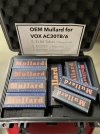
Thanks everyone on the feedback. TriodeLuvr, I also purchase new tubes like JJ for my Vox AC30s and AC15s (reissue Korg/Marshall) but I do have a stash of NOS Mullards that keep locked up for a rainy day.

I always relied on my Guitar Shop to measure tubes (Wallgreen's type standing unit) but unfortunately Joe Bonamassa purchased it leaving our town without local tube tester. Makes sense that the "Life Test" is irrelevant if you are buying new tubes but I am really excited to measure those NOS Mullards I been hoarding all these years. Thanks again everyone.

I just purchased a Phillips JAN "83", NOS "5Y3" as a backup as these are used in this unit. I think for just checking the common "Guitar Tubes" as a GOOD / BAD reading and measuring against printed 6000a chart values................... can't beat this little unit. Thanks again everyone.......... I didn't want to seem rude by wanting only Experienced Users of the Kickok 6000a but I wanted real life user's feedback. Have a good one.
 

Attachments

  • IMG_6390.jpg
    IMG_6390.jpg
    136.4 KB · Views: 6
Back
Top Bottom