• The move to the new server is done. There are some software and database maintenance updates in process. This has us passing the hat around to help out. We appreciate any donations. Seriously, even a dollar helps. The payment page may be found here - https://www.audiokarma.org/support.html

HiFi Engine and Watts per Channel Specs ...... ?

yosl

Active Member
Have noticed that increasingly local sellers on various "buy and sell" web sites are quoting specs for the vintage gear they're flogging based on what they've pulled off the hifiengine web site. Problem is that what they're quoting from hifiengine bears little resemblance to the rules of thumb I've always considered gospel.

Recent example, a Pioneer SX-727 receiver put up for sale by an enterprising local quoting hifiengine specs where on the one hand he specifies a power output of 37 w/c (RMS) into 8 Ohms and on the other hand then goes on to claim it also puts out "up to" 195 w/c into 4 Ohms. Sure enough that's exactly what's on the hifiengine site. By any standard I know, producing 195 w/c in to 4 Ohms from a 37 w/c @ 8 Ohms amplification section is a near impossibility. Are we talking peak watts or perhaps these are specs for some mono mode?

Irrespective, my concern is that a lot of newbies are being led down the garden path by these claims particularly as in this case the seller wanted $300 for a cleaned-up original (no refurb and recap). I've owned an SX-727, to say that it had all manner of hidden power reserves would untrue. It was a smooth sounding mid lineup receiver that when paired with reasonably efficient speakers did well but if you hooked the SX-727 up to inefficient speakers, the results were thoroughly underwhelming, possibly even abysmal.

Any ideas as to what these hifiengine specs are based on?
 
Register to hide this ad
copied off the internet ....

What is IHF dynamic power?
There is a secondary power rating, the IHF "Dynamic Headroom," which is the ratio between the maximum power the amplifier can put out for a burst just 20ms long, and the continuous power. An amplifier that can deliver 200W for 20ms but 50W continuously will have a dynamic headroom of 6dB.5 Aug 1989
 
Sure enough that's exactly what's on the hifiengine site.
:bs:

Better brush up on the definition of exactly.

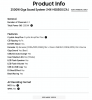
This is exactly whats on the hifiengine site:

And the unit puts out up to 195 watts of music power (at 4 ohms), more than enough to fill a large room with great sound.

Where does it say watts per channel, RMS, continuous, etc.. ?

Some hack seller may have claimed 195 wpc. But, don't cast that aspersion on a data based website that posts the data exactly as it appears in the manufacturer's own published literature.

Here's the 195 watt music power claim right in Pioneer's own literature:

pioneer72-07.jpg
 
Any ideas as to what these hifiengine specs are based on?
I wrote this just the other day: https://audiokarma.org/forums/index.php?threads/audio-salesmanship.925369/#post-14027207 just posted here in its entirety look at that thread for any context you think might be missing. It all has to so with the history of this hobby.

Go look at early x2x pioneer receiver poop sheets as they are some of the brochures that state a number of power output results for an amp. Other companies also listed multiple numbers, Sansui and such.

Here is the one from the 626. Guess which one the US FTC required to be posted in larger print if others are used and that number must be determined after preconditioning the amp at 1/3 power (the most heat producing power output level) and contain the watts per channel, both channels driven, frequency response of the power (low powered units might be rated only 40Hz - 20kHz), into a specified load (usually 8Ω, sometimes 4Ω added) with maximum THD. All that must be stated with numbers and be separate and larger print if some other measurement method was used. Some later brochures have more than one but most stopped putting anything except the FTC numbers on the flyer.

This was done to keep the consumer safe, comparing the same kind of number. Some companies used only the biggest number from their ratings and others would use a more conservative number and a comparison was meaningless. We don't RMS our gear and other numbers are more indicative of what we would be using in the real world but the US govt didn't know anything about amp power and came up with the system we use for 2 channel stereo units. It works but it isn't convertible to a bench test that a tech might do. He would usually do a 1kHz signal, not full frequency (mostly 20Hz-20kHz), no preconditioning, crank up one channel until it clipped on the scope and write the number down.

This difference between Spec power (for FTC spec'ed unit) vs. Bench test units can lead to big differences. Most post 1974 receivers will easily do 10-35 watts more on a bench test then an FTC rating so folks quote the bench test of their refreshed unit and lead us to believe that the Lirpa R-1250 will do 175 watts per channel when the spec sheet says it is a 125 wpc unit. Bench racing at its finest. Glenn (GD70) got me interested in getting this straightened out when he mentioned his JVC power amp doing 210 watts per channel. I would know if JVC made an amp with that rated power so I looked it up and found out it was rated 150. That extra 60 is damn fine and healthy but he and I discussed this on the boards and he is comfortable stating that it is a 210 watt amp bench tested. Everyone wants to use the big number and I don't care which spec or bench because I can roughly translate, if the number is noted as being spec or bench. As stated above everything easily exceeds its FTC number on the bench.

Classic Audio in their gear for sale section does a bench power test on amps. I have been looking at those for a decade and see the number they post for their 1% THD was higher than the FTC spec. I asked and folks thought that clipping was about the same as this 1% distortion. FTC power number would be limited to the quoted distortion level, 0.5-1% for small units and 0.05 or less for the big boys. If you look at power output graphs vs. distortion the line goes across the graph, power increasing until the amp starts running out of juice and the distortion line is damn near vertical but still adding 10-20% before it gets to the 1% distortion level.

All food for thought for you as you said you like learning new things. I felt personally connected to the issue because I bought my first big amp the week the FTC ruling was promulgated, Nov, 1974.

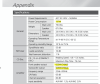
Again for the Pioneer SX-626 here are the power specs, legal when it was produced and sold. It is a 110 watt amp but...FTC number would be 20 wpc, 20Hz -20kHz, @ 8Ω, with less than 1.0% THD. A big difference from the 110 watt first number
index.php

For comparison here is the power spec section of the brochure for the 737 model, first of the Pioneer series to be made available after the FTC rule.
Note the bold FTC required power rating. All the bold writing was required by law, power, load, frequency response and distortion. Note Pioneer chose to provide both 4Ω and 8Ω ratings. Many companies didn't and that has left folks scared their amp won't drive a 4Ω load because it isn't listed...but the back of the amp says it is ok. Here is that 737 power section
index.php
 
Yup,
Had a Fisher, early transistor receiver, 200-T, had the sticker on the glass 70 Watts right there selling the unit. 70 Watts was the IHF 4Ω power, the biggest number in the units arsenal. It was a 20wpc RMS @ 1kHz, 0.8% THD...no full frequency response given, but power bandwidth, the frequency response at half power was only 22Hz to 30kHz, showing it didn't have full low end power.
 
Thanks for the insights, not trying to dis hifiengine. I always suspected the 195 watts came from a quoted spec somewhere and suspected the number was peak power. My beef was mostly with the seller in that it was quoted out of context and have noted the same with others. It's probably best considered an indication of headroom but with 45 year old electrolytics I doubt this unit would be capable of anything near that. Just having a bit of a rant, goes to show the old adage "caveat emptor" always applies.

Why this perhaps struck a nerve was that there are a number of YouTube audio reviewers who are now beginning to acknowledge vintage as a valid option rather than poo-poo'ing it in favor of new stuff. That in turn means there's a whole bunch of millennials diving in without really having a clue. Oh well, I guess they'll learn just as we did.
 
Let's take a step back.
If you're bidding on a piece, it sort of stands to reason you know what it is.
If something pops up interesting, it is (IMO) on you to do a little research.
I do agree the #s are deceptive (or at least not clear).
If you know (think you know) what you want. You should have an idea what you're bidding on even without the ad copy.
 
Prior to 1974 (in the US), power specifications were, in essence, the Wild West.

Perusal of published specifications in the years just preceding the US FTC regulations on power output claims for home stereo hifi gives us a wry glimpse of what things were like.

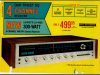
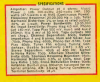
Consider, e.g., these specs from the 1973 Lafayette Radio Electronics (LRE) catalog:
upload_2020-8-14_16-57-29.png

upload_2020-8-14_16-59-34.png
source: https://worldradiohistory.com/Archive-Catalogs/Lafayette-Catalogs/Lafayette-1973.pdf

OK, OK, this one is quad but -- in this case -- it doesn't actually matter much ;)
"We" would probably think of this behemoth as a "23.75 watt per channel" :confused: receiver (into 8 ohms) -- @ 1% THD.

A couple of comments.

  • Way back when, in the days when most, (though not all) consumer loudpseakers were nominally of 8 ohm impedance, the power specs were typically quoted at 4 ohms (whether that was acknowledged or not). Why? Because it doubles the numerical value of the power (2.83 AC RMS volts is 1 watt into 8 ohms, but 2 watts into 4 ohms... twice the current is required from the amplifier). :)
  • The power output in the pre '74 FTC days was usually (though not always) reported as "stereo power" -- e.g., 15 watts per channel = 30 watts stereo. That's not really quite as misleading as it might seem. All else being equal, the difference in "output" (SPL) between of one channel vs. two channels is 3 dB (a factor of two in terms of power).
 

Attachments

  • upload_2020-8-14_17-0-27.png
    upload_2020-8-14_17-0-27.png
    275.7 KB · Views: 1
Last edited:
My beef was mostly with the seller in that it was quoted out of context and have noted the same with others.

I see you are complaining about the seller of the chunk of gear you are looking at. Did you notice that the manufacturers used the same bigger numbers until the Feds slapped their hands and said stop it? Well you can't blame the seller, he is just like a fisherman, boasting about the 18" minnow that got away. See it all the time on ak folks boasting about there amp and using the bench number instead of the spec for the amp which would be a number 20 or so lower than the one he posted. Everyone does it so that means it is up to the buyer to determine what the truth is.
 
I see you are complaining about the seller of the chunk of gear you are looking at. Did you notice that the manufacturers used the same bigger numbers until the Feds slapped their hands and said stop it? Well you can't blame the seller, he is just like a fisherman, boasting about the 18" minnow that got away. See it all the time on ak folks boasting about there amp and using the bench number instead of the spec for the amp which would be a number 20 or so lower than the one he posted. Everyone does it so that means it is up to the buyer to determine what the truth is.

I know as well as the next that sellers more often that not will quote the specs most favorable to making a sale but that doesn't make it right. It's called misrepresentation. No doubt that's why the Feds intervened in the 1970s and I can blame the seller, particularly as there is an entire generation that hasn't the faintest idea about the wattage wars that preceded regulatory intervention. But as I also said, "caveat emptor", let the buyer beware meaning not informing yourself comes with consequence.
 
Last edited:
I know as well as the next that sellers more often that not will quote the specs most favorable to making a sale but that doesn't make it right. It's called misrepresentation. No doubt that's why the Feds intervened in the 1970s and I can blame the seller,

For the new gear back then the Seller was the Manufacturer and because there were so many different numbers bandied about the feds dropped in to put order to that mess. Many here know exactly what each of those different power levels means, not that they know exactly what kind of power that relates to but the average Harry Homeowner or Timmy Teenager had no idea at all what they meant. The feds cleaned that up.

Can't blame someone for posting the biggest number...watts consumed, that they find on a unit they know nothing about and just want out of the house. As for posting the first number they see online for something, on early units that would be the big IHF number. Can't blame them for not looking into the whole FTC RMW wattage crap and researching exactly what number is correct. Hell they were using the Manufacturer's numbers.

Bottom line go with your caveat emptor and do your homework. The info is out there on these units.
 
Then people wonder why I save my nickles and buy Mcintosh and keep it for decades at a time. That was true in the 60's and is true today. You get what you pay for.
 
Back
Top Bottom