
• The move to the new server is done. There are some software and database maintenance updates in process. This has us passing the hat around to help out. We appreciate any donations. Seriously, even a dollar helps. The payment page may be found here - https://www.audiokarma.org/support.html

High end speaker construction - solid wood?

johnnm

Audio Enthusiast
I've been browsing some audio porn lately, in particular lines from Vienna Acoustics and Sonus Faber. They make some gorgeous speakers, with solid wood visible.

Does anyone know if these cabinets are constructed entirely out of solid wood, or are they made of MDF and covered with the wood?

Some gorgeous speakers...
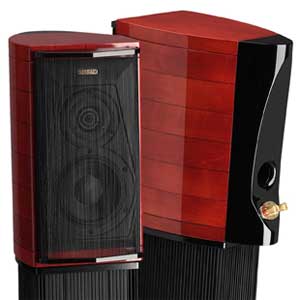
Sonas-Faber_1.jpg


guar1.jpg


Homage_-_Amati_Anniversario_velika.jpg


EDIT: Looks like they're solid wood... "Making of a Sonus Faber" (Dutch)

guarneri_298w.jpg


amati3.jpg
 
Register to hide this ad
Those are some beautiful cabinets! A lot of the cabinets made these days might have solid wood baffles and even some surrounding pieces with MDF internals/braces etc., almost a box within a box. A lot of veneering for the most part. As with the Sonus Faber, there are exceptions! Tim
 
I'd certainly recommend avoiding solid wood cabinets. Inconsistent densities, dimensional instability, and resonance issue make solid wood a no go in any of my projects.

If you have serious money to invest, you could get the wood stabilized, a process where the moisture in the wood is removed and replaced with acrylic. I could see this working out well for a cabinet.

The linked sonus fabers are all wood, AFAIK.
 
sounds like another case of marketing over Science

for some already mentioned reasons ; dimensional stability , joinery , density, sample to sample inconsistencies : solid wood is not the first choice for speakers .........as a woodworker for 30 yrs , trust me , this breaks my heart because I could build some awesome and unique pieces with "real" wood.........

Dave : as far as moisture replacement are you talking about PEG treatment of the wet wood (like woodturners do?) or are you talking about another process (that I am not familiar with?) Ive heard of completely covering all surfaces with a thick acrylic..... and Ive heard of stabilizing punky wood with it (mainly works because of the amount of large spaces in the low density wood... again a woodturners trick) but not impregnating the actual cells with it in a "good" piece of wood ....do you have any links on this process ? (gives me some ideas : because if it works it would make the wood denser / stable etc .....would open up some opportunities build-wise
 
http://www.stabilizedwood.com/

This is the link that someone showed me recently. doing some internet searching found a link where a 5" cube of wood showed thorough penetration of the acrylic. Machining it feels and smells like machining plastic, not wood.
 
IIRC some of the brands were using baltic birch plywood. Its 13 ply and is supposed to be more consistent (no voids) than normal ply? Don't remember exacly why it was supposed to be better than mdf, though....
 
I saw a pair of solid wood speaker cabinets once. The drivers had been removed, so you could see the thick, solid blocks that built up the speakers, like massive butcher blocks but much larger pieces. i think it was a custom job, though, and not a name-brand set-up. It appeared to have been built for a D'Appolito (Sp?) array, and I didn't have suitable drivers for it nor the desire to pay the asking price... but it was impressive to see!

As others have said, though, solid wood is probably not the best things for speakers. If you want your speakers to have "colored" sound, it might work well. After all, solid woods are used to make the casings of many string instruments and some woodwinds and percussion instruments, too!

Hhhhmmmm, I wonder if anyone has tried making speaker cabinets out of the least resonant substance... solid lead? :D
 
Hhhhmmmm, I wonder if anyone has tried making speaker cabinets out of the least resonant substance... solid lead? :D

It's been effectively "done" in a sense. By a couple companies:

http://www.kef.com/us/loudspeakers/muon/muon

The KEF muon is one - solid aluminum.

http://www.stereophile.com/floorlou...s_anat_reference_ii_professional_loudspeaker/

The other is YG Anat Reference II, about twice as heavy as the muon per channel. Solid aluminum. Accelerometer tests were very very good as may be expected.

Lead would be pretty fun to try though.
 
To me, it appears that the construction method used on those should minimize the drawbacks of solid wood... resonance, stability, etc. All those short, thick pieces of wood with the grain running the shorter dimension, glued together with some sort of different layer between them are almost like a macro-plywood. On top of that, there aren't many large flat surfaces either. Seems like an acceptable solution to providing a solid-wood cabinet... for those who can afford them.

I'm no speaker expert, but speaking from a woodworkers POV, it makes sense.
 
Thorough "sealing" of solid lumber renders it probably as stable as manufactured products. Consistency can be ensured by hand selection. This has worked well enough for piano builders for the last couple centuries. I am specifically referring to the soundboards(clear spruce) and bridges(clear hard maple), and not so much the case/cabinet work. A stable soundboard and bridges are imperative to tuning stability, and down bearing stability.

For speaker cabinets however, the cost and labor for the DIYer would seem to make it fairly prohibitive on a small or individual scale. In terms of production for an established company, it's still going to raise the cost over the use of more conventional materials, but it's surely "doable" if the demand/market will support it.
 
It's been effectively "done" in a sense. By a couple companies:

http://www.kef.com/us/loudspeakers/muon/muon

The KEF muon is one - solid aluminum.

http://www.stereophile.com/floorlou...s_anat_reference_ii_professional_loudspeaker/

The other is YG Anat Reference II, about twice as heavy as the muon per channel. Solid aluminum. Accelerometer tests were very very good as may be expected.

Lead would be pretty fun to try though.
Aren't some of the Wilson cabinets milled from a solid block of concrete or similar compound?
 
There are epoxy granite enclosures out there which would in my mind be nearly the perfect material. Highly damped and extraordinarily stiff.

MDF is inexpensive, very stable, stiff enough, easy to work with, effective, and is an excellent substrate for various finishes. You can go through a massive amount of effort and expense to approach it's quality.
 
To me, it appears that the construction method used on those should minimize the drawbacks of solid wood... resonance, stability, etc. All those short, thick pieces of wood with the grain running the shorter dimension, glued together with some sort of different layer between them are almost like a macro-plywood. On top of that, there aren't many large flat surfaces either. Seems like an acceptable solution to providing a solid-wood cabinet... for those who can afford them.

I'm no speaker expert, but speaking from a woodworkers POV, it makes sense.
+1 The curved sides increase the section modulus (compared to flat). They would not have the same resonant frequency or propensity to "drum" as a flat panel.
 
Re: piano soundboards : EXACTLY : they are soundboards : the wood is meant to resonate : it is chosen for its sonic signature ......speaker cabs are supposed to be dead..... "real" wood HAS been successfully used in speaker cabs : but , ceterus parabus, it is always more of a pain , and more $$ than using mdf and particle board (sadly enough)
The idea to use real wood , therefore, is laden with provisos : wheras mdf and particle board (in comparison) is not.
 
There are two ways to really go about resonant issues. Build something heavy to make the resonant frequency lower than the intended range of the speaker or build it very stiff to raise the resonant frequency above the drivers range. For midrange cabinets, heavy and well damped (MDF) works well as it's easier to drop the resonance of the cabinet below the pass band. For subwoofers and woofers producing very deep bass, the easier method is often to make the cabinets exceptionally stiff. This is where marine grade plywood and baltic birch shine.

I suppose there is a third approach which is to have cabinets that intentionally resonate at some frequency deemed as pleasing and design the cabinets to dissipate the energy quickly.

The first two is where I have found that most designers like to be, but the third option has a very devoted set of followers.
 
Re: piano soundboards : EXACTLY : they are soundboards : the wood is meant to resonate : it is chosen for its sonic signature
My point was in regard to stability.

The only wood i'm aware of that's ever chosen because of it's "sonic signature" is the rosewood used for xylophone bars.

Spruce was chosen for soundboards because of it's relatively low mass vs it's strength, availability, and once low cost.

The resonance of a piano soundboard is more a product of it's construction methodology than any other single factor. It is ideally neutral as far as tonality, the goal is to resonate the voice of the vibrating strings without imparting significant colorations of it's own.

Soundboards are in fact fairly non resonant until properly crowned and installed.

But, they are inherently stable over long periods of time and wide ranges of temperature and humidity changes.
 
When Boy Wonder and I play with cabinetry, it's either been MDF or high-quality plywood. The next project, Boy Wonder's own Maggie subs, will be slightly different. The idea is to experiment with laminations of alternating 1/4" plywood and 1/4" hardboard. We were going to make the Stripes using such a method, but, I chickened out at the last minute.

However, the internal bracing we use is solid and well aged oak.
 
I find it odd with some of the comments in this thread - most musical instruments are made from wood, and have a natural timbral resonance. Harmonics play a very big part in music. I see no reason not to utilise solid timber in speaker designs.

SF let's the wood used in their designs age in special kilns for 12 years I believe. This totally removes moisture.

Dave
 
Back
Top Bottom