• The move to the new server is done. There are some software and database maintenance updates in process. This has us passing the hat around to help out. We appreciate any donations. Seriously, even a dollar helps. The payment page may be found here - https://www.audiokarma.org/support.html

High Fidelity: Decades of Decline

Register to hide this ad
This will be a hotly contested topic. I.B.T.L.
Edit: the read is not as pointed as I thought it might be, so there were points of enjoyment. I skipped the vid tho.
 
Last edited:
As an indictment of compression, the video is laudable, although I found it too fragmented to watch.

As for the article, the idea that loudspeakers peaked in the '30s and '40s is simply ridiculous. Loudspeakers peaked in 1957. ;)
I included the short hipster view video for newbies that may not take the time to read the article. :music:The article seemed geared towards the older crowd.

314B72D2-EBEF-4459-B5A6-5B4456A41FDF.png
Those are some pretty big 1930 speakers.
 
Last edited:
Perhaps a good description of what compression is would be helpful to start with. I assume the problem is not packing bits closer together to save room. But leaving bits out to pack more music in a space?
I assume this has nothing to do with over mastering of a bad piece of music to try and get something usable out of it.
 
Well thank God we have a choice to purchase vintage or new audio equipment that satisfies each individual hearing needs. Be smart listen only with your ears when buying audio equipment. Screw what the salesman is is promoting . with new equipment you will have to spend a arm and a leg to get a decent sounding system. This is not written in stone but McIntosh still make fantastic sounding equipment. Just my 1 cent worth any audio equipment that sounds good at low volume to loud volume is good most new audio equipment at low volume is missing bass' silky smooth mids and sharp detail tweets.
 
Perhaps a good description of what compression is would be helpful to start with.
In this case, it’s not the compression of a digital stream as you find with lossy content like MP3, MQA, etc.

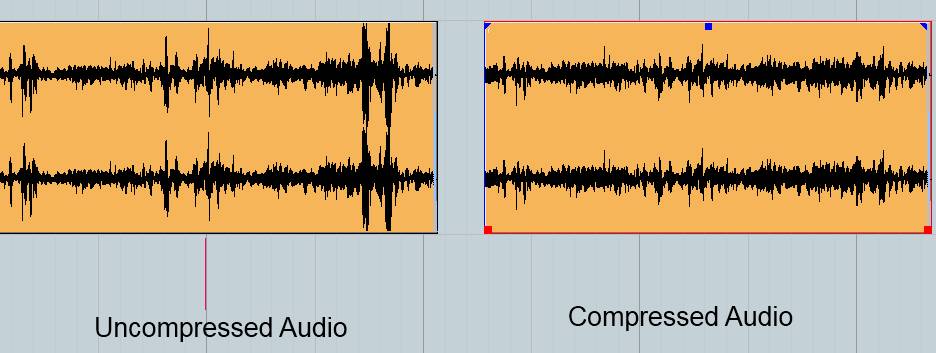
Rather it is the compression of dynamics to make everything sound louder. While removing all the emotion from the music at the same time. Such has been done in radio for years to accommodate the car environment. Here is an example of a non-compressed signal from the Rogue One soundtrack:

hereforus.jpg
 
If speakers peaked in the 40's or 50's why doesn't anyone reproduce them to the exact specs?
Lol. Speakers have very much improved over the years from the 40s 50s with better materials xovers. Altec and klipsch made efficient great sounding speakers but newer companies like jbl Bowers Wilkins make fantastic sounding speakers. Well I do agree the newer small speakers with a 6 inch or 8 inch woofer will not come close to performance to an older altec 19
 
I love good sounding music from funk blues classic rock r&b . I also love AK when I am hungry- food for thought. You can learn a lot or gain DECADES OF EXPERIENCE AND KNOWLEDGE from the people on this site and I THANK YOU ALL FOR THAT. What ever new audio or vintage audio AK will have answers to if that particular peace of equipment is worth buying. Also gives you recommendations to try this type or brand of audio equipment. Which is priceless
 
If speakers peaked in the 40's or 50's why doesn't anyone reproduce them to the exact specs?
Yep, it's not because they can't, it's because speaker technology has surpassed the 40s and 50s today. If one doesn't believe this, then why are people buying $70,000 speakers when they could but vintage TOTL at $3000. Or why doesn't the demand and price of vintage TOTL go way up because the ones with a lot of money can out spend others to get better sound.
 
I thought dynamic compression was pushing everything to the top. And file compression was stripping every other part, then cramming it together to get more music in the same space..
 
There are many reasons for the decline in Fidelity. First off folks in the early 70's discovered connivence was the driving force into selling larger numbers and making more money. Let's face it LP's and R2R tapes. are not convenient. So Cassettes, and iPods and now smart phones have taken over and each step has lowered Hifidelity quality. More people would rather have the ease of selecting music on their Smart Phone that listening to a good high fi system that is expensive and is not easy to use. CD's and DVD's haven't helped the situation either. They can be just as big of a nuisance as LP's or Audio Tape. All it takes is one scratch or one ugly smudge and your DVD or CD may need a thorough cleaning or replacement. $$$$$ and time. Its just easier to use your smart phone. And everything can be stored on a cloud for easy access. I just hope it doesn't rain washing away all your music.
 
I thought dynamic compression was pushing everything to the top. And file compression was stripping every other part, then cramming it together to get more music in the same space..

Close. Dynamic compression, as has been mentioned earlier, is making loud parts softer, and soft parts louder, to facilitate broadcasting, cutting to vinyl and other recording limitations. File compression, is removing the parts that you wouldn't hear anyway. (At least, with a sophisticated, good quality encoder.) Imagine I drop a pin on glass once a second, and record it with a really good mic. Then, every other pin-drop, I hit a kick drum. On the recording, the high-frequency pin drop will show up on a 'scope, but you wouldn't hear it because of the way our ears respond to loud material. A good MP3 encoder would simply remove the pin drop every time the drum hits. It would sound identical, but save a few bits of file size.

Make sense?
 
Back
Top Bottom