Musictubes
Isaac
Does anyone have a good timeline for the different types of 6sn7 and 6sl7 that Sylvania made? Common wisdom is that the loctal versions of 7n7 and 7f7 plus the 12v 14n7 and 14f7 mirrored the production of the 6sn7 and 6sl7. That mostly seems true but I have noticed some exceptions.
I have a few 7f7 that are built differently than any other 6sl7 that I can find. It has the copper support rod like the metal base 6sl7wgt but is black plate instead of grey and has slightly different micas. The metal base 6sl7wgt is the only 6sl7 Sylvania made with a copper support rod. The same holds true for the metal base 6sn7wgt, I'll get to that one in a sec.
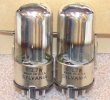
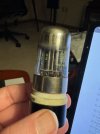
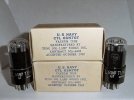
I have also seen the same construction in 14f7 and 12sl7 but not any of the 6sl7. Most do not have the copper support rod, or any support rod for that matter. I'm trying to figure out what the overlap was between these loctals (and 12sl7) and the elusive metal base W version. My first thought is it was just a timing issue. They had the tooling set up for the W and then decided to make a run of the loctals. Does anyone have a good idea of when the metal base 6sn7 and 6sl7 were made? Loctals never seem to have any date codes but these particular 7f7 have the old leaf logo on them. Plus, the boxes say they were made for the US Army Signal Corps by Hygrade Sylvania. Doing a bit of research it looks like they stopped using that branding by 1946. What is the oldest Sylvania made 6sl7 or 6sn7? I keep seeing the "fact" that Loctals were only made for a short time but that doesn't seem true since you can find newer versions of the 6sn7 in 7n7.
I got onto this search because I noticed the 14n7 is the only *sn7 with a copper support rod other than the unobtanium metal base 6sn7wgt. I have every other version of the *sn7 including the 7n7 with (non copper) support rod and even the elusive National Union round plate 7n7. The 14n7 is clearly better in my system. I don't have every variation of the Sylvania but I have a few and these 7f7 with support rod are also the best sounding to me.
Anyone have a timeline for the production of these or have a good theory as to why they have that copper support rod?
I have a few 7f7 that are built differently than any other 6sl7 that I can find. It has the copper support rod like the metal base 6sl7wgt but is black plate instead of grey and has slightly different micas. The metal base 6sl7wgt is the only 6sl7 Sylvania made with a copper support rod. The same holds true for the metal base 6sn7wgt, I'll get to that one in a sec.
I have also seen the same construction in 14f7 and 12sl7 but not any of the 6sl7. Most do not have the copper support rod, or any support rod for that matter. I'm trying to figure out what the overlap was between these loctals (and 12sl7) and the elusive metal base W version. My first thought is it was just a timing issue. They had the tooling set up for the W and then decided to make a run of the loctals. Does anyone have a good idea of when the metal base 6sn7 and 6sl7 were made? Loctals never seem to have any date codes but these particular 7f7 have the old leaf logo on them. Plus, the boxes say they were made for the US Army Signal Corps by Hygrade Sylvania. Doing a bit of research it looks like they stopped using that branding by 1946. What is the oldest Sylvania made 6sl7 or 6sn7? I keep seeing the "fact" that Loctals were only made for a short time but that doesn't seem true since you can find newer versions of the 6sn7 in 7n7.
I got onto this search because I noticed the 14n7 is the only *sn7 with a copper support rod other than the unobtanium metal base 6sn7wgt. I have every other version of the *sn7 including the 7n7 with (non copper) support rod and even the elusive National Union round plate 7n7. The 14n7 is clearly better in my system. I don't have every variation of the Sylvania but I have a few and these 7f7 with support rod are also the best sounding to me.
Anyone have a timeline for the production of these or have a good theory as to why they have that copper support rod?