

You are using an out of date browser. It may not display this or other websites correctly.
You should upgrade or use an alternative browser.
You should upgrade or use an alternative browser.
How long does it take
- Thread starter godawgs
- Start date
Register to hide this ad


When I added sound absorption panels behind my speakers the change in sound was immediate and better. When I added some to the corners of my back wall the booming bass heard in some locations disappeared immediately too. If you're not hearing the difference right away it likely did not help (or hurt !).

godawgs
What Bill of Rights?
Long story semi-long. I bought burlap coffee bean bags and put r-5 pink foam in them. Put them on the side walls and behind rear ported speakers, ( Ascend Acoustic SIERRA-2EX V2 ) I had a British Battle Flag I got from a British submarine in Cocoa Beach Fla at the Trident Basin and hung it on the ceiling. I then put an Alpaca rug on the rear wall, ( though not centered to the speakers due to room constraints).

gizzyman47
Addicted Member
Room treatments can't be put just anywhere and be expected to make improvements. You want to place the treatments for the side walls at the first and second reflection points. I doubt the flag is doing anything. "too thin".
When you get it right you should be able to tell immediately an improvement. What's hard is not turning your space into a studio setting if it's also a multi use room such as a living room. The WAF comes into play! Good luck!
When you get it right you should be able to tell immediately an improvement. What's hard is not turning your space into a studio setting if it's also a multi use room such as a living room. The WAF comes into play! Good luck!
godawgs
What Bill of Rights?
You want to place the treatments for the side walls at the first and second reflection points.
When you get it right you should be able to tell immediately an improvement.. The WAF comes into play! Good luck!
1. You want to place the treatments for the side walls at the first and second reflection points.
Got that one covered.
2, When you get it right you should be able to tell immediately an improvement.
Sound is most different with the panels placed behind the speakers.
3. The WAF comes into play!
I built my own room in the barn, so... No. Thank God.
I've looked at all the PROPER materials to use and room placement for the last 6 months. I'm not confused on what to use and where, but I just used things laying around and decide to try it.
Last edited:

jayvis
Addicted Member
Did you build a ceiling? If so, at what height? Assuming that the base floor is concrete, what type of floor covering are you using?I built my own room in the barn

Quadman2
Lunatic Member
Assessment of end sound results it really a subjective event, and they can differ in estimation.
And your take on things may be different from another is asked to measure. If both opinions coincide, then you are closer to a possible subjective truth.
Not ALL changes make a difference, but some like flooring and walls that are treated, are more obvious after effects that can be noticed.
Then there's positioning of the speakers...another variable to factor in.
Q
And your take on things may be different from another is asked to measure. If both opinions coincide, then you are closer to a possible subjective truth.
Not ALL changes make a difference, but some like flooring and walls that are treated, are more obvious after effects that can be noticed.
Then there's positioning of the speakers...another variable to factor in.
Q
godawgs
What Bill of Rights?
Yep, ceiling is 7'. The floor is wood with a 9X7' rug between the speakers an listening position. Speaker stands are spiked.Did you build a ceiling? If so, at what height? Assuming that the base floor is concrete, what type of floor covering are you using?
jayvis
Addicted Member
I'd think that a larger rug or carpet in your listening space would make as much difference as wall coverings. It all really depends on what type of sound you prefer. Every change to your space, whether it be wall coverings, floor coverings or even repositioned furniture will affect the sound that you hear. Just like with everything else in the audio hobby, experimentation is key.Yep, ceiling is 7'. The floor is wood with a 9X7' rug between the speakers an listening position. Speaker stands are spiked.

sound hound
Super Member
How large is the room? Is there a door? What is the rug made of and underpadding?
godawgs
What Bill of Rights?
The room is 17 'long by 15' wide. 4 1/2' dutch door Northeast corner rear side wall. Man door Westsouth front sidewall. Door to my shop is rear wall Northwest corner. Rug is probably a wool blend oriental.How large is the room? Is there a door? What is the rug made of and underpadding?
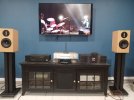
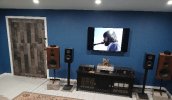

sound hound
Super Member
Wow! Impressive. What is the ceiling material? I would think it could also be absorbing a lot of standing waves.
godawgs
What Bill of Rights?
Just 1/2"sheet rock. Took me about a month to build out when I retired. It's my man cave in the barn.Wow! Impressive. What is the ceiling material? I would think it could also be absorbing a lot of standing waves.
sound hound
Super Member
I looked up the acoustic properties of r-5 pink foam. That ever present online pest AI said it doesn't adsorb sound waves but rather can reflect them. If we can believe AI, using it may be part of the problem. My experience with materials with sound adsorption properties when I was building speaker enclosures many decades ago was that wool or jute padding was superior to fiberglass insulation or foam padding..

Nice listening space. 
I usually try to place a couple open cell polyurethane foam (with 2.0 lb {32 kg} density rating) pads. This is exactly the rating that foam acoustic panels have (but at much greater expense). The wall locations you mentioned are good starting points, but experiment. Also with more wall locations. Important: Don't forget to try a couple on the ceiling (between the listening position and gear).
If you want to make the foam pads look nice, it's an option to stick them behind photo/painting canvas (or blank canvas for the ceiling).
Some more things:
~ Corner bass traps are usually not effective.
~ Also play with speaker placement/toe in & out when experimenting with treatment.
~ Invite an audio friend over so you can sit in the same position whilst they move the panels (and speakers) around for A/B testing. Use their ears too for 2nd opinion. It's fun!
I usually try to place a couple open cell polyurethane foam (with 2.0 lb {32 kg} density rating) pads. This is exactly the rating that foam acoustic panels have (but at much greater expense). The wall locations you mentioned are good starting points, but experiment. Also with more wall locations. Important: Don't forget to try a couple on the ceiling (between the listening position and gear).
If you want to make the foam pads look nice, it's an option to stick them behind photo/painting canvas (or blank canvas for the ceiling).
Some more things:
~ Corner bass traps are usually not effective.
~ Also play with speaker placement/toe in & out when experimenting with treatment.
~ Invite an audio friend over so you can sit in the same position whilst they move the panels (and speakers) around for A/B testing. Use their ears too for 2nd opinion. It's fun!

Several years ago I helped a sound engineer friend build sound panels, using recycled denim, for a recording studio he was putting together. Some were put on the walls, and some were hung from the ceiling.I looked up the acoustic properties of r-5 pink foam. That ever present online pest AI said it doesn't adsorb sound waves but rather can reflect them. If we can believe AI, using it may be part of the problem. My experience with materials with sound adsorption properties when I was building speaker enclosures many decades ago was that wool or jute padding was superior to fiberglass insulation or foam padding..
I have more examples in mind that work, density is the key it seems.Several years ago I helped a sound engineer friend build sound panels, using recycled denim, for a recording studio he was putting together. Some were put on the walls, and some were hung from the ceiling.
Recycled denim is very dense, and used to be (20+ years ago) relatively inexpensive, and readily available. Not so anymore, for either. Because of that, I'll be using Rockwool Safe N sound when I I make my panels.I have more examples in mind that work, density is the key it seems.
As to your comment about base traps, I once stacked a couple of very large pillow in a corner, and they did indeed make a big difference. Of course, in that particular house, the one speaker was very close to the corner. In my current house, the speakers are much further from the corners, and I doubt it would it would have the same effect.

ibog1
Active Member
I've installed some very non scientific room treatment. Yes, I do hear a difference, better?How long to determine if it is really better, or not? I know every change we make can make a difference and it takes awhile for our ears/brain to adjust, but...