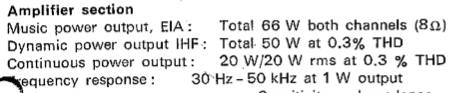
While I do not want to pile on either, sometimes these threads go way into the weeds. The OP asked about the rating of his amp. For reference I pasted the page from the manual below. Note this is an all-in-one stereo, not a component receiver, and is about as far from an Electrocompienet or McIntosh as can be.
So what am I reading in that spec? The following are the generally agreed upon definitions:
RMS power: Amp output and distortion with a test signal of a wide spectrum sweep over a range of frequencies.
FTC power: RMS power with the additional requirement of defining the frequency sweep as 20-20K Hz, the accepted convention for the range of human hearing. It is called "FTC" based on a mid-1970s regulation by the US Federal Trade Commission.
IHF Dynamic Power: A series of burst tones of 200 milliseconds (1/5 second) are measured. This in theory simulates musical peaks. It is sometimes thought to be an inferior performance indicator because continuous power is more typical of a music signal, and because certain companies used it to increase the ratings of their otherwise lower powered amps.
EIA Music Power: A single 1000 Hz tone is measured. This too is a generally considered an inferior measurement because many amps perform better at 1000 Hz than over the spectrum of hearing.
Distortion or THD is an indicator of how closely the amp can copy the input signal at a given wattage. Typically the rating is at the point where the distortion levels begin to inflect, e.g. at 20 watts distortion is .3% and at 21 watts it's 5%.
The Sony was built in 1972, which is during (pre-FTC regulation) wild and wooly days of marketing claims for amp power. Nevertheless, it is clear from those ratings that this Sony is an entry level hi-fi. The RMS rating is not 20-20K Hz, and the IHF and EIA ratings are far above the stated RMS power, all of which indicate some marketing manipulation of the numbers. However, Sony is a quality brand and probably really did the tests, and therefore the amp section should be a decent performer within its parameters.
So to answer the original question,
@BOUXY had it right - RMS power, even with these non-standard frequencies, is the most important rating.



 Heavy Transformers.


