


doctor fuse
Super Member
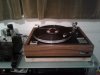
Just used this excellent How-To Guide (http://mr-ives.blogspot.ca/2013/07/restoring-pioneer-pl-12d-turntable.html) for tuning up and restoring a Pioneer PL-12D. My new bedroom table is a CEC BD-2000 (rebadged "Electra"), which is so close to the Pioneer it makes you think if they weren't manufactured in the same factory, and designed by the same engineers, it is a miracle a major lawsuit wasn't involved.
This guide should also apply to the Realistic Lab-300, and dozens of other rebranded CEC tables.
I also added a pound of dollar-store plasticine to the underside of the platter, bringing the weight up from 2.5 lbs to 3.5 lbs. I haven't been too concerned about putting the platter's balance out. Unfortunately, if you put much at all of the plasticine at the outer edge (where it makes the most improvement to the flywheel effect), it will make contact with the motor pulley and belt. I don't notice any visual wobble to the platter when it spins, and its speed control and sound are much improved.

I added another pound to the underside of the upper chassis, and a bit more in the corners of the bottom of the lightweight plinth, to dampen and add mass (forgot to take a photo). The platter mat was replaced with a heavier Angstrom Ultimat. I slapped on an unused Grado XF-3 with 8MZ stylus. The deck sits atop a thick maple cutting board, with plasticine sandwiched between, and under the cutting board.
The re-oiling of the spindle and motor (10W40), and suspension refreshing (chucking the rotten foam in the springs, and replacing with loosely and haphazardly cut new foam) were done following the guide.
Gone are the audible wow&flutter, subtle reverberations, and resonances. Bass is tighter, and the overall sound is a bit "harder". Or to put it more positive; clearer. It's definitely not the same relaxed sound before the restoration/mods. But the quietness is quite astounding, as is the improved s/n ratio, instrument separation, detail retrieval, dynamics, and "slam" ( a bit harder than an idler, but still kind of cool). And it is no longer susceptible to footfall.
I still can't believe the sound and performance we can coax out of these unassuming early/mid 70s Japanese belt drives. Worth picking up good specimens if you find them for cheap! The table cost me $30 with Dust Bug arm brush and Empire 2000E cartridge (broken stylus ) included! The 3 lbs of plasticine cost $6.00.
Total cost: $36.00 CAD.
How-To Restoration Guide:
http://mr-ives.blogspot.ca/2013/07/restoring-pioneer-pl-12d-turntable.html
This guide should also apply to the Realistic Lab-300, and dozens of other rebranded CEC tables.
I also added a pound of dollar-store plasticine to the underside of the platter, bringing the weight up from 2.5 lbs to 3.5 lbs. I haven't been too concerned about putting the platter's balance out. Unfortunately, if you put much at all of the plasticine at the outer edge (where it makes the most improvement to the flywheel effect), it will make contact with the motor pulley and belt. I don't notice any visual wobble to the platter when it spins, and its speed control and sound are much improved.
I added another pound to the underside of the upper chassis, and a bit more in the corners of the bottom of the lightweight plinth, to dampen and add mass (forgot to take a photo). The platter mat was replaced with a heavier Angstrom Ultimat. I slapped on an unused Grado XF-3 with 8MZ stylus. The deck sits atop a thick maple cutting board, with plasticine sandwiched between, and under the cutting board.
The re-oiling of the spindle and motor (10W40), and suspension refreshing (chucking the rotten foam in the springs, and replacing with loosely and haphazardly cut new foam) were done following the guide.
Gone are the audible wow&flutter, subtle reverberations, and resonances. Bass is tighter, and the overall sound is a bit "harder". Or to put it more positive; clearer. It's definitely not the same relaxed sound before the restoration/mods. But the quietness is quite astounding, as is the improved s/n ratio, instrument separation, detail retrieval, dynamics, and "slam" ( a bit harder than an idler, but still kind of cool). And it is no longer susceptible to footfall.
I still can't believe the sound and performance we can coax out of these unassuming early/mid 70s Japanese belt drives. Worth picking up good specimens if you find them for cheap! The table cost me $30 with Dust Bug arm brush and Empire 2000E cartridge (broken stylus
) included! The 3 lbs of plasticine cost $6.00.Total cost: $36.00 CAD.
How-To Restoration Guide:
http://mr-ives.blogspot.ca/2013/07/restoring-pioneer-pl-12d-turntable.html
Last edited:

