

You are using an out of date browser. It may not display this or other websites correctly.
You should upgrade or use an alternative browser.
You should upgrade or use an alternative browser.
How to tell if my recever can handle 4 omh speakers?
- Thread starter conanred
- Start date
Register to hide this ad

audiotemp
Super Member
Questions like this usually draw several different answers and often there isn't one that is the obviously "correct" one. I'll give you one answer: find the manual for each on the internet and read it carefully.
https://archive.org/details/manual_STR4800_SONY
https://archive.org/details/manual_STR4800_SONY
charles 1973
Super Member
Actually it's easy to identify most reciever's or amp manufacturers nominal impedance recommendations, Which will dip lower. On the back of most units it will be printed near the speaker terminals.
As a rule of thumb, most decent vintage amps and recievers are stable into 4 ohm loads. Including your 3 units. BTY that Fisher RS 2010 is a real gem.
To keep an amp from either running out of current, or clipping with 4 ohm loads, keep them aprox -3 db's of the max volume used for 8 ohm speakers. If you hear any kind distortion, or the bass/volume doesn't increase as you turn up the volume stop.
Last edited:

Blue Shadow
Waiting for Vintage Gear from this century
As Charles says above. Google image, find pic of speaker connection area and read.
TX-65:

TX-65:
Last edited:

| Receiver Model | Supported Nominal Speaker Load (manufacturer spec) |
| Sony STR-4800 | 4Ω to 16Ω |
| Onkyo Integra TX-65 | 4Ω to 16Ω |
| Fisher RS-2010 | 8Ω to 16Ω |
P.s. If you post stuff here you can also Google these specifications.

Instructions on (multiple) speaker connections are oddly written in the Fisher RS 1210 owner's manual. However, it seems to suggest two pair of speakers can be played simultaneously so long as they are 8 ohm or higher (presenting a 4 ohm load). That's my interpretation anyway.
Attachments

Last edited:
bowtie427ss
Lunatic Member
The Fisher uses STK's, i'd not run it hard with anything less than an 8 ohm load.

Great info. So definitely dont use nothing but 8 ohms or higher on rs 2010 then. Well when AI fails you with out a good awnser go to the people that knows. Thank you all for the quick and rapid response.
Don't rely on AI for anything. When it doesn't know an answer it can and does make things up. It lies.
They call that AI hallucinations.
I loathe AI.

whoaru99
Epic Member
Instructions ... written in the Fisher RS 1210 owner's manual. It seems to suggest two pair of speakers can be played simultaneously so long as they are 8 ohm or higher (presenting a 4 ohm load). That's my interpretation anyway.
That is how I read it too.

This is key,i'd not run it hard with anything less than an 8 ohm load.
Any amp that I know of can be used with 4 ohm speakers. Problems can arise when volumes increase in systems where the
power supply is not robust enough to cope with demands.
The kind of music you favor also plays a role.
EDM at nosebleed levels: Possible Problem.
17th century lute music at low levels: OK
'If it sounds bad, turn it down'
Last edited:
charles 1973
Super Member
This is what I see with the Fisher 2010.
Only 2 pair of speakers can be selected to operate at the same time, A + B. Two 8 ohm pairs in parallel will result in a 4 ohm load.
C speakers can only be operated by themselves, so a 4 ohm speaker pair here will present the same load to the amp as two pair of 8 ohm speakers.
If your speakers are less the 8 ohms, they should be safe on C speakers, or either A OR B speakers, not both..
I think, as a general rule, the markings on the back panel speaker outputs should be considered the reference spec. If, for example, a manufacturer made different versions of a receiver model that had differing impedance compatibilities, the back panel impedance info should always be in sync with the internal components.
The Sony's STR-4800 is a bit more vague than most in not mentioning A+B impedance range, but I think (not certain) that's because it's one of the rare receivers that wires multiple speaker in series rather than parallel. I'd use the back panel impedance info over any other source.
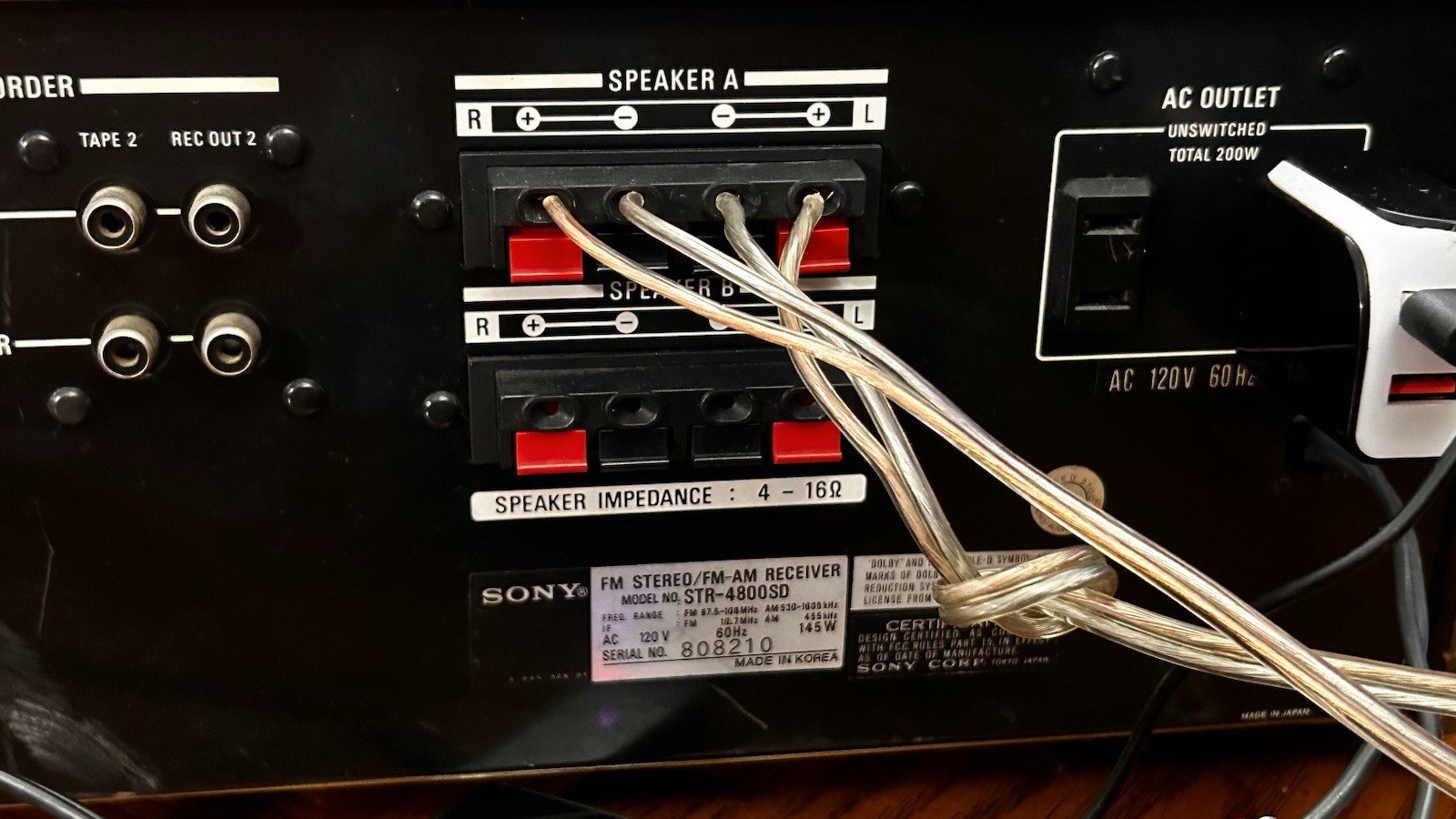
The Sony's STR-4800 is a bit more vague than most in not mentioning A+B impedance range, but I think (not certain) that's because it's one of the rare receivers that wires multiple speaker in series rather than parallel. I'd use the back panel impedance info over any other source.
Blue Shadow
Waiting for Vintage Gear from this century
The problem with ai is it gets both correct and incorrect answers and spits them out as ‘the’ answer.Well when AI fails you with out a good awnser go to the people that knows
Right now ai is Stupid Intelligence because it can not figure out what is correct, just parrots everything it has scraped from its sources.
Here you have folks that know the difference and actually think not just regurgitate recently ingested scrapings.
ai has a ways to go.

charles 1973
Super Member
It certainly looks like the Sony 4800 sd speaker terminals for A and B speakers are connected in series. I always thought this would degrade sound quality significantly. But perhaps it would be fine for casual listening.
I wonder if it Is it much different then installing an attenuator in series with speakers, which I've done. Seemed to work just fine.
I just don't see it very often. The simple test 62 Caddy suggests is a good idea.
I wonder if it Is it much different then installing an attenuator in series with speakers, which I've done. Seemed to work just fine.
I just don't see it very often. The simple test 62 Caddy suggests is a good idea.
Last edited:
Yes, @62caddy 's approach is definitely a good way to quickly determine if they are wired in series. I kind of regret including the Sony back panel pic and Sony comments in my post because I created a distraction from my main point (the first paragraph in that post), which is that the impedance markings on the back of the receiver itself should be considered the "gold standard" guide for impedance compatibility for a given receiver. They are there on almost every receiver/amp -- and (absent a typo) they should absolutely state the impedance compatibility. If, for example, a manufacturer made multiple versions of an amp model that had differing impedance compatibility, the back panel should still be correct for any given individual amp/receiver. Look at the back panel before using AI or looking up manually online.