• The move to the new server is done. There are some software and database maintenance updates in process. This has us passing the hat around to help out. We appreciate any donations. Seriously, even a dollar helps. The payment page may be found here - https://www.audiokarma.org/support.html

How to troubleshoot this transformer?

z-adamson

Addicted Member
The 2A slo blo fuse blows at turn on.

I think a careless (stupid) mistake I made created a transformer problem.

Basically, everything was perfect. All voltages were what they were supposed to be.

Then I made an error, which essentially shorted the outside of the power transformer to the outside of the output transformer. I am talking about the lamination plates. Ever since then, at turn on, the fuse blows. Replaced the fuse, it blows again.

So, how do I asses the damage?

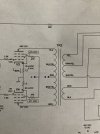
Power transformer…
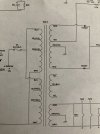
image.jpg

Output transformer…


image.jpg
 
Register to hide this ad
Disconnect all of the secondary windings from their loads. Power up the transformer without a load. Does the fuse blow?
If not, hook up secondary loads one by one, see if one of them causes an overload and check for problems on that supply... Generally when you kill a power transformer, you know that you did so, because something violent Generally occurs, explosions, sparks and smoke being top of the list...
 
Something mildly “violent” did occur.

Are you saying that if the primary side of the power transformer is intact and the secondary side is open and the fuse still blows, the power transformer has failed?
 
if the primary side of the power transformer is intact and the secondary side is open and the fuse still blows, the power transformer has failed?

This is a "divide and conquer" approach to troubleshooting. If the fuse blows with no loads on the secondaries, the transformer is shorted.

If it doesn't blow the fuse, the short is somewhere else in the circuit.

Use a dim bulb tester to save going through a bunch of fuses while troubleshooting.
 
Perhaps this will help….

I had it up and running, set bias and let it idle for a while, making sure it was stable, checking up on the voltages.

Then I decided to touch the top of the power transformer to see if it was getting hot. Then I touched the output transformer to see if it was getting hot. One seemed a little warmer than the other so I touched on with one hand and the other with the other hand. I felt a little bit of a jolt. I took a little shock. Hmm. So I set my meter to ac volts and measured from the outside top of one transformer to the other and sure enough 120volts ac.

After that, the problem started.
 
Update:

Hooked up DBT. Turned it on without changing anything. 60watt bulb shined bright, fuse does not blow.image.jpg

I cut the two red wires going to the rectifier diodes 1n4007. Turned it back on and…..bulb goes dim.
 
(Presumably you have visually inspected this unit very closely for any signs of a short, like heat marks, bulged caps, scorched resistors, etc.)
You say "I am talking about the lamination plates" and that the transformer "outsides" somehow shorted (meaning a conductor simultaneously touched both transformers' laminated iron cores and/or frames, and despite lacquer coating allowed current to flow). If that's all there is to it, then IDK~it's kinda mysterious since in my experience xformer cores are isolated and not generally connected to any part of the circuit. Maybe grounded through frame to chassis?
  • AK experts, correct me if I'm wrong. Above posts seem to focus on the internal primary and secondary windings and yes, you'd want to check them to verify both transformers are good (i.e., not "burned out"). Use any kind of continuity tester, like VOM or DMM ohms, to check each winding and if you get "an open" well there you are, replace xformer. Schematic shows power xformer has three secondaries with three center taps, and the output xformer has taps on both sides. "Disconnecting" windings from loads probably involves de-soldering.
  • Another possibility IMHO is your accident may have shorted more than just the two cores, such as grounding or energizing some other component that's not supposed to carry current that way.
  • So, if your xformers test good then you can proceed to general troubleshooting by testing individual parts as well as circuit paths using schematic.
Good Luck!
 
(Presumably you have visually inspected this unit very closely for any signs of a short, like heat marks, bulged caps, scorched resistors, etc.)
You say "I am talking about the lamination plates" and that the transformer "outsides" somehow shorted (meaning a conductor simultaneously touched both transformers' laminated iron cores and/or frames, and despite lacquer coating allowed current to flow). If that's all there is to it, then IDK~it's kinda mysterious since in my experience xformer cores are isolated and not generally connected to any part of the circuit. Maybe grounded through frame to chassis?
  • AK experts, correct me if I'm wrong. Above posts seem to focus on the internal primary and secondary windings and yes, you'd want to check them to verify both transformers are good (i.e., not "burned out"). Use any kind of continuity tester, like VOM or DMM ohms, to check each winding and if you get "an open" well there you are, replace xformer. Schematic shows power xformer has three secondaries with three center taps, and the output xformer has taps on both sides. "Disconnecting" windings from loads probably involves de-soldering.
  • Another possibility IMHO is your accident may have shorted more than just the two cores, such as grounding or energizing some other component that's not supposed to carry current that way.
  • So, if your xformers test good then you can proceed to general troubleshooting by testing individual parts as well as circuit paths using schematic.
Good Luck!
No bulging caps, no toasty looking resistors. No burn marks.

Since cutting the red leads has made the bulb go dim, then it seems the short is not in the transformer. Since the bulb glows strong without dimming with the red wires intact, then we have some serious current draw and somewhere outside of the transformer. My touching the transformers, using myself as the conductor, created a short and something got damaged.
 
@gadget73

So, diodes removed from circuit…

First diode - 0.02volts one way, 0.02volts the other way.

Second diode- 0.55volts one way, OL the other way.

So first diode bad for sure.

Anything else I should check?
 
That first cap may not have been impressed with the shorted diode but if the fuse popped early enough it likely wasn't harmed. Might want to check the mounting of the transformers to chassis. I'm assuming its a metal chassis at least. They should show low resistance from transformer frame to chassis and should show no voltage between them. If you have voltage on the chassis, thats potentially another issue entirely. Not sure what the primary side of things looks like but any cap from line to chassis is suspect, and if this has a grounded cord, make sure its actually reading from ground pin to chassis and the outlet itself has a proper connection to ground.
 
Then I decided to touch the top of the power transformer to see if it was getting hot. Then I touched the output transformer to see if it was getting hot. One seemed a little warmer than the other so I touched on with one hand and the other with the other hand. I felt a little bit of a jolt. I took a little shock. Hmm. So I set my meter to ac volts and measured from the outside top of one transformer to the other and sure enough 120volts ac.

After that, the problem started.
You body has a fairy high impedance. A meter set to measure voltage has a high impedance. Neither would allow enough current to flow to damage a transformer.
Reservoir caps can fail short circuit and cause fuses to blow. You touching things before the problems started is probably just coincidence.
 
Disconnect all of the secondary windings from their loads. Power up the transformer without a load. Does the fuse blow?
If not, hook up secondary loads one by one, see if one of them causes an overload and check for problems on that supply... Generally when you kill a power transformer, you know that you did so, because something violent Generally occurs, explosions, sparks and smoke being top of the list...
Aso, check that there is not a short between the primary winding and the core of the power xfmr, which is unlikely but possible.
 
Back
Top Bottom