• The move to the new server is done. There are some software and database maintenance updates in process. This has us passing the hat around to help out. We appreciate any donations. Seriously, even a dollar helps. The payment page may be found here - https://www.audiokarma.org/support.html

Huge AEA Analog 620 power amp ?

Chap

Electrochap
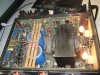
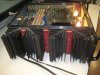
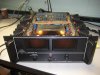
One of my friends asked me the other day to repair this monster. He found it at the recycling place. It is a AEA ( Analog engineering associates ) model analog 620. Weight around 100 pds. Real monster 24 TO3 ( MJ15003 & 15004 I think ) but.... but ... It sits at 100 WPC only. Can that be thru ? For that size ? That what I measure with tones and a dummy load... It has 10 amps fuses at the speaker output. Ramp is +/- 50 VDC.

I guess it won't ever get hot...

Only the power switch needs repair.

Anobody ever heard of these before ? It was built in Rockville Maryland USA.

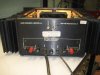
For sure some pictures !

By the way, it has 2 power cords... 1 is for "remote" ? Lok at the back picture.
 

Attachments

  • IMG_2095.jpg
    IMG_2095.jpg
    75 KB · Views: 533
  • IMG_2096.jpg
    IMG_2096.jpg
    95.9 KB · Views: 421
  • IMG_2097.jpg
    IMG_2097.jpg
    76.9 KB · Views: 403
  • IMG_2098.jpg
    IMG_2098.jpg
    62.6 KB · Views: 404
Register to hide this ad
With fuses on each channel, it is more than likely a high current amplifier.

This enables the amplifier to double it's output wattage as the impedance decrease.

It could offer 250 watts @ 8 ohms, 500 watts @ 4 ohms, 1000 watts @ 2 ohms. It also could be a Class A amplifier providing it gets warm while idling for 5 minutes with no load. The transistors are 250 watts and, with voltage rails of 50 volts those numbers are quite possible.

Why don't you just bench it?

Best Regards,
 
Yop, high current. I did bench it. I measured 100 WPC with an 8 ohm load. So I guess it can get to 2 ohms at...400 WPC

It is not a class A as, like I wrote, there are PNP and NPN TO3s.
 
It's a good amplifier nonetheless.

Far better than what many go nuts over on Audiokarama. :thmbsp:

I have around 12 power amps that follow the same principal (24 MJ15024, Oil Can sized Capacitors and, 10 - 14 amps per channel on the outputs) but the voltage rails are 75 - 81 +/- volts.

They really show their class when you are driving low impedance (2 ohms) loads. While others get hot they don't. :yes:


Best Regards,
 
You're right !!!

To get that one hot, you need a whole shopping center wired in parallel !!!
 
What does having NPN and PNP have to do with whether it's class A or A/B? Either design can use bipolar complimentary pairs, or they could use MOSFET outputs, etc.

Class A just means the output stage is biased on even when there is little or no signal present. You can tell pretty easily if a monster this big is class A.

With amp idling:
1) Your electrical meter will be spinning faster than you've ever seen it

2) Your face starts to turn red from the heat if you sit in front of it for too long

John
 
Well, Jdurbin1 I always tought class A meant it was using the same driver, used in it's linear area, for both positive and negative side of signal. I had a tube amp working like that ( Philips in my avatar ). Do you mean we can have a PNP NPN one on top of the other used in class A cct ? Just by having them biased at all time ? For this monster would be quite obvious. But in a 30 WPC amp, how can you tell it is class A ? By temp ? A push pull amp badly biased becomes a class A ?

Please light my bulb ?
 
I think you're mixing single-ended with class A... and yes, class A can use a bipolar pair.

Push-pull biased so the output stage is on with little or no signal present would be class A, but I wouldn't call it bad necessarily.

John
 
Listed here as 325 WPC RMS @ 4ohms

The company is listed as "inactive."http://www.google.com/url?sa=U&start=8&q=http://www.corporationwiki.com/Maryland/Rockville/analog-engineering-associates-inc-4868341.aspx&ei=hRyYSZ3rKY3BtgfwmISgCw&usg=AFQjCNEoKSu4ed_gVMNOdRfuVd9YEfdClw

Found the following little gem here:
Kenneth Leonard - CEO and Serial Entrepreneur. Mr. Leonard has been founder and/or CEO of a string of ten technology, wireless, and Internet start-ups, with a strong record of successful exits. Mr. Leonard is the Chairman of PeerPC, providing Internet based collaboration tools for Microsoft Office and web application. Mr. Leonard is the CEO of On Map, which dynamically generates interactive maps in "real-time" over wired or wireless networks. He is also the CEO and founder of NameTree, which supports, expands and enhances the Domain Names System (DNS) and the Internet name registration industry. Additionally, Mr. Leonard currently serves on the Board of Advisors of Global Internet Ventures. Mr. Leonard's string of prior accomplishments include:...


Founding Analog Engineering Associates (AEA) to develop products for the emerging high-end stereo - hi-fi consumer market. AEA technology was sold to Sony, Marantz, and Sansui.
 
The list was $1220 in 1979 as shown in the Stereo Review guide.

Rated 2 ohm stable, nice piece.
 
My best friend has an Analog 620 in perfect working order driven by an older Yamaha preamp and they drive a pair of Dahlquist DQ10's and a powered subwoofer. The sound is very detailed and awesome.
 
I have on too!

This amp was rated for 325wpc/8ohms. It was unusual at that time because it was a quadrant bridged design, basically two of the model a 610's bridged on one chassis. The two power cords were for separate functions, the heavy one for the output stages and the other for the driver stages. There is a power switch and a push switch which disconnected the frontend from the outputs. Quadrant bridging also meant that both speaker legs were driven. I listened to both AEA amps in the late 70's and owned their pre-amp for many years, just selling it on eBay last year. That was an interesting unit too, being one of the first to utilize IC's for most of the functions, hidden in sealed modules. I bought the A 620 a few years ago out of Quebec and it worked for a week. My tech here replaced outputs but they fail. I don't think there is a soft start circut and this amp might be an inherently unstable. I remember the dealer sending the big amp back a few times, and maybe this contributed to the demise of this company if it was a design problem. Something like that could kill a young audio company. What made me buy it was what I remembered from back then, a totally effortless and natural presentation which revealed things on records like I had never experienced. This forum has the most info in one place on this brand that I've come across in 15 years. I'd like to get mine up and running.
 
I had one once that I've measured output using an 8 ohm power resistor and I did measure around 100 Watts. I know everybody calls it a 325 WPC .. WHy ? My 8 ohms resistor IS an 8 ohms resistor that I use all the time and it usually matches the predicted level. Was my 620 modified ?

The unit I had was very stable. Had no problem with it.
 
I'm Ken Leonard, founder of Analog Engineering Associates, and the lead designer of all the AEA amps/preamps. I'm really glad to see they are still being enjoyed. We had a lot of fun designing them; trying to create the very best equipment possible with the most advanced technology available at that time. The 70's were great times in the technical advancement of high-end audio gear... I was only 27 years old when I started AEA, and unfortunately I no longer have any schematics or parts, but I'll be happy to answer any questions anyone might have.

The 620 was a "quad bridge" output design. That's basically two class AB amps feeding the load in opposite phase: so that when one is going positive, the other is going negative, which doubles the voltage across the load (and doubles the power). This was done because the maximum voltage high-power transistors of that day could handle was too low to develop high power into 8 ohms. The amp was rated at 500 watts RMS into 8 ohms, and had the highest power rating of any amp at the time. If it is not delivering that power now, possibly the bias setting on the output transistors is off, or one of the two sides of the bridge amp is shorted out, so you are only getting half the voltage to the load.

Happy to answer any other questions...
 
Back
Top Bottom