• The move to the new server is done. There are some software and database maintenance updates in process. This has us passing the hat around to help out. We appreciate any donations. Seriously, even a dollar helps. The payment page may be found here - https://www.audiokarma.org/support.html

I know absolutely nothing.

JordanVA

New Member
I'm ashamed to say that as a lifelong musician my technical knowledge is limited to on/off switch, and plugging things into the wall. This is also the limit of my knowledge when it comes to my stereo equipment.

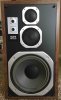
I'm hoping someone will be kind enough to explain to me what the different parts of these speakers are? I don't know the difference between subwoofers (now just learning that there's subwoofers and woofers?), drivers, tweeters, loudspeakers, etc. I'm 100% clueless. I'm a musician, but I'm not an audiophile or at least experienced with different quality equipment. So I can tell if something is a total piece of ****, but I don't know if these are great or not. I've attached some pictures. Any help would be greatly appreciated.

Thank you!
 

Attachments

  • IMG_64713.jpg
    IMG_64713.jpg
    45.7 KB · Views: 79
  • IMG_64724.jpg
    IMG_64724.jpg
    45.8 KB · Views: 71
  • IMG_64746.jpg
    IMG_64746.jpg
    36.3 KB · Views: 73
  • IMG_64702.jpg
    IMG_64702.jpg
    100.6 KB · Views: 72
Register to hide this ad
The SR AL-10 speaker posted in the first picture shows a tweeter on top, mid-range at center and woofer down below. The second picture shows what are known as L-pads which simply put, allow you to raise or lower the volume on your tweeter (high frequency) or mid range (mid frequency) speaker. The third picture shows what is know as a passive radiator. The passive radiator has no electrical connections and increases the low frequency response (bass) of the speaker.

Welcome to AK!
 
The SR AL-10 speaker posted in the first picture shows a tweeter on top, mid-range at center and woofer down below. The second picture shows what are known as L-pads which simply put, allow you to raise or lower the volume on your tweeter (high frequency) or mid range (mid frequency) speaker. The third picture shows what is know as a passive radiator. The passive radiator has no electrical connections and increases the low frequency response (bass) of the speaker.

Welcome to AK!

That was fast! Thank you!!
 
A sub-woofer is usually a stand alone unit for handling Ultra Low Frequencies that a normal Woofer cannot handle.
 
A sub-woofer is usually a stand alone unit for handling Ultra Low Frequencies that a normal Woofer cannot handle.

So in the speaker is a woofer, and a subwoofer is usually a stand alone unit? Sub woofers typically face down right?

Is that a cartoon Les Claypool?
 
I'd say to think of what is most curious to you right now and start going through the countless info around.

Also you know something now. SOUND DESIGN IS JUNK AND NEVER UNDER ANY CIRCUMSTANCES THINK ITS NOT JUNK.

Welcome buddy!
 
I'd say to think of what is most curious to you right now and start going through the countless info around.

Also you know something now. SOUND DESIGN IS JUNK AND NEVER UNDER ANY CIRCUMSTANCES THINK ITS NOT JUNK.

Welcome buddy!

Is that what these are? I haven't been able to find anything on Sound Research other than a couple of forums on here where people said they were probably SRL, some cheap house brand from the 70s or 80s?
 
Easy to learn this about speakers.
Unless you are looking at a modern higher end speakers as stated the subwoofer is usually a separate device, with or without an amp built in. Subwoofer drivers can be faced anywhere the designer wants and design of the speaker overall is influenced by those choices. The down firing subs may well be common on the less expensive speaker to avoid having to put a cover over the driver.

Woofers are usually the largest driver in the speaker but that passive radiator, you got a good example with that speaker since most speakers don't have one can be as large or larger than the woofer. It is moved by the air pressure in the cabinet produced by the movement of the woofer.

Mid-woofers
Mid-range
Mid-tweet
all come next in size, generally

Then the tweeter and super-tweeter for those speakers that are designed with all that stuff in them. Careful with those Horn Tweeters, a speaker way down deep inside the horn structure that makes the speaker look larger than the woofer.

The number of different drivers usually determines the 2-way (woof-tweet), 3-way (add midrange), 4 and up.

The number of drivers, don't get speakers based on that, get them based on sound quality, but you know that part. There are sales pitches based on more or fewer drivers that can be convincing.

Lots of info out there but the folks here can probably answer most of your questions. Welcome to AK.
 
Lots of info out there but the folks here can probably answer most of your questions. Welcome to AK.

Thanks! I appreciate the info. People are very friendly here. I was a bit worried based on experience in other forums that people would respond with "**** off, figure it out yourself".

I've worked in various sales jobs for years now, so if I go to a local place I'm usually pretty good at telling when a salesperson is genuinely interested in finding the best product for my needs or if they're just weaving a golden tale of BS to get me to reach for my wallet.
 
So in the speaker is a woofer, and a subwoofer is usually a stand alone unit? Sub woofers typically face down right?

Is that a cartoon Les Claypool?
No rule, Subs can be Front, Rear, or Down firing depending on MFG.

And Yes to Les.
 
So in the speaker is a woofer, and a subwoofer is usually a stand alone unit? Sub woofers typically face down right?

Is that a cartoon Les Claypool?

There are many different subwoofer configurations, down-firing, front-firing, woofers on two baffles... What's important is they handle the lowest frequencies. Having a stand-alone sub allows you to maximize your main speakers ability to handle mid and high frequencies, allow smaller main speakers for their easier placement and allow more precise room response for bass frequencies by flexible sub placement. Some mains are very capable of handling the entire audible frequency range, but are usually large to allow enough internal area. The audible range for human hearing is considered to be 20Hz - 20KHz. Subwoofers normally have a frequency range adjustable from 20Hz-250Hz. The little boxes that come with some Bose, Sound Design... can't go that low, so are called "bass modules" or something similar.
 
other forums that people would respond with "**** off, figure it out yourself".
we used to do that in the dollars and sense forum (asking anything about value) when some one dropped in and wanted to know value without saying hi. Seems some were protective of the knowledge base here on ak. But I think we have gotten past that.

I've worked in various sales jobs for years now, so if I go to a local place I'm usually pretty good at telling when a salesperson is genuinely interested in finding the best product for my needs or if they're just weaving a golden tale of BS to get me to reach for my wallet.

The discussion (sales pitch) for or against the number of drivers in a cabinet are convincing for all discussions. I have excellent 2-way, 3-way and 5- way (that have a sub available, making them 6-way) speakers. Good words and strong followings for all on AK.

All these different -ways has me thinking about Cincinnati Chili!!
 
There are many different subwoofer configurations, down-firing, front-firing, woofers on two baffles... What's important is they handle the lowest frequencies. Having a stand-alone sub allows you to maximize your main speakers ability to handle mid and high frequencies, allow smaller main speakers for their easier placement and allow more precise room response for bass frequencies by flexible sub placement. Some mains are very capable of handling the entire audible frequency range, but are usually large to allow enough internal area. The audible range for human hearing is considered to be 20Hz - 20KHz. Subwoofers normally have a frequency range adjustable from 20Hz-250Hz. The little boxes that come with some Bose, Sound Design... can't go that low, so are called "bass modules" or something similar.

Are speaker brands like Bose and Sound Design similar to Beats headphones in that they're expensive because of the name, but not actually the high quality they claim to be?
 
we used to do that in the dollars and sense forum (asking anything about value) when some one dropped in and wanted to know value without saying hi. Seems some were protective of the knowledge base here on ak. But I think we have gotten past that.


The discussion (sales pitch) for or against the number of drivers in a cabinet are convincing for all discussions. I have excellent 2-way, 3-way and 5- way (that have a sub available, making them 6-way) speakers. Good words and strong followings for all on AK.

All these different -ways has me thinking about Cincinnati Chili!!

I've tried looking at youtube videos explaining things, but for some reason I have a hard time focusing on those. Reading responses from people and having a discussion makes it much easier for me to understand and retain the information. I could see how someone just dropping in and wanting to know the value of something being annoying, since they probably just found some speakers and only want to know what they can sell them for.

I don't know what Cincinnati Chili is, but now I'm hungry.
 
I'm ashamed to say that as a lifelong musician my technical knowledge is limited to on/off switch, and plugging things into the wall. This is also the limit of my knowledge when it comes to my stereo equipment.

I'm hoping someone will be kind enough to explain to me what the different parts of these speakers are? I don't know the difference between subwoofers (now just learning that there's subwoofers and woofers?), drivers, tweeters, loudspeakers, etc. I'm 100% clueless. I'm a musician, but I'm not an audiophile or at least experienced with different quality equipment. So I can tell if something is a total piece of ****, but I don't know if these are great or not. I've attached some pictures. Any help would be greatly appreciated.

Thank you!

Once you know how to replace the muffler bearing on your turntable you'll do fine. It's sort of a right of passage to audiophile techie nirvana ;).

BTW, that is sort of a trick question because Direct Drive turntables don't have a muffler bearing. :D
 
Is that what these are? I haven't been able to find anything on Sound Research other than a couple of forums on here where people said they were probably SRL, some cheap house brand from the 70s or 80s?


No your speakers have nothing to do with Sound Design. I just purely meant to remember that the stuff belongs on the curb.
 
Back
Top Bottom