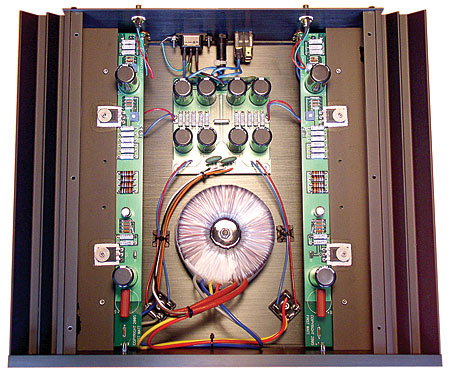
I like big amplifiers, even when they are not being pushed to feel-it-rattle-the-bones volumes. I like them for several reasons:
1. For the really big, well-designed beasts, no speakers need be feared. Good high-power amps are more likely to be high-current-capable, so they can handle the big Infinity speakers I like, without blowing up or taking out the EMITs.
2. Full-range sound with ample and tight bass. Smaller amps usually just can't put out enough energy to FULLY drive full-range speaker systems. Often, something is missing, and most often, it is the bass, because POWER is required to produce lower tones with most current technologies. Okay, with efficient enough speakers this isn't so much of a problem, but, for example, the sound of acoustic suspension speakers when driven properly (by a BIG, powerful amp with good damping and slew rate) is better, to my ears, than an efficient horn driven by a lesser-powered amp. You can get wonderful-sounding midrange with liquidy vocals from a small SET amp and efficient speakers, but only at the cost of a relatively wimpy bottom end and often a slightly thinner high end. (Of course, bi-amping with a sub might get around this problem, but most SET purists won't go down that road, in my experience.) With a BIG amp that is well-designed, you might lose a teensy bit of the warmth and smoothness of the midrange, but this is more than compensated for (IMO) by getting the rest of the sound spectrum filled in, for an OVERALL realism that can be even higher.
3. Dynamics. With all that headroom a big amp provides, even on peak transients like bass drum slams or fortissimo blasts from a full orchestra, you'll get the full whack without the amp breaking a sweat or distorting. That kind of effortless meeting of any dynamic demand the music asks for, really comes only with BIG, powerful amps. I don't like "kick-in-the-gut" music, but on occasion when the live music was that way, I don't mind the realism in my living room.
4. No discernible distortion, even on those occasions when you DO want to crank them up. Regular amps will start clipping and distorting audibly, if pushed too hard. They can make you worry and cause you to jump up and turn down the volume, before something decides to emit magic smoke. BIG amps never put you through that; they just send chills down your spine as that huge orchestra with those big tympanies, or Kodo drummers or whatever just keeps performing right there in front of you.
5, The sheer impressiveness of a big, bad-a$$ monster sitting there in your system, radiating heat and demanding attention and respect. There is something viscerally appealing about really heavy iron and lots of watts, like standing next to a huge waterfall or watching a volcano or being out in a major thunderstorm; power is cool! That little ozone odor that says "Danger - Serious Electricity is Dancing Here" appeals the way a high-compression engine in a high-performance car does. I can enjoy the sound of a little headphone amp putting notes in my head, but brutal iron is a different kind of appeal altogether. There is nothing quite the same as sheer brute power. Maybe it's a testosterone thing(?).
6. The flip side of no. 5 above is that the big amps are "polite" when they should be. When you play with one of these, and you listen at the same levels you would with other amps (generally) you'll get similar effects; perhaps a bit more smooth and effortless, but the differences are not so major... it is only when the music demands it; when there is a dynamic blast or you decide to crank it, that the differences REALLY emerge. A 500-watt amp when playing at a moderately quiet volume isn't all that much different from a 50 watt amp playing at the same levels; they won't sound too much different, except that one is barely awake, and the other may be breathing hard already. As soon as you make a little extra demand on the system, the difference will catch your attention. A bit like cruising at 40 MPH in a Ferrari vs doing the same speed in a Toyota. You won't feel too much difference, until you decide to pass that car in front of you. Then the difference will be more than obvious. It always brings a smile to my face when something that sounded good already, sounds just as good in demanding passages where I've heard lesser amps struggling.
All the above is a good part of why I'm bringing home an amp soon that puts out a conservatively-rated 500 WPC into 8 ohms/750 WPC into 4 ohms. (Yamaha 101M). Banks of 20 transistors per side blanketing the back of this oversized 135-pound beast, that still manages 10Hz-100kHz frequency range, 122 dB S/N ratio, and less than 0.002% distortion. Hooked up, it sounds as clear and realistic as (or maybe a bit more so than) just about any amp out there, including big ones from Accuphase, Marc Levinson, etc... What is there NOT to like about an amp like that?
I'll still be using a much smaller amp for headphone use by my computer, and I'll keep a smaller-powered amp for my office-room system, but for those "serious" dedicated listening sessions, where I want to play my best recordings and really hear them at their most realistic and involving best? Give me a BIG amp, any day! :yes:
P.S./DISCLAIMER -- The above comments refer to well-designed, well-made amps like the brands and models mentioned (and similar ones like Ampzilla, etc...), ONLY. I've heard very powerful but cheap and generic pro amps that I wouldn't want to listen to.

High rated output power alone is NOT SUFFICIENT to make a GOOD amp, but it might just be NECESSARY to make the BEST overall amp. The catch to this is that it is difficult to design an amp that is BOTH high-power AND good-sounding; it gets expensive. But when it is done and done right, nothing is better, IMO. No disrespect to those who prefer their low-powered SET amps; I appreciate their strengths, too... but overall I choose to walk the other path, because when done right, I find it satisfies my ears better. I notice what is missing from those low-power systems, just as much as I notice what is right about them, and the missing parts leave me feeling unsatisfied. Other people focus on their strengths, and find satisfaction enough in those. Neither way is wrong; it's just a matter of personal preference, the way one person likes blue and another likes red.



 f course I have no way of measuring it I'm just going on published specs but I also don't want to blow a set of speakers and find myself broke...again,over audio gear.


 })