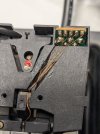
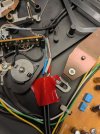
I'm troubleshooting a B&O Beogram turntable, part of a Beomaster 6500 system. The turntable connects to the receiver and starts on command from the remote as expected. The output of both channels is highly distorted, like blown car radio speaker distorted. I thought the simple fix would be re-capping the RIAA board, which is inside the turntable on this model. Recapping made no change in the sound quality.
I decided to side-step the RIAA board entirely, and connect to the raw cartridge outputs, picking the signals up on an internal board that includes a mechanically operated muting switch. I used a spare receiver (Onkyo) with a proper phono stage for testing. Wiring an RCA cable directly to the cartridge wiring on the muting board, the test album still sounds distorted. I completely disconnected the cartridge wiring from the board, soldered in my test cables, same distortion. I can't see that there is anything but two sections of straight wire from the cartridge to the test cable, ie no electronics.
The same cartridge (MMC2) works perfectly in a 2nd B&O standalone table (TX2) driving the same Onkyo receiver. In my mind these two systems should be identical, cartridge wired to phono preamp with no other electronics. I've performed these tests repeatedly, and used my test cable soldered into the TX2 just to make sure I did not have an issue in the test cable.
So, that sounds like a problem in the wiring from the cartridge socket through the tone arm to the turntable electronics. But an ohmmeter check does not show anything amiss, with the cartridge in place I measure about 770 ohms across two pairs of wires, which is what I measured at the cartridge pins with the cartridge removed. There is no leakage between any of the four wires with the cartridge disconnected, using a Meg range on the meter.
I can't explain how a section of cable could introduce this kind of distortion in both channels. The problem is not intermittent. I realize that the low level audio signal is much different than a DC meter test, but I can't imagine a defect in cabling that would present this issue without showing some clues in the ohm meter test.
Any opinions would be appreciated!
- KTM Don
I decided to side-step the RIAA board entirely, and connect to the raw cartridge outputs, picking the signals up on an internal board that includes a mechanically operated muting switch. I used a spare receiver (Onkyo) with a proper phono stage for testing. Wiring an RCA cable directly to the cartridge wiring on the muting board, the test album still sounds distorted. I completely disconnected the cartridge wiring from the board, soldered in my test cables, same distortion. I can't see that there is anything but two sections of straight wire from the cartridge to the test cable, ie no electronics.
The same cartridge (MMC2) works perfectly in a 2nd B&O standalone table (TX2) driving the same Onkyo receiver. In my mind these two systems should be identical, cartridge wired to phono preamp with no other electronics. I've performed these tests repeatedly, and used my test cable soldered into the TX2 just to make sure I did not have an issue in the test cable.
So, that sounds like a problem in the wiring from the cartridge socket through the tone arm to the turntable electronics. But an ohmmeter check does not show anything amiss, with the cartridge in place I measure about 770 ohms across two pairs of wires, which is what I measured at the cartridge pins with the cartridge removed. There is no leakage between any of the four wires with the cartridge disconnected, using a Meg range on the meter.
I can't explain how a section of cable could introduce this kind of distortion in both channels. The problem is not intermittent. I realize that the low level audio signal is much different than a DC meter test, but I can't imagine a defect in cabling that would present this issue without showing some clues in the ohm meter test.
Any opinions would be appreciated!
- KTM Don