• The move to the new server is done. There are some software and database maintenance updates in process. This has us passing the hat around to help out. We appreciate any donations. Seriously, even a dollar helps. The payment page may be found here - https://www.audiokarma.org/support.html

I need a practice solder board

JSanders2056

My Life Has Gone to the Dogs
Subscriber
I am sorry if this has already been discussed and possibly beaten to death, but I'm not finding a lot. If there is a thread please point.
I just ordered a practice board and it's the size of a credit card. I don't know if that is going to help. I will start with that and hope I find something more in line with an amp size board
Something a little bigger would be of value to me. There is a kit I want to build, and I need to get the technique down. AkitiKa in case you are curious
Pretty sure I've got the correct tools (no desolder tools, so any recommendations appreciated)
Thank you
Jeff
 
Register to hide this ad
Check out this thread here in the DIY forum !!


He had lots of fun doing these small projects .

nashou
 
If I were to start over again, I'd probably get a few of these and the cheapest set of resistors I could find, and would start soldering away. That's probably the cheapest and easiest way to practice.
But building those small kits I talked about in the other thread, albeit a bit more expensive, was incomparably more fun. And it also taught me a lot more than just the soldering technique.

For desoldering I use an Engineer SS-03. It's extremely well built, very easy to clean (which you rarely need to do, because it's mostly self-cleaning), and works really great. The silicone tip is awesome. Sure, a dedicated desoldering station would be faster and more convenient, but I'm getting along so well with this little pump that I never had any reason to consider upgrading. I can desolder anything with it, and quite easily at that.
As usual, it's all about technique. As tempting as it may be to cover the whole joint with the tip, because the flexibile silicone tip allows it, you shouldn't do that, because then the pump won't be able to suck the solder. The soft tip makes such a good seal, that the vacuum causes the tip to stick to the board like a suction cup, and when you pry it away it won't extract anything. You need to leave a small gap, to allow for some airflow when you release the plunger. This may be common knowledge, but for me it wasn't and I learned it the hard way. :)
Also, what helps a lot, especially when desoldering commercial stuff made with unleaded solder, is to add extra solder to the joint beforehand. It may be counterintuitive, but the fresh solder helps enormously with the heat transfer and melts the old solder in no time, even at leaded solder temperatures. Don't worry about the pump having to suck more solder at once. It won't mind. It can, and it will. That soft silicone tip, when placed correctly, allows it to suck an impressive amount of solder in one go.
Spring-loaded desoldering pumps have a bad reputation, which is mostly well deserved, because most of the cheap ones that you will find for a few bucks in hardware stores are crap. But this Engineer has nothing in common with those apart from the working principle. It works like a charm.

 
Last edited:
You just need to remember to keep your face away from the pump knob (the red bit), otherwise you might look like this:- ;)
 
If I were to start over again, I'd probably get a few of these and the cheapest set of resistors I could find, and would start soldering away. That's probably the cheapest and easiest way to practice.
But building those small kits I talked about in the other thread, albeit a bit more expensive, was incomparably more fun. And it also taught me a lot more than just the soldering technique.

For desoldering I use an Engineer SS-03. It's extremely well built, very easy to clean (which you rarely need to do, because it's mostly self-cleaning), and works really great. The silicone tip is awesome. Sure, a dedicated desoldering station would be faster and more convenient, but I'm getting along so well with this little pump that I never had any reason to consider upgrading. I can desolder anything with it, and quite easily at that.
As usual, it's all about technique. As tempting as it may be to cover the whole joint with the tip, because the flexibile silicone tip allows it, you shouldn't do that, because then the pump won't be able to suck the solder. The soft tip makes such a good seal, that the vacuum causes the tip to stick to the board like a suction cup, and when you pry it away it won't extract anything. You need to leave a small gap, to allow for some airflow when you release the plunger. This may be common knowledge, but for me it wasn't and I learned it the hard way. :)
Also, what helps a lot, especially when desoldering commercial stuff made with unleaded solder, is to add extra solder to the joint beforehand. It may be counterintuitive, but the fresh solder helps enormously with the heat transfer and melts the old solder in no time, even at leaded solder temperatures. Don't worry about the pump having to suck more solder at once. It won't mind. It can, and it will. That soft silicone tip, when placed correctly, allows it to suck an impressive amount of solder in one go.
Spring-loaded desoldering pumps have a bad reputation, which is mostly well deserved, because most of the cheap ones that you will find for a few bucks in hardware stores are crap. But this Engineer has nothing in common with those apart from the working principle. It works like a charm.

That's all I really need, I did not know they were called Breadboards. I'll be ordering those right quick and a desolder tool you described.
I have a practise kit that arrived today, I'm going to do it, but its small size is daunting.
 
Regarding the small size, the overwhelming majority of hobbyists and professionals alike will recommend a microscope, either digital (small footprint, relatively inexpensive, but more difficult to use due to the lack of 3D vision), or optical (superb, three-dimensional image quality, but very bulky and overly expensive).
Personally, I think that's overkill for an amateur who doesn't make a living out of soldering microscopic components all day long. Besides, it's not all beer and skittles; it does have quite a few downsides as well.

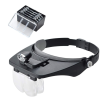
My preference is for something like this:
Screenshot 2026-08-23 at 09.39.28.png
A search for "magnifying goggles", or "magnifying headband", or something along those lines, on Amazon or AliExpress will find countless variations. I have the cheapest one I could find locally - exactly the one in the photo. It was about $9 including same-day shipping. Despite being made from the absolute cheapest kind of plastic you could ever imagine, it does work perfectly. I find that the lowest magnification, which is x1.8, is good enough for everything, including SMD soldering, and is an acceptable compromise in regard to focusing distance.
I love it. It's perfect.
The light is utterly useless, but I don't mind. I have plenty of light on my desk.

I do have a digital microscope that some people use for soldering with good results, an Andonstar AD210, but I find the goggles much better. I find the microscope great for a lot of things, just not for soldering directly under it. But that's just me. Many other people swear by it.
 
Last edited:
Depending on how you like to work, I dislike the head mounted magnification. A nice big (glass ideally) magnifying desk lamp is my go to. The best are the old ones with a florescent ring and an incandescent. Avoid the led ones, the spectrum messes up colors...
 
you asked about a solder practicing board ,check amazon for useful projects that you can really use.
ebay has many tube power amps for assembly and also preamps.
if you are going to build something make sure you can use it, maybe a signal generator or a signal
tracer.
since you want a practice board check the thrift stores that you can work over and not have to worry
as much if it is damaged.
 
Yes, I'm a dumpster diver. There's always something somebody is throwing away, receiver, TV, radio or busted phaser pistol. Unsolder everything and take it apart. Put it together. Experiment with tip size, temperature and dwell time. Use flux. Don't use flux. (rosin only) Play with leaded and lead-free. Try a solder sucker. Try solder wick. Solder on circuit boards. Solder on lugs. Solder plastic wire without making the insulation creep upwards. Take switches and pots apart to see how they're made and see if you can get them back together as good as new.
 
Back
Top Bottom