• The move to the new server is done. There are some software and database maintenance updates in process. This has us passing the hat around to help out. We appreciate any donations. Seriously, even a dollar helps. The payment page may be found here - https://www.audiokarma.org/support.html

I'm afraid I've crossed a line and there's no going back

Mellotronix

Super Member
I'll be brief. I purchased a Grado ME+ mono cart and set it up on my old Project Esprit Carbon turntable with the intent on playing my old and new mono records. The ME+ has about 25 hours of break in time--not quite enough yet, but big improvement since new. I'm especially interested in jazz from the 50's-60's, reissued Stones, Beatles and Beach Boys like pretty much everyone seems to be at the moment.

First--yes, the Project has an AC motor and the Grado will hum, but only very slightly on the inner most part of the record. Usually the stylus hits the runout groove before the hum is noticeable.

Second--this is a very good cartridge. The Project Esprit was my main deck for about a year and I have had four different cartridges on it, so I know how it performs. What I heard from the ME+ was tonal balance, powerful bass, and excellent detail.

As good as I thought the Esprit/ME+ sounded, I was in for a rude awakening. Sides 1-3 of The Beach Boys Smile Sessions are mono. I listened to all of those cool, weird little songs including the gorgeous Surf's Up and Good Vibrations on my mono setup. Very sweet. The $150 was money well spent.

Then I got to Side 4, and since it is in stereo, I played it on my VPI/Grado Statement Master 2/Sutherland KC Vibe setup. Holy sunken ship. The sub was slammin'. The little tweeters on top of the BW705's started dancing. The room opened up and came to life with the sound of Brian Wilson's beautiful imagination.

It must be that it's in stereo, right? Well, no, actually. I turned the record back to Side Three and cued up Good Vibrations in mono on my VPI with its stereo cartridge, and it just sounded better in every possible way you can imagine than it did on my Esprit/ME+ rig.

So, I've decided that I'm going to keep the Project/ME+ for my 50 year old vinyl which has no business underneath a $1000 cartridge, and for a fun diversion in order to remind me how spending $4500 on a deck, cart, and preamp has tangible dividends.

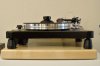
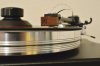
Then, I'm going to purchase a new armwand for my VPI and a low output version of a nice moving iron or moving coil mono cartridge. Pics for your enjoyment.

I'll be brief! Yeah. Sure. Why say something with 10 words when you can use 1000?

_DSC4062.jpg_DSC4074.jpg_DSC4068.jpg_DSC4087.jpg_DSC4097.jpg
 
Last edited:
Register to hide this ad
My dad has a Grado Black 2 stereo cart with a 78 conical stylus playing through a Crown IC150A with panarama control set to center. Its the best I've ever heard 78's.
 
My dad has a Grado Black 2 stereo cart with a 78 conical stylus playing through a Crown IC150A with panarama control set to center. Its the best I've ever heard 78's.

Wow. Great setup! A conical stylus is, of course, the only thing to use with old 78's. For older mono 33 records, a 1 mil conical seems to be the ideal choice in order to keep the needle riding higher in the groove, thus avoiding noise from the bottom of the groove. The current mono microgroove reissues, eg Beatles in mono, use a different spec. They have a narrower groove that is designed to work with . 7mil needles. The idea is that the majority of users will not be using a mono cart to listen to these mono reissues, so the grooves are spec'd to sound good with the current crop of popular stereo carts with .7 mil elliptical diamonds. For true mono playback, a cartridge with a .7 conical or elliptical stylus is best for the current microgroove reissues, but I've read that they sound just as good with 1 mil conical diamonds.

Even so, you have to understand what you are getting when you purchase a true mono cart. My Grado has a .7 elliptical stylus so it's not ideal for my older microgroove records made in the 60's. It may pick up some non-musical noise from the bottom of the groove. But you also have to take into consideration that all record grooves--no matter what the spec is or was--are not created equally, and some have wider or deeper grooves while others have narrower or shallower grooves. There's a bit of variation based on a whole bunch of factors, so it gets slightly murky when deciding on what type of mono cart is best for a particular application.

By the way--I'm going from memory here and I've been wrong with details many times in the past, so .7 mil could actually be .8. I'll have to look it up to be sure.
 
. . . By the way--I'm going from memory here and I've been wrong with details many times in the past, so .7 mil could actually be .8. I'll have to look it up to be sure.
Gramophone magazine once did an article on playing a mixed collection of stereo and mono records. Yes, older mono records had a slightly wider groove, and the best fit stylus size was a 1 mil conical stylus. However, Gramophone found that sizes down to a .5 mil, though riding a bit lower on the groove wall, worked quite well and could give less tracing distortion. For stereo records, .5 mil was considered the best fit, but sizes up to .7 mil worked quite well. Gramophone said that the 1 mil mono stylus rode too high on the groove wall and tracked poorly. The .7 mil size had been pretty much standard for a while and was the size RCA used in modeling tracing characteristics when they developed the Dynagroove system. These days, the .6 mil size seems more common, being used by AT, Sumiko, Nagaoka, and Goldring; Ortofon's OM 1S sports a .7 mil. Sumiko's Black Pearl uses a .5 mil conical, and it worked well for me on all my older mono as well as newer mono and stereo albums.
 
Gramophone magazine once did an article on playing a mixed collection of stereo and mono records. Yes, older mono records had a slightly wider groove, and the best fit stylus size was a 1 mil conical stylus. However, Gramophone found that sizes down to a .5 mil, though riding a bit lower on the groove wall, worked quite well and could give less tracing distortion. For stereo records, .5 mil was considered the best fit, but sizes up to .7 mil worked quite well. Gramophone said that the 1 mil mono stylus rode too high on the groove wall and tracked poorly. The .7 mil size had been pretty much standard for a while and was the size RCA used in modeling tracing characteristics when they developed the Dynagroove system. These days, the .6 mil size seems more common, being used by AT, Sumiko, Nagaoka, and Goldring; Ortofon's OM 1S sports a .7 mil. Sumiko's Black Pearl uses a .5 mil conical, and it worked well for me on all my older mono as well as newer mono and stereo albums.

Great info. Thanks. I'm going to see if I can find that article.
 
Wow. Great setup! A conical stylus is, of course, the only thing to use with old 78's. For older mono 33 records, a 1 mil conical seems to be the ideal choice in order to keep the needle riding higher in the groove, thus avoiding noise from the bottom of the groove. The current mono microgroove reissues, eg Beatles in mono, use a different spec. They have a narrower groove that is designed to work with . 7mil needles. The idea is that the majority of users will not be using a mono cart to listen to these mono reissues, so the grooves are spec'd to sound good with the current crop of popular stereo carts with .7 mil elliptical diamonds. For true mono playback, a cartridge with a .7 conical or elliptical stylus is best for the current microgroove reissues, but I've read that they sound just as good with 1 mil conical diamonds.

Even so, you have to understand what you are getting when you purchase a true mono cart. My Grado has a .7 elliptical stylus so it's not ideal for my older microgroove records made in the 60's. It may pick up some non-musical noise from the bottom of the groove. But you also have to take into consideration that all record grooves--no matter what the spec is or was--are not created equally, and some have wider or deeper grooves while others have narrower or shallower grooves. There's a bit of variation based on a whole bunch of factors, so it gets slightly murky when deciding on what type of mono cart is best for a particular application.

By the way--I'm going from memory here and I've been wrong with details many times in the past, so .7 mil could actually be .8. I'll have to look it up to be sure.

Gramophone magazine once did an article on playing a mixed collection of stereo and mono records. Yes, older mono records had a slightly wider groove, and the best fit stylus size was a 1 mil conical stylus. However, Gramophone found that sizes down to a .5 mil, though riding a bit lower on the groove wall, worked quite well and could give less tracing distortion. For stereo records, .5 mil was considered the best fit, but sizes up to .7 mil worked quite well. Gramophone said that the 1 mil mono stylus rode too high on the groove wall and tracked poorly. The .7 mil size had been pretty much standard for a while and was the size RCA used in modeling tracing characteristics when they developed the Dynagroove system. These days, the .6 mil size seems more common, being used by AT, Sumiko, Nagaoka, and Goldring; Ortofon's OM 1S sports a .7 mil. Sumiko's Black Pearl uses a .5 mil conical, and it worked well for me on all my older mono as well as newer mono and stereo albums.

Vintage mono records have a U-shaped groove. Stereo records - and modern reissues of mono recordings, like the recent Beatles LPs - have V-shaped grooves.
 
Back
Top Bottom