


MrPoetry
New Member
About 30 years ago I had a "Guy" who fixed my MC240, and he built a switch box for the amp (see below pics). Turn on righthand switch: both outlets received power. Once the 150W bulb became fully bright, turn on left switch: bulb turned off, all power to MC240. I took his word that this was good for the amp, and it gave me a switch for the amp which itself has none.
Recently the switch broke internally. I bought a replacement light switch and wired it exactly the same way the old switch had been wired (which is all I know how to do with wiring). The box now doesn't work properly: regardless of switch positions, power is always on for right outlet and always off for left outlet -- i.e. in below photos, which show all three switch combinations, the MC240 is on and the bulb off.
My question is not how to fix this, but rather, should I bother?
I want a switch for the amp. If some kind of in-rush protection is good for the amp and/or tubes, I want that, too. But would the amp & tubes be just as happy with a power strip or some other kind of switch? If so, recommendations welcome. If not, I can ask my electrician to fix the box so it works as it used to. Third possibility: amp does need some on/off protection, but not this kind of set up, in which case, recommendations needed (I myself can't build or mod anything that won't short out).
Here is how the box worked for 30 years:

Both switches are off. Both bulb and amp should be off, but amp is on.
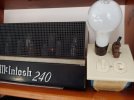
Right switch is on. Both bulb and amp should be on. Amp is, bulb not.

Left and right switch are on. Bulb should be off, amp on. Analogous to a clock that is correct twice a day, the box in this picture is working as it should: bulb off, amp on.
Recently the switch broke internally. I bought a replacement light switch and wired it exactly the same way the old switch had been wired (which is all I know how to do with wiring). The box now doesn't work properly: regardless of switch positions, power is always on for right outlet and always off for left outlet -- i.e. in below photos, which show all three switch combinations, the MC240 is on and the bulb off.
My question is not how to fix this, but rather, should I bother?
I want a switch for the amp. If some kind of in-rush protection is good for the amp and/or tubes, I want that, too. But would the amp & tubes be just as happy with a power strip or some other kind of switch? If so, recommendations welcome. If not, I can ask my electrician to fix the box so it works as it used to. Third possibility: amp does need some on/off protection, but not this kind of set up, in which case, recommendations needed (I myself can't build or mod anything that won't short out).
Here is how the box worked for 30 years:
Both switches are off. Both bulb and amp should be off, but amp is on.
Right switch is on. Both bulb and amp should be on. Amp is, bulb not.
Left and right switch are on. Bulb should be off, amp on. Analogous to a clock that is correct twice a day, the box in this picture is working as it should: bulb off, amp on.


