• The move to the new server is done. There are some software and database maintenance updates in process. This has us passing the hat around to help out. We appreciate any donations. Seriously, even a dollar helps. The payment page may be found here - https://www.audiokarma.org/support.html

Infinity Black Widow Tonearm - Trying to identify

Bigboi33

Dazed and Confused
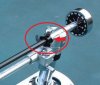
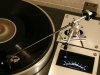
I've got an Infinity Black Widow on hand and I'm trying to figure out what this piece actually is. I hope we have some experts on bored that can identify this part? I checked the manual and it has no mention of this part. It also doesn't show up on very many pics of the tonearm. It seems some have it and some don't. As delicate as this tonearm is. I don't want to futz anything up. Can someone please help me out on this one? :dunno:


Attachments

  • Tonearm.JPG
    Tonearm.JPG
    52.4 KB · Views: 42
  • Tonearm.JPG
    Tonearm.JPG
    52.4 KB · Views: 46
Register to hide this ad
The original had a carbon fiber shaft with that collar and set screw. At least that's what it looks like. The newer ones are made from graphite and don't have that collar. The graphite shaft also has a demarcation in the middle.

black-widow.jpg
 
Last edited:
I've got an Infinity Black Widow on hand and I'm trying to figure out what this piece actually is. I hope we have some experts on bored that can identify this part? I checked the manual and it has no mention of this part. It also doesn't show up on very many pics of the tonearm. It seems some have it and some don't. As delicate as this tonearm is. I don't want to futz anything up. Can someone please help me out on this one? :dunno:
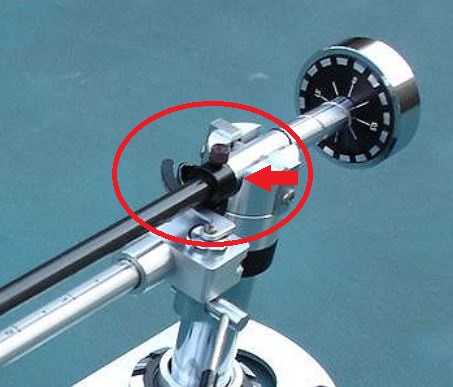

I think I have that same version, a small rod goes through that collar piece and extends down into the oil dampening tray below.
 
The original had a carbon fiber shaft with that collar and set screw. At least that's what it looks like. The newer ones are made from graphite and don't have that collar. The graphite shaft also has a demarcation in the middle.

View attachment 1084912
That appendage is the paddle. It is part of the viscous damping system. There is a trough that is meant to hold a viscous fluid such as silicone . The paddle, which is attached to the arm tube, passes through the fluid in the trough as the arm tracks the record. The viscosity of the fluid causes some minor resistance to the quicker motions of the arm, allowing the cantilever in the cartridge to take greater loadings.
Here are a couple of photos of mine.
DSC_0794.jpg
DSC_0815.jpg

Sorry I don't have a close-up detail of the damping trough. I can say through experience that it is worth putting this to use. In every case where I have had fluid in the trough, the system produced greater bass weight.

-Steve
 
The original had a carbon fiber shaft with that collar and set screw. At least that's what it looks like. The newer ones are made from graphite and don't have that collar. The graphite shaft also has a demarcation in the middle.

View attachment 1084912

In this context, carbon and graphite are the same thing. There may be two different versions, but they're both going to be carbon graphite of some sort. It's most likely a pulltruded rod.
 
Ah I see now. Ok got it! :thumbsup:
Thank you thank you to you all!
I wasn't sure if the dampening trough was an actual trough or if it was for something else.
Is there any particular specification for the dampening fluid? Or will the kind from the RC Hobby Stores work fine?
Really curious to see how things work with a little dampening.
 
It is my understanding that the earliest version of the BW used an aluminum arm tube....and did not receive good reviews. Then came the graphite arm tube.and the reviews got better. I believe Harry Pearson liked it quite a lot. Then later on still, came the graphite arm tube with damping trough system, the last version.

-Steve
 
That appendage is the paddle. It is part of the viscous damping system. There is a trough that is meant to hold a viscous fluid such as silicone . The paddle, which is attached to the arm tube, passes through the fluid in the trough as the arm tracks the record. The viscosity of the fluid causes some minor resistance to the quicker motions of the arm, allowing the cantilever in the cartridge to take greater loadings.
Here are a couple of photos of mine.
DSC_0794.jpg
DSC_0815.jpg

Sorry I don't have a close-up detail of the damping trough. I can say through experience that it is worth putting this to use. In every case where I have had fluid in the trough, the system produced greater bass weight.

-Steve
Thanks for the clarification. I never realized there was a trough for dampening fluid.
 
Last edited:
It is my understanding that the earliest version of the BW used an aluminum arm tube....and did not receive good reviews. Then came the graphite arm tube.and the reviews got better. I believe Harry Pearson liked it quite a lot. Then later on still, came the graphite arm tube with damping trough system, the last version.

-Steve

Carbon composite, being a mixture of stiff ceramic and soft (relative to the carbon) resin has some inherent advantages from a resonance standpoint. It's actually quite interesting to me that it can be made both very stiff and "dead" as well as resonant depending on construction techniques and specific choices of fiber/resin, the ratio between the two, and geometry. Carbon fiber road bikes are known to have a "floaty" feel to them because the frame naturally damps out a lot of the road vibration coming through the tires. The Boeing dreamliner and it's Airbus equivalent the A350 are significantly quieter than aluminum aircraft. Meanwhile, carbon fiber cellos are often said to be the best sounding cellos under $10k or so. In that application you want and need resonance for good tone and volume.

It's one of my personal favorite materials to design with as well. :)
 
Ah I see now. Ok got it! :thumbsup:
Thank you thank you to you all!
I wasn't sure if the dampening trough was an actual trough or if it was for something else.
Is there any particular specification for the dampening fluid? Or will the kind from the RC Hobby Stores work fine?
Really curious to see how things work with a little dampening.
I have no info on any factory specified damping fluid. I have used an automotive differential lube with good enough results. As to trying different silicone fluids as used in RC racer suspensions, I guess it is possible to go too thick and sticky, but I would not know where that limit might be. It could be fun to experiment.
-Steve
 
Carbon composite, being a mixture of stiff ceramic and soft (relative to the carbon) resin has some inherent advantages from a resonance standpoint. It's actually quite interesting to me that it can be made both very stiff and "dead" as well as resonant depending on construction techniques and specific choices of fiber/resin, the ratio between the two, and geometry. Carbon fiber road bikes are known to have a "floaty" feel to them because the frame naturally damps out a lot of the road vibration coming through the tires. The Boeing dreamliner and it's Airbus equivalent the A350 are significantly quieter than aluminum aircraft. Meanwhile, carbon fiber cellos are often said to be the best sounding cellos under $10k or so. In that application you want and need resonance for good tone and volume.

It's one of my personal favorite materials to design with as well. :)
I'm happy to take your info on that. Historically, the actual graphite rod used in the arm isn't specified afik. Some have speculated that it may have more in common with a graphite fly fishing rod than anything more tech-y. But that is just un-referenced heresay.
So far I've tried three different cartridges. The first two were obvious choices, ADC XLM-II and a Sonus Blue. Those worked well, and if you like the sound of ADC cartridges, this could be nirvana. I also tried it with a Technics EP205C-II. I wrote a review of that here..
http://www.theanalogdept.com/epc205cmk2.htm
Even though the Technics cartridge was less compliant than the previous two, I preferred that cartridge in this arm to the others. It was more 'meaty' sounding and had significantly greater bass weight. And the damping trough helped to improve that. At a later time I may experiment with different silicone fluids in that damping trough to find out where the limits of viscosity are.

Anyway, the BW is one of those classic tonearms that stand apart from everything else, in a good way. The limits being the amount of mass the arm can counterbalance and the level of cartridge compliance it can deal with.

-Steve
 
I have no info on any factory specified damping fluid. I have used an automotive differential lube with good enough results. As to trying different silicone fluids as used in RC racer suspensions, I guess it is possible to go too thick and sticky, but I would not know where that limit might be. It could be fun to experiment.
-Steve

I think most people use the RC Shock fluid. Something like 30,000 or 50,000 CST if I remember right.

EDIT: The KAB damper for the SL-1200mkII uses 60,000 CST fluid. I might try somethng a bit lighter for the Black Widow simply because it's a more delicate, lighter tracking arm and you're likely to be using more compliant carts on it than you'd use on the SL-1200mkII.
 
It is my understanding that the earliest version of the BW used an aluminum arm tube....and did not receive good reviews. Then came the graphite arm tube.and the reviews got better. I believe Harry Pearson liked it quite a lot. Then later on still, came the graphite arm tube with damping trough system, the last version.

-Steve
Au contrare. The first version got a rave from Absolute Sound, "Thank you (Arnold Nudell) for the gift of fine music", iirc. The one piece graphite was supposed to be better, but other than the included damper, I don't know how much or if the average user could find a dime's difference between them.
 
Thanks Nate,

I'm gonna check out the hobby shop this weekend. I'll more than likely pickup 30,000 CST and see how that works out. Then move my way up.
So far, it sounds great with a Grado Gold on my buddy's Thorens125mkII. Almost better than on my ARXB.
 

For the record, I just looked up another common damping system and checked what CST it uses. It's totally possible that the designs are so different that 10x lighter weight fluid is the right choice.

I think you both might be right. I was able to get word back from an old friend who has a bit of experience. He said he wasn't sure but that I should start of light do to the very light weight of the tonearm. Our local hobby store sells them at different weights for pretty cheap something like $7 a bottle. So I may try at the least 3 different weights.
 
I recall there being some question regarding different viscosity measurements being used in early silicon
arms versus todays available products.

Example being the SME 200 kit was it not described as 200,000 something?
This was used on both the light 5 gram eff series III's and other 3009's
 
Au contrare. The first version got a rave from Absolute Sound, "Thank you (Arnold Nudell) for the gift of fine music", iirc. The one piece graphite was supposed to be better, but other than the included damper, I don't know how much or if the average user could find a dime's difference between them.
As I type this I have next to me a copy of The Absolute Sound, Volume 3, number 9 - Spring 1977.
Page 51. First Paragraph which I quote:
"I don't think I shall waste your time and my time discussing the first version of the Infinity tonearm that was mentioned prematurely in Issue 8. At that time I (and the rest of the staff) was led to believe that this was the final version of The Black Widow--which is why we referred to it.
This tonearm is striking in its appearance. It is extremely simple. It is extremely slender, it is black with a very small carbon-fiber cartridge mount. It has an elegantly simple, yet convenient to use, antiskate mechanism. More on this later......'
The author went by the moniker PHD.

In that issue the arm described had the graphite arm tube but did not have the damping trough. It was a rave review. HP posted some follow-up comments that also gave the arm high praise. That, so far, is the best reference I have. Does anyone else have some vintage copies of TAS to scan through? Like volume 3, number 8? While memory can be tricky I do recall reading somewhere (I can't remember where) that the first version featured an aluminum arm tube. And I'll stick with that until I can find a better reference that either contradicts or supports my assertion here.

While I don't have a copy of Issue 8 which the author refers to as 'premature' I can presume it refers to the first version of the BW arm that they saw. Elsewhere in an interview with Arnie Nudel and Stereophile writer David Lander, the BW does get some disscussion, but it won't tell us what we would like to know in this thread.

https://www.stereophile.com/content/arnie-nudell-here-infinity-page-2

Anyway, it's a really cool tonearm or we would not be discussing it here and now in 2018.

-Steve
 
My vintage TAS have vanished. I bought the telescoped alu tubing version based on TAS rave reviews, and later, the GF version, which tho' not here I still own. They resided on a Kenny KD-550 (what else?). The guy I loaned it to has a KD-500.
 
Back
Top Bottom