• The move to the new server is done. There are some software and database maintenance updates in process. This has us passing the hat around to help out. We appreciate any donations. Seriously, even a dollar helps. The payment page may be found here - https://www.audiokarma.org/support.html

Infinity Reference Six Crossover Cap Questions

drp1003

Well-Known Member
Hello,

I want to replace the bi-polar electrolytic capacitors on the crossover network of one REFERENCE SIX speaker. Then test the results against the other speaker. And proceed with rebuilding both crossover networks if everything sounds good.

There are five caps:

125uf 100vdc (woofer)
7uf 100vdc (tweeter)
55uf 100vdc (midwoofer and I think midrange as well)
75uf 100vdc (midrange only)
12.5uf 100vdc (in parallel with the midwoofer)

I reverse engineered the circuit, made a sketch on paper, and the weird thing about this crossover is that the midrange and the midbass drivers share electrical components in a very strange and an almost seemingly impossible way.

The woofer and the tweeter crossover designs are straightforward.

There are two diodes in parallel with the tweeter:

1N-5343

The caps are RADIAL - both legs sticking out one end. And the diodes are axial.

I'm thinking about replacing the diodes (Yes? No?)

Can anyone with knowledge of Infinity speakers recommend film capacitor replacements? I don't want to buy gigantic axial poly caps that will never fit right in the first place. Just a nice similarly sized radial film capacitor will do for each. If I have to, I'll use similar radial electrolytic caps like Nichicon MUSE, but film would be better and last longer, or forever.

Also, there is a fuse on the tweeter: CULVER 1A-30. What's the deal with that thing? Keep? Replace? Something else?

UPDATE 9-20-20: ADDED SCHEMATIC

Thanks!
 

Attachments

  • 0919202026[1].jpg
    0919202026[1].jpg
    82.2 KB · Views: 116
  • 0920201057[1].jpg
    0920201057[1].jpg
    49.5 KB · Views: 111
Last edited:
Register to hide this ad
Hello again,

First off, finding BI-POLAR capacitors with the exact same capacitance as the original caps in any type of BI-POLAR capacitor, whether it was film, poly, or electrolytic, was pretty much out of the question. They just do not exist.

Finding small film or poly capacitors with a 100 volt rating was not even close to being possible either; for example, those small red caps from WIMA or those PANASONIC film caps just do not exist in a 100 volt rating.

In order for the new caps to fit, they had to be RADIAL like the original ones; so those big boutique axial poly caps like from SOLEN or wherever were out of the question since they're AXIAL, and just way too BIG to begin with!

In order for this project to be anywhere near successful, then, I needed capacitors that were small, radial, bipolar, and be able to handle 100 volts, just like the original ones.

So my options were limited but not impossible to find. I ended up buying NICHICON UVP ALUMINUM ELECTROLYTIC BI-POLAR capacitors. Nichicon UVP capacitors are used in "ENTERTAINMENT ELECTRONICS"

I wanted to use NICHICON UES (MUSE) bi-polar caps, but they only go up to 50 volts!
I wanted to use the NICHICON UDB bi-polar caps (for use in speaker crossovers), but they only go up to 50 volts as well!

The UVP series goes up to 100 volts! Hurray!

Like I stated earlier, I could not find caps with the exact same capacitance values as the originals, so I had to buy two different caps with two different capacitance values that added up to the same value as the original caps. Whoo! Got it !?!?!


100uf + 22uf = 122uf (which is very close to 125uf!)
4.7uf + 2.2uf = 6.9uf (which is very close to 7uf!)
10uf + 2.2uf = 12.2uf (which is very close to 12.5uf!)
47uf + 10uf = 57uf (which is very close to 55uf!)
47uf + 33uf = 80uf (which is kinda close to 75uf!)

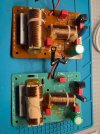
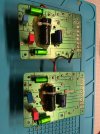
I soldered the biggest of the two caps to the top of the PCB, and the smaller one to the bottom of the PCB right below it using the same two holes. They are soldered in parallel, which means that you add the capacitance together

I have not tested this thing yet. I have to give it back to the guy who owns the speakers, and he's gonna do all the listening and testing.

I won't know for a while if it'll sound good or not. I'll post the results soon!

PS - I replaced the two diodes with new ones as well...

UPDATE 9/24/2020: I added a pdf download of the NICHICON UVP series capacitors.
 

Attachments

  • 0923201451a[1].jpg
    0923201451a[1].jpg
    67.6 KB · Views: 90
  • 0923201452[1].jpg
    0923201452[1].jpg
    78.1 KB · Views: 89
  • e-uvp.pdf
    e-uvp.pdf
    634.8 KB · Views: 35
Last edited:
You can find the Technical Sheet on HiFi Engine.

https://www.hifiengine.com/manual_library/infinity/reference-six.shtml


You will have to create an account in order to download the pdf.

The Culver “fuse” is a polyswitch. Basically a self-resetting circuit breaker. Some will suggest to just bypass it. New ones can be acquired through Parts Express and probably some other places as well.

Poly caps for the upper midrange and tweeter would be an upgrade but, personally, I wouldn’t waste the extra money using them for the mid-bass and woofer.

If the Ref Sixes respond to fresh/upgraded caps like other Infinitys I’ve recapped, you should notice a better balance between the bass/mid-bass and the upper range. Infinity must not have thought as highly of these as they did most of their other series from the earlier years. No yellow poly caps for the upper mid and tweeter.
 
You can find the Technical Sheet on HiFi Engine.
https://www.hifiengine.com/manual_library/infinity/reference-six.shtml

You will have to create an account in order to download the pdf.

The Culver “fuse” is a polyswitch. Basically a self-resetting circuit breaker. Some will suggest to just bypass it. New ones can be acquired through Parts Express and probably some other places as well.

Poly caps for the upper midrange and tweeter would be an upgrade but, personally, I wouldn’t waste the extra money using them for the mid-bass and woofer.

If the Ref Sixes respond to fresh/upgraded caps like other Infinitys I’ve recapped, you should notice a better balance between the bass/mid-bass and the upper range. Infinity must not have thought as highly of these as they did most of their other series from the earlier years. No yellow poly caps for the upper mid and tweeter.
I looked up those WIMA MKS2 capacitors, and found something that might work. The red ones that everyone uses for output capacitors. Unfortunately they were MAX rated at 50 volts. Which is half of what's needed, but since it's the tweeter, I thought about getting one anyway, a 6.8uf, but ultimately passed. Oh well...
 
I’ve been using the Mundorf AC e-caps for replacing the electrolytics in the Kappas and RS models I’ve done. I’ve been pretty happy with the results so far. I use the 63v ones even though the caps that were replaced were 100v. I suspect 100v caps may have been used because that was what was available at the time. If you do the math, at full power to the speakers, they should never see anything close to 100v let alone 63v.

All the upper model Infinitys used the famous yellow poly caps which many say is part of the “Infinity sound”.
 
Hello,
i got a pair of Reference Six a few months ago and recapped the crossovers.
The drivers were already refoamed.
The speakers sounds fantastic.
Chris
 

Attachments

  • IMG_4152.jpeg
    IMG_4152.jpeg
    251 KB · Views: 14
  • IMG_4149.jpeg
    IMG_4149.jpeg
    245.1 KB · Views: 14
The original values:

C1 6.0 uf non-polarized electrolytic
C2
53.0 uf non-polarized electrolytic
C3
12.5 uf non-polarized electrolytic
C4
75.0 uf non-polarized electrolytic
C5
125.0 uf non-polarized electrolytic


The closest that I can come up with today are as follows:

C1 UVP2A4R7MED 4.7uf
UVP2A010MDD 1.0uf

C1
UVP2A4R7MED 4.7uf
UVP2A2R2MED 2.2uf

C2
UVP2A220MPD 22.0 uf
UVP2A330MHD 33.0 uf

C2
UVP2A100MPD 10 uf
UVP2A470MHD 47 uf

C3
UVP2A100MPD 10 uf
UVP2A2R2MED 2.2uf

C3
UVP2A100MPD 10 uf
UVP2A3R3MED 3.3 uf

C4
UVP2A470MHD 47 uf
UVP2A330MHD 33.0 uf

C4
UVP2A470MHD 47 uf
UVP2A220MPD 22.0 uf

C5
UVP2A101MHD 100.0 uf
UVP2A220MPD 22.0 uf


Which combination of values will be the best choice?
I cannot find any poly caps that are even close, any suggestions for upgraded caps?
 
Last edited:
I am reading that generally only the tweeter and midrange capacitors really benefit from an upgrade to polypropylene capacitors. I am considering Dayton Audio, Solen, Audyn, or Jantzen for the tweeter and midrange, and standard NPE's for the woofer and midbass. These would be used to rebuild the crossovers in Infinity Reference Six's, in which the midrange and midbass are wired strange. Would polypropylene capacitors be of any real benefit for the midbass? C1 is for the tweeter, C5 is for the wooder, C2-C3-C4 are for the midrange and midbass. I am not good with this stuff and could use help with which of C2-C3-C4 can be polypropylence and which can be standard NPE's..
 

Attachments

I am reading that generally only the tweeter and midrange capacitors really benefit from an upgrade to polypropylene capacitors. I am considering Dayton Audio, Solen, Audyn, or Jantzen for the tweeter and midrange, and standard NPE's for the woofer and midbass. These would be used to rebuild the crossovers in Infinity Reference Six's, in which the midrange and midbass are wired strange. Would polypropylene capacitors be of any real benefit for the midbass? C1 is for the tweeter, C5 is for the wooder, C2-C3-C4 are for the midrange and midbass. I am not good with this stuff and could use help with which of C2-C3-C4 can be polypropylence and which can be standard NPE's..

Given the "Reference X" series is at the lower end of the Infinity scale I personally wouldn't invest the money it would take to do poly caps for C2-5. High value poly caps(even "budget" ones) will add up fast dollar wise. I would do a poly upgrade to C1 as the value isn't too bad. For C2-5 I would suggest stepping up to Mundorf NPE's. A little more expensive than most others but definitely an upgrade. I've used them in many Infinity recaps and very happy with the results. You may also want to look at L2, L3. If they are iron or ferrite core you could replace them with air core inductors if the cost is acceptable.
 
It really depends on how far you want to take things, and how evolved the rest of the system. My view is that all drivers will benefit from good caps, but the woofer values become expensive (and large), so it's very common to let them slide. I'm not sure where the crossover points are for these, but if the woofers are participating in the vocal range, it very well could be audible. You could go part way and add some poly bypass caps to a good electrolytic to hit the final value.

If upgrading caps, I also like to upgrade the resistors to a non-inductive type. Just another small thing that helps clear up minor smearing.

I agree with choosing air core inductors over the iron core....just be mindful that the DC resistance doesn't very a ton. Yet another small step forward.

Sorry, no clue about the diodes...never used them or heard of them in a speaker crossover.
 
I use ALCAP products when recapping crossovers with odd sizes. This brand used in original KEF 104/2 crossovers. It’s also what I used to restore them. The sound was staggering..just beautiful.
 

Attachments

  • IMG_1965.jpeg
    IMG_1965.jpeg
    146 KB · Views: 3
If upgrading caps, I also like to upgrade the resistors to a non-inductive type. Just another small thing that helps clear up minor smearing.

I agree with choosing air core inductors over the iron core....just be mindful that the DC resistance doesn't very a ton. Yet another small step forward.

Sorry, no clue about the diodes...never used them or heard of them in a speaker crossover.
Does this resistor fit the bill?
These speakers have 2 zener diodes, thinking of replacing them too.
 
Given the "Reference X" series is at the lower end of the Infinity scale I personally wouldn't invest the money it would take to do poly caps for C2-5. High value poly caps(even "budget" ones) will add up fast dollar wise. I would do a poly upgrade to C1 as the value isn't too bad. For C2-5 I would suggest stepping up to Mundorf NPE's. A little more expensive than most others but definitely an upgrade. I've used them in many Infinity recaps and very happy with the results. You may also want to look at L2, L3. If they are iron or ferrite core you could replace them with air core inductors if the cost is acceptable.
I really wanted to have polypropylene capacitors for the tweeter and midrange, but there are almost nothing available that matches the original values, most would require
2 parallel capacitors to achieve, and with poly the sizes become an issue. So I think I will follow your advice and get a Polypropylene for C1 only, good axial NPE's are much smaller than polypropylene so size would be less of an issue, and still be an upgrade. Also cannot find any inductors that match so will probably leave them alone.
But thinking about replacing the resistor and the zeners.
 
For C2-5 I would suggest stepping up to Mundorf NPE's. A little more expensive than most others but definitely an upgrade. I've used them in many Infinity recaps and very happy with the results.
Is there a source in the US for these? Everything I have found is in the EU.
 
Is there a source in the US for these? Everything I have found is in the EU.
SoniCraft and Parts Connexion carry the Mundorfs, both NPEs and different lines of poly caps. I purchased mainly from Parts Connexion but their NPE selection for Mundorf has shrunk. SoniCraft seems to have more selection with regards to lower values.
 
Does this resistor fit the bill?
These speakers have 2 zener diodes, thinking of replacing them too.

You bet!
 
Original crossover capacitors:

C1 6.0 uf non-polarized electrolytic (20% tolerance)
C2 53.0 uf non-polarized electrolytic (20% tolerance)
C3 12.5 uf non-polarized electrolytic (20% tolerance)
C4 75.0 uf non-polarized electrolytic (20% tolerance)
C5 125.0 uf non-polarized electrolytic (20% tolerance)


I decided to go with the following capacitors:

C1 6.0uf Solen non-polarized polypropylene (5% tolerance)
C2 47.0uf+5.6uf= 52.6uf Jantzen non-polarized electrolytic (5% tolerance)
C3 5.6uf+6.8uf=12.4uf Jantzen non-polarized electrolytic (5% tolerance)
C4 68.0uf+6.8uf=74.8uf Jantzen non-polarized electrolytic (5% tolerance)
C5 125.0uf Parts Express non-polarized electrolytic (10% tolerance)

These are a step up from the original capacitors in quality and tolerance, and the values are very close to or the same as the original values.

This upgrade should achieve a noticable audio improvement.
 
Back
Top Bottom