• The move to the new server is done. There are some software and database maintenance updates in process. This has us passing the hat around to help out. We appreciate any donations. Seriously, even a dollar helps. The payment page may be found here - https://www.audiokarma.org/support.html

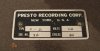
Info. on a Presto Disc Recorder Type 8-R, please?

Superscoper

Active Member
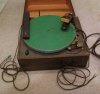
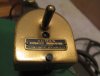
I wasn't sure where I should post about this nifty old thing. it's non-working and missing parts, but had powered on at one point a decade ago. I can't restore it myself, but It's a really beautiful thing from a bygone era and a part of history I should think. It should be preserved, eh?.

Thanks to mfrench for his gracious help. :)

IMG_4105.JPG IMG_4106.JPG IMG_4108.JPG IMG_4109.JPG IMG_1855.JPG IMG_1856.JPG

I've had it since around 2001. At that time, I tried to research it, but found very little. I did find a gentleman in Oregon via newsgroups and emails who said he'd never seen one like it, but that it seemed to be a Police or Military version from the late 1940s because of the heavy walnut case and lack of decoration.

Any ideas?

I took a lot of photos, so you can see the rest here: http://imgur.com/a/9ccN0#0

BTW, that faded little paper tag in the gallery reads: Z = 15 Ω
 
Last edited:
Register to hide this ad
Thanks for posting!

Its a rim drive, like I thought; but as suggested in PM's, they made so many different drive line variations, its hard to know. The drive wheel might have just worn to a point of no contact between the drive and rim.
I'm quite curious about that gearing on the platter bearing housing and the platter bearing spindle. I'd love to see under the entire deck to see if that gearing had any connection to the tonearm?!
I've seen other Prestos that have a rubber-like, neoprene-like "padding" around the rim of the platter. I was looking for that on this one, but didn't see any sign of it; something like a machined groove, or recess below the platter top side edge. But maybe this one just drove from the smaller pulley under the cover, directly on the edge of the platter? Trying to get a platter perimeter retread would be a more difficult task than getting that smaller pulley retread.
Is there any sort of movement that allows for the motor to move in and out away from the platter, to disengage?
 
Last edited:
Thanks for posting!

Its a rim drive, like I thought; but as suggested in PM's, they made so many different drive line variations, its hard to know. The drive wheel might have just worn to a point of no contact between the drive and rim.
I'm quite curious about that gearing on the platter bearing housing and the platter.
I've seen other Prestos that have a rubber-like, neoprene-like "padding" around the rim of the platter. I was looking for that on this one, but didn't see any sign of it; something like a machined groove, or recess below the platter top side edge. But maybe this one just drove from the smaller pulley under the cover, directly on the edge of the platter? Trying to get a platter perimeter retread would be a more difficult task than getting that smaller pulley retread.
Is there any sort of movement that allows for the motor to move in and out away from the platter, to disengage?


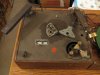
This pic shows what I assume is the speed and/or disengage things, that does indeed have a rubbery roller..still rolls.

When I moved the lever to a different position, I was able to lift off the platter off. Seems that the platter screws into that threaded hole part in the center of the table?

It's weirdness man...like a R2R mated with a Phonograph. ;)

mTseGKol.jpg


dfh0teml.jpg


That lever seems to move the motor around some while changing the roller, but I don't know if that is intended.

Weirder still...no markings or indicators on anything. Maybe someone broke their case and built that case by hand to house the beasty? 1940's DIY or such?

So many little brass screws...I'm hesitant to try to disassemble it more. I don't want to plug it in either as who knows what is going on in there...and what are those wires for? I assume one might be speaker but those battery-cable looking things...???

It's in amazing shape really for it's age: grease still smells like grease, nearly everything is brass or that crinkle paint that lasts forever. The copper windings in the motor gleam.
 
Last edited:
Oh hey, this looks close....except it's more confusion :D

JrModel.JPG

The J5 or "Junior" model.


Then, there is this one...

ModelM.JPG

Model M (Portable??) This is a unique model, consisting of 2 J5 turntables and an amplifier with
two mike inputs and ability to switch to either cutter for continuous recording. There were also
versions of this model made for the Goverment and Police agencies which consisted of some
models running at 12 rpm and 16 rpm for long recording time (as vs 78 rpm.)
These were used mostly in recording interviews, telephone conversations, survelience, and so on.
Some models had automatic relays for starting the next record when the side was full -
the operator just had to change blanks and re-set the recording head. This was an ideal recorder for
small studios which did on location recording. This model is dated abut 1935 or 1936. The model M
was in the catalog for a short period of time.

Source: http://www.prestohistory.com/Presto2.html
 
Last edited:
I absolutely adore that dual TT portable recorder, and have for a long time.
That is my area of specialty in this wide world of audio; remote field recording, with portable gear. We're now down to four channel recorders that are about the size of a VHS tape. I can't imagine hauling that dual TT beast around, and all of its media, but I still love it for what it is.

And, yes, that is the same deck as yours.
There used to be a very informative site regarding the history of Presto Recording Corp.; Telvar or something similar to that. But sadly, it became vapor on the web a year or two ago.
 
Last edited:
If you are interested in Presto Recorders you must see this movie about the 78 Project. These folks have a Presto that they have hauled around the country recording various musicians in their homes, and they have made a movie about it. I saw them present the movie in New Orleans, and then they recorded a 78 with some musician friends of mine. There is a scene in the movie where they visit someone who is an expert on Presto repairs; I am sure the producers could give his info if you contact them through their web page.
 
While neat in concept, they failed miserly in its production (the first record).
To me, it sounds like they got a Presto off of eBay, and did nothing as far as maintenance to it. You can hear flat spots in the drive mechanism, brickwalling of the mic preamp. I doubt that they even lubed the bearing. I was ultimately disappointed by their effort, and didn't buy the second disc, and wouldn't recommend the first one to anybody.
 
I absolutely adore that dual TT portable recorder, and have for a long time.
That is my area of specialty in this wide world of audio; remote field recording, with portable gear. We're now down to four channel recorders that are about the size of a VHS tape. I can't imagine hauling that dual TT beast around, and all of its media, but I still love it for what it is.

And, yes, that is the same deck as yours.
There used to be a very informative site regarding the history of Presto Recording Corp.; Telvar or something similar to that. But sadly, it became vapor on the web a year or two ago.

Yeah, I've been searching for info, it's out there but it's hard to find.

Found this tidbit:

The Presto disc recorder helped to bring about the widespread use of recorded material in the news media. On May 6, 1937, a Presto recorder being field-tested by a Chicago radio station inadvertently captured the Hindenberg disaster. The resulting report was so compelling that the National Broadcasting Company waived its rule prohibiting the use of recorded materials (except for sound effects) and aired the report on 144 stations.

The devices recorded at 33-1/3 and 78 rpm and produced discs that ranged in size from six to sixteen inches in diameter. The discs were coated with an acetate lacquer and had a core base, which could be made from either glass or aluminum. They usually had three holes, which helped to secure the record to the turntable and reduce slippage. Needles were made from various materials including brass and steel.

Source: http://memory.loc.gov/ammem/afcphhtml/afcphsp1.html

That explains those three holes around the platter center. Only one of the original screws left, but now I know why they were there. =)

I remember that Telvar site from my searches in 2001, can't remember the exact URL or I'd hit it up on archive.org. I'll find it....nothing on the 'Net really goes away. ;)
 
If you are interested in Presto Recorders you must see this movie about the 78 Project. These folks have a Presto that they have hauled around the country recording various musicians in their homes, and they have made a movie about it. I saw them present the movie in New Orleans, and then they recorded a 78 with some musician friends of mine. There is a scene in the movie where they visit someone who is an expert on Presto repairs; I am sure the producers could give his info if you contact them through their web page.

Thanks, I've been to that site before, lots of stuff but it's a PITA to find specific things. I did all this searching 15yrs ago...wish I had all that info still. :(
 
I absolutely adore that dual TT portable recorder, and have for a long time.
That is my area of specialty in this wide world of audio; remote field recording, with portable gear.

I am searching the Library of Congress, fun stuff.
http://www.loc.gov/search/?in=&q=presto+phonograph+recorder&new=true&st=

You might like this:

Southern Mosaic - The John and Ruby Lomax 1939 Southern States Recording Trip

http://www.loc.gov/loc/lcib/9908/lomax.html

http://www.loc.gov/item/lomaxbib000855/


Some nifty links here, many DOA though: http://edisontinfoil.com/phonolinks.htm
 
Back
Top Bottom