• The move to the new server is done. There are some software and database maintenance updates in process. This has us passing the hat around to help out. We appreciate any donations. Seriously, even a dollar helps. The payment page may be found here - https://www.audiokarma.org/support.html

Install connectors to avoid (de)soldering?

Sergimm

Active Member
I’m restoring a vintage amplifier, and the current board I want to work on (the tone board) has a lot of cables coming from diverse knobs and switches directly wired to pins on the board. It would be a ton of work to desolder all those pins and then solder them again, and in my experience desoldering pins is trickier than doing it on normal components.

I am thinking of cutting all those cables in the middle to be able to extract the board, and then adding connectors like this to make it more convenient in the future (and not having to torture the pcb to all the soldering): https://www.amazon.es/dp/B07GXN2521/ref=cm_sw_r_cp_api_fabc_xlWPFbC8WXWZD?_encoding=UTF8&psc=1

Is this a good idea at all? What are the cons of doing something like that?
 
Register to hide this ad
Many times the board can be moved enough while still connected to effect repairs or updates. Have an 828 here that was recapped by cutting all the wires going to wire wraps and then resoldering them. I have removed most of the boards still soldered in place to make repairs.

Usually just unsoldering the pin isn't too hard. Are you sure that work is more than installing a few connectors?
 
I always think in the less invasive or destructive intervention. And in some units, the less invasive is to cut a wire and then solder it again, (never thought about installing a connector).

I usually start to work on a board without cutting or desoldering wires, and once I start moving the board, I desolder only the wires that are stopping the needed movements. A few times I had to cut a wire instead of desolder it from the PCB, but I don't hesitate of doing a clean cut and soldering again later. Many times it's easier and less invasive than deep disassembling a chassis to access to some hidden corner. Some people like to deep disassemble the units, taking apart every board and everything. Not me. I completely remove a board only when needed.

Desoldering pins, if you have access to the solder side, it's usually quite easy, melting the solder and pulling with some nose pliers from the pin.
 
Last edited:
....
......What are the cons of doing something like that?

Introduction of new, and unnecessary, contact points that will work fine for a while, but will eventually develop corrosion to some degree, perhaps minor, perhaps not. It is why every serious restore effort should include comprehensive contact cleaning. And it is why switches, pots, and other contacts are the most troublesome parts of vintage equipment. Corrosion from air born contaminants, oxidation, etc. like rust, it never sleeps.
 
Add to that, not only the introduction of connectors, but also (looking at the Amazon link) extra cable length - which is also a bad idea.
 
agree with trying to work around the wiring. I've done a few things with wire wrap and most of the time the boards can be moved enough to allow component replacement without disconnecting things. If you do have to disconnect things, remove as few wires as possible to allow the board to be accessed.
 
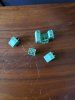
I've used connectors on several builds. The screw type work very well. I don't really like the plug in connectors. Just soldered them to the PCB and connect the wires. They come in singles as well.
20201110_094320.jpg
 
It seems to me that just removing the wires from one end and reattaching after you do your work might be less time consuming than adding connectors. Connectors are useful when you need to disconnect. You may never use the connector after this restoration.
 
What about unwrapping and re-wrapping the wire from the pin? There are tools that do this. I am thinking of getting one before I dive into an SX-626 which is loaded with wire wrap connections to PC boards. Has anyone had any experience with doing this? If it works, I would think this is less invasive than desoldering/resoldering pins, and certainly less invasive than cutting wires. In agreement with above posts, I would only do this where necessary to get access that is otherwise not possible.
 
What about unwrapping and re-wrapping the wire from the pin? There are tools that do this. I am thinking of getting one before I dive into an SX-626 which is loaded with wire wrap connections to PC boards. Has anyone had any experience with doing this? If it works, I would think this is less invasive than desoldering/resoldering pins, and certainly less invasive than cutting wires. In agreement with above posts, I would only do this where necessary to get access that is otherwise not possible.
I have used this tool with some success (https://www.amazon.com/gp/product/B07DFL5RQR/ref=ppx_yo_dt_b_asin_title_o00_s00?ie=UTF8&psc=1). It generally does a good job unwrapping wire wraps but using it to re-wrap is much more hit and miss. Wire used in the vintage equipment I have worked on is often very brittle and many times breaks when unwrapped. It is also difficult to straighten the wire enough after it is unwrapped to work with the tool to rewrap. When it does work you still have to solder the connection in order to make sure you get the best contact.
 
Thanks. I will practice different techniques on a spare board, and report back (probably in a few weeks).
 
What about unwrapping and re-wrapping the wire from the pin? There are tools that do this. I am thinking of getting one before I dive into an SX-626 which is loaded with wire wrap connections to PC boards. Has anyone had any experience with doing this? If it works, I would think this is less invasive than desoldering/resoldering pins, and certainly less invasive than cutting wires. In agreement with above posts, I would only do this where necessary to get access that is otherwise not possible.
Although I have not tried it myself, unsoldering the entire wire wrap pin seems to be a good soloution
 
There ya go ... unsolder the pins if you can, but keep in mind you're dealing with more mass for the iron to handle. More mass = more heat = more OMG WHAT JUST HAPPENED !! when the board falls apart.

Also keep in mind this is something you'll probably only have to do once, so modifying original connections that lasted decades seems a bit overkill, eh.
 
If a wire is cut, then resoldered together with some shrink wrap, or even liquid tape, it should be as good as it originally was.
 
I have used this tool with some success (https://www.amazon.com/gp/product/B07DFL5RQR/ref=ppx_yo_dt_b_asin_title_o00_s00?ie=UTF8&psc=1). It generally does a good job unwrapping wire wraps but using it to re-wrap is much more hit and miss. Wire used in the vintage equipment I have worked on is often very brittle and many times breaks when unwrapped. It is also difficult to straighten the wire enough after it is unwrapped to work with the tool to rewrap. When it does work you still have to solder the connection in order to make sure you get the best contact.
I have a couple of these types that I have owned for over 25 years. We used to use them connecting T1 circuits to remote cell sites. It’s best to strip fresh wire back instead of using the unwrapped wire. It often breaks. Sometimes, you don’t have a choice though. It says it’s for 22ga wire, but you can fit a slightly larger wire in there, but not much larger. The unwrap side will work well on wires much larger. The gun type wrap tools work well, but can be tough when using thicker wire. We had an electric one at our main switching office. The old phone company guys would talk about using one of those and were expected to make 1200 wraps a day. Wire wrap is almost non-existent in wireless installations now- all fiber and ethernet. Sometimes, dry contact switches for local alarm reporting ( open door, hi temp, etc) will be tied to a wire wrap panel.
 
Back
Top Bottom