• The move to the new server is done. There are some software and database maintenance updates in process. This has us passing the hat around to help out. We appreciate any donations. Seriously, even a dollar helps. The payment page may be found here - https://www.audiokarma.org/support.html

Interconnects

What interconnect should I use?


  • Total voters
    23
  • Poll closed .
I've had a good experience with CullenCable,
I actually heard what appeared to be an audible improvement ,
With each Cable change ( PC, IC's, Speaker )..
I replaced the whole Loom with his "Crossover" line of cables ( Affordable)..
He will listen to your needs and budget and you get the lengths, Ends, Metals, that work for your system..
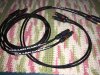
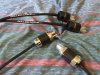
IMG_0354.JPG IMG_0077.JPG
 
I bought McIntosh unbalanced (RCA pin plugs) 2 meter connectors and a pair of McIntosh 3 meter speaker cables. They are aesthetically beautiful but give no better sound than cheap zip cord and unbalanced cables from Amazon. I was experiencing quite a bit of hum on my turntable's MT-5 to MX-121 connection. I tried all sorts of expensive cables to no avail. Then, I ran across these $9.00 cables from Amazon.

https://www.amazon.com/gp/product/B016QVZF06/ref=oh_aui_search_detailpage?ie=UTF8&psc=1

I got a pair of these a few days ago. They look real nice. I had some ultra-cheap ones that I use for testing equipment and they made an audible difference.
 
"Digital RCA" cables are not at all the same as standard RCA interconnects. Theses are digital coaxial cables, which happen to unfortunately share the same plug. They are NOT designed to carry analog RCA signals! They are designed to have a 75 Ohm impedance, but should only be used for digital signals. Your vintage system is entirely analog. Do not use these.

The basic quality of the cables aside, simple transmission line theory which is well know and understood tells us that this is not necessarily true.

All coaxial cables, "digital" or not will have a characteristic impedance determined by their physical construction. See the picture below.
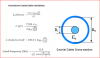
COAXIAL CABLE IMPEDANCE.PNG

The characteristic impedance of a coaxial cable only comes into play when the length of the coaxial cable approaches or exceeds about 1/10 of a wavelength at the frequency of operation. For an audio signal of 20 KHz this would be about 3800 feet. And when the source impedance and the load impedance are the same. This is not usually the case with analog audio signals.

Even basic "analog" coaxial cables will have a characteristic impedance of from around 50 Ohms to around 100 Ohms. But because the frequency of the analog signal, the coaxial cable does not function as a transmission line and the characteristic impedance does not come into play.

Coaxial cables designed for digital audio signals will be designed to function as transmission lines, hence the specified impedance, but this does not rule them out for use with analog signals. In fact the opposite may be true.

The debate about the best "sounding" cables aside, analog signals are perfectly happy traveling along "digital" coaxial cables.

Again this is basic transmission line theory 101 which is well known and understood.

There is no smoke, magic, or mirrors involved.:D

BTW, you mentioned BJC products. Note that they recommend the same 75 Ohm coaxial cable for both analog and digital audio.


upload_2017-9-22_21-22-46.png
 
Last edited:
The characteristic impedance of a coaxial cable only comes into play when the length of the coaxial cable approaches or exceeds about 1/10 of a wavelength at the frequency of operation. For an audio signal of 20 KHz this would be about 3800 feet. And when the source impedance and the load impedance are the same. This is not usually the case with analog audio signals.

Even basic "analog" coaxial cables will have a characteristic impedance of from around 50 Ohms to around 100 Ohms. But because the frequency of the analog signal, the coaxial cable does not function as a transmission line and the characteristic impedance does not come into play.

Coaxial cables designed for digital audio signals will be designed to function as transmission lines, hence the specified impedance, but this does not rule them out for use with analog signals. In fact the opposite may be true.

The debate about the best "sounding" cables aside, analog signals are perfectly happy traveling along "digital" coaxial cables.

Again this is basic transmission line theory 101 which is well known and understood.

Well said. It's amazing that this still has to be repeated in 2017.
 
Back
Top Bottom