• The move to the new server is done. There are some software and database maintenance updates in process. This has us passing the hat around to help out. We appreciate any donations. Seriously, even a dollar helps. The payment page may be found here - https://www.audiokarma.org/support.html

Intermittent Phono?

Colin M.

New Member
This is related to another thread I posted about some issues I was originally having with my turntable. I've been trying to weed out this problem on and off for a while but have recently really started to get work done to solve it.
The problem I'm facing is that the left channel (always left) on the phono input will intermittently drop out partially into a crackly, staticky mess with the music just hardly legible under it all. I originally suspected my turntable, an SL-1710, to be the culprit because tugging on the RCA cables or gently tapping around the table would audibly change or temporarily fix the issue when it arose. When it was playing fine it stayed fine, even if I did mess with it. I thought for sure it had to be a problem there so I went and overhauled the whole thing, replacing all electrolytic caps on the motor board, lubing everything, new cables, and checked continuity from the end of the tonearm through to the end of the RCA cables and it all checked out great. Thankfully it spun as it should however the left channel issue persists in exactly the same way. I also think I ruled out my headshell/cartridge, swapping the L/R wires didn't change the issue, still left channel.
To try and rule out my receiver, an SX-780, as a potential culprit, I switched the RCA cables to the opposite jack and the problem STILL persists in the left channel only. To me this means the issue is somewhere in the receiver, is my logic correct? I just can't look over that tapping the table fixes the issue. I tried swapping the HA1457 chips to see if the problem would follow the chip, but it didn't. I also tapped around with a chop stick to see if I could isolate a noisy component and pulled a suspect resistor, but it tests fine and went back in. Lastly, I listened to a whole LP through an aux input and the problem never showed (but the album sounded pretty bad). Came right back when on the phono input.
I'm really stumped. I guess it could be a tiny cold solder joint somewhere or maybe a capacitor, or maybe it's still a problem with the turntable? I don't know at this point, if anyone could drop some insight I'd like to hear it. Thanks!
 
Register to hide this ad
In my experience the selector switch on the 780's can be very problematic. What about other sources, (FM,AM) do they all play fine?
What happens if you slightly "jiggle" (highly technical term) the input selector knob a little while it is dropping out?
Or if you have the lid off and are tapping around try tapping the input selector switch.
 
In my experience the selector switch on the 780's can be very problematic. What about other sources, (FM,AM) do they all play fine?
What happens if you slightly "jiggle" (highly technical term) the input selector knob a little while it is dropping out?
Or if you have the lid off and are tapping around try tapping the input selector switch.
All other channels play fine, yeah. I have the covers off so I’ll jiggle the input selector and tap around more. I’ll also clean everything else again just in case.
 
All other channels play fine, yeah. I have the covers off so I’ll jiggle the input selector and tap around more. I’ll also clean everything else again just in case.
In my experience that selector switch if really crudded up does not seem to respond well to the typical cleaning process. If you have some low or no residue cleaner you can flush it out and then use your contact cleaner on it again. You may have to repeat the process a few times. I have had several 780's that I had to remove the switch, take it apart and manually clean it all up.

You probably know this but you can get "stuff" into the switch in several places, the open back probably being the best.

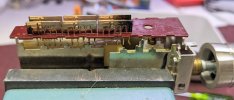
780switch.jpg


This is not a 780 switch but very similar type of construction. I had to use some high grit 2000-4000 grit sanding sticks to polish off the crud.
Kind of a last resort, many ways it can go wrong.

780switcha.jpg


One other thought, have you looked at the RCA jacks for the phono input, and the wires that connect them to the circuit board?
 
In my experience that selector switch if really crudded up does not seem to respond well to the typical cleaning process. If you have some low or no residue cleaner you can flush it out and then use your contact cleaner on it again. You may have to repeat the process a few times. I have had several 780's that I had to remove the switch, take it apart and manually clean it all up.

You probably know this but you can get "stuff" into the switch in several places, the open back probably being the best.

View attachment 3280280


This is not a 780 switch but very similar type of construction. I had to use some high grit 2000-4000 grit sanding sticks to polish off the crud.
Kind of a last resort, many ways it can go wrong.

View attachment 3280284


One other thought, have you looked at the RCA jacks for the phono input, and the wires that connect them to the circuit board?
Wow, thanks for the pictures and everything that’s great. I might just go ahead and remove the selector knob assembly entirely for a cleaning and to see what happens. Would an initial cleaning with isopropyl followed up with contact cleaner be a good start?
The first place I checked initially was the RCA connectors which got as thorough of a clean as I could manage. All the connecting wires are wire wrapped posts which I’m entirely unfamiliar with how to undo/redo the connections for so I haven’t touched them.
 
Last edited:
I would not remove the switch unless you have to. Lots of places for things to go wrong. I don't know how experienced you are and what tools you have. A lot of legs to desolder just to get the switch out. Then you have to bend several metal tabs back to get the switch contact plate out of the metal housing. Then you have the plastic sliders and the moving contacts (which are quite fragile) and how it is all indexed. It is absolutely do-able but like working on a fine watch. I never looked but there may be some tutorials or series of pictures on here or maybe youtube.

Yes the alcohol followed by a lot of cycles of the switch from one end to the other, then flush with the alcohol again. Let it dry a bit and then the contact cleaner and more switch cycles.

Wire wrap connections don't really go bad, unless the wire breaks off. Did you look at the back side of the RCA's? Maybe the center collar needs a little more tension (slight pinch).
 
I would save the F5 for last if you can get it to behave. That is assuming the switch is the problem.

There is a plastic cover the holds the sliding contacts that is slid back and forth by a (you got it) gear driven cam.
 
I would save the F5 for last if you can get it to behave. That is assuming the switch is the problem.

There is a plastic cover the holds the sliding contacts that is slid back and forth by a (you got it) gear driven cam.
Well this went from annoying to bad quick. Not sure what happened, I cleaned out the selector switch and the other pots while I was at it, and let it dry for over an hour while I cleaned up the faceplate and knobs (currently drying out separate from the unit). I just came back and plugged everything in, lights come on with no relay click. The only thing I could think of is that some component is very static sensitive? I wasn't poking around much but I suppose my workbench isn't completely esd safe.
 
Ok very weird. I let it sit on for a minute and the relay clicked, the speakers moved a tiny bit, and it clicked off again. I turned it off and on and it clicked normally and I have sound now. I have no clue what that was about but hopefully that doesn't become a normal thing for my receiver
 
Well this went from annoying to bad quick. Not sure what happened, I cleaned out the selector switch and the other pots while I was at it, and let it dry for over an hour while I cleaned up the faceplate and knobs (currently drying out separate from the unit). I just came back and plugged everything in, lights come on with no relay click. The only thing I could think of is that some component is very static sensitive? I wasn't poking around much but I suppose my workbench isn't completely esd safe.
Not very likely an issue with ESD. Once components are soldered in the circuit boards they are generally not static sensitive. I'm not saying they can be damaged but unlikely.

Ok very weird. I let it sit on for a minute and the relay clicked, the speakers moved a tiny bit, and it clicked off again. I turned it off and on and it clicked normally and I have sound now. I have no clue what that was about but hopefully that doesn't become a normal thing for my receiver
I have a couple of things you can check that may point us in the right direction. First of all you should have a look at the solder joints in the Power supply part of the circuit.

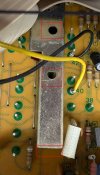
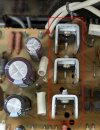
There are three regulator transistors in the 780 that run VERY hot, hot enough that they can de-solder themselves, but usually the joint just deteriorates to the point the connection is no longer solid. Have a look at the bottom side of the board where they are I will bet the solder joints are very grey and grainy looking.

At the very least you need to re-flow the joints adding a little new solder. IMO you should remove all the old solder and then re-solder the joint with new solder.

Also check the solder joint of the two resistors that stand off the board just to the left of the transistors

780reg.jpg

If those solder joints were compromised (and I bet they are) all the tapping around you did could have created an intermittent or high resistance connection on one or more of them.

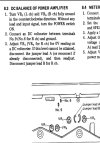
After you go over the solder joints have a look at the offset. Service manual page has the procedure.
If you can't dial it down to spec as it sits dont cut or add the jumpers. just see how close you can get it to spec as it sits.
Volume all the way down.
I might skip step one.
Adjustments may be very twitchy slight turn, let it settle repeat etc.

780offset.jpg
 
Last edited:
Not very likely an issue with ESD. Once components are soldered in the circuit boards they are generally not static sensitive. I'm not saying they can be damaged but unlikely.


I have a couple of things you can check that may point us in the right direction. First of all you should have a look at the solder joints in the Power supply part of the circuit.

There are three regulator transistors in the 780 that run VERY hot, hot enough that they can de-solder themselves, but usually the joint just deteriorates to the point the connection is no longer solid. Have a look at the bottom side of the board where they are I will bet the solder joints are very grey and grainy looking.

At the very least you need to re-flow the joints adding a little new solder. IMO you should remove all the old solder and then re-solder the joint with new solder.

Also check the solder joint of the two resistors that stand off the board just to the left of the transistors
Thank you so much for sharing all this knowledge, It's really been helpful. I actually did go through and spot checked the entire board for suspicious looking solder joints and did reflow/resolder quite a few of them, those transistors included. I did that while waiting for my switch cleaning to dry a little, so when I went to test it out and saw it didn't work I thought I must've botched something along the way. Somehow it did manage to come back to life on its own and seems to be settled now, so for the time being I will leave things as is until another issue pops up. I do plan on overhauling the entire receiver with new caps, replacing failure-prone parts, and maybe the STK power pack replacements often discussed on these forums, but I don't have the time or workspace to take that on at the moment. My unit has both original STK's in it, so I'm sure that time will come sooner than later. I will definitely be referring to your advice here when the time comes.

As for my original issue, it seems like your tip of cleaning out the input selector solved it, though time will tell. I've managed to listen to a few records completely through without an issue so I will call the issue fixed for now thanks to your help, which is much appreciated.

I'm still really confused by the way this issue presented itself though. I chased a red herring that led to my turntable being the problem and overhauled that entire thing (though I'm glad I did), but how could it be that tapping around the table influenced the distortion? If the issue was truly in the receiver, I would think tapping around there would change it. I'm really curious to know, do you have any ideas?
 
Sometimes jiggling the selector a little bit one way or the other will make it come and go. It was probably so oxidized it just did what it did?

Did you check the offsets?

Lots of original STK packs still chugging along. They seem to be pretty hardy if they are not abused. I did use a pair of the replacements for a rebuild I did. Nice parts work great.
 
Sometimes jiggling the selector a little bit one way or the other will make it come and go. It was probably so oxidized it just did what it did?

Did you check the offsets?

Lots of original STK packs still chugging along. They seem to be pretty hardy if they are not abused. I did use a pair of the replacements for a rebuild I did. Nice parts work great.
Offsets I measured are 37.0mV on the left and 26.0mV on the right after about an hour of listening to (non distorted) music. I don't have a good set of clip leads for my multimeter so I can watch the measurement while I adjust, I'll pick some up and get those offsets closer to 0.
 
Back
Top Bottom