• Please note that Audiokarma will be offline briefly for updates early on Monday morning, September 28th.

Is 256 kbps, 16 bits, and 44.1 kHz “Lossless”?

LG100

New Member
…Is it “High Rez”?

Just now listening to Sade’s “No Ordinary Love” (“Love Deluxe” album”) streaming Apple Music over Airplay into a WiiM Pro Plus, decent-but-modest system carefully set up in a painstakingly but DIY sound treated space w/Cat 8 Ethernet (no name, $14.98/6ft) cable and Blue Jeans RCA interconnect….no external DAC. It’s registering as the thread title describes in the WiiM app on my iPhone and I can’t fathom that better SQ could be achieved in this astral plane, at least to my 67 yr. old ears…..this coming from someone who used to haunt the big city brick & mortar places where they sold Mark Levinson gear hooked up to Magnepans that resembled room dividers for mansions…just to listen until they kicked me out. Anyway, enough rambling, is the aforementioned bona fide lossless?, high rez??? “My friend, Google” gives me conflicting answers on this so I was wondering what the consensus here was.
Thanks.
 
Register to hide this ad
Uncompressed CD bitrate is 1.4Mb/second. The best lossless compression can get that down to about 40% of original, so 256kbps would be considered somewhat "lossy" compression. However, I have long maintained that given a good compressor and a reasonable bitrate, the vast majority of people (myself included) will not hear a difference between lossy compression and no compression. So is that hi res? No, it's not. Of course, the Nyquest-Shannon theorem says that anything above the CD sampling and bit rate is superfluous. Obviously some poeple will disagree.
 
LG100: It can't be. I.e., if you do the math, linear PCM with 16 bit quantisation and a sample rathe of 44.1 kHz in stereo requires 2 x 2 bytes x 44100 /s = 176400 byte/s. Typical lossless compression formats would compress that to roundabout 50 % at best, so let's assume 88200 byte/s or respectively 705.6 kbit/s. So lossless compression at 256 kbit/s would appear pretty unlikely. And no, not high-rez either, as 16 bit / 44.1 kHz (L)PCM nowadays isn't considered as high resolution audio.

Greetings from Munich!

Manfred / lini
 
The term "high-resolution" as applied to digital music originally referred to bitrates higher than CD (more than 16 bits, more than 44.1K sampling rate, or both). Effectively, the term meant higher resolution (that is, higher than CD, which up until higher-resolution recording became available was the standard for high-quality digital audio).

However, over the past five years or so, the streaming services have co-opted and re-defined the term to include CD bitrate.

In any case, it must be lossless to be considered high-resolution.

BTW I am certainly one of those who will disagree, strongly, with the assertion that lossy and lossless files are indistinguishable. I find it fairly easy to distinguish between Spotify (lossy) and lossless sources when listening on an ongoing basis (as opposed to ABX testing). That said, it is my opinion that with high resolution recordings (including CD-quality), the engineering of the recording plays a bigger role in sound quality than does bitrate.

Sidebar: The Nyquist-Shannon sampling theorem does NOT say that anything above the CD sampling rate is superfluous. Nor does it make any other subjective value judgements. A higher sampling rate can offer other advantages in addition to reproduction of frequencies generally believed to be beyond human aural perception.
 
Last edited:
The term "high-resolution" as applied to digital music originally referred to bitrates higher than CD (more than 16 bits, more than 44.1K sampling rate, or both). Effectively, the term meant higher resolution (that is, higher than CD, which up until higher-resolution recording became available was the standard for high-quality digital audio).

However, over the past five years or so, the streaming services have co-opted and re-defined the term to include CD bitrate.

In any case, it must be lossless to be considered high-resolution.

BTW I am certainly one of those who will disagree, strongly, with the assertion that lossy and lossless files are indistinguishable. I find it fairly easy to distinguish between Spotify (lossy) and lossless sources when listening on an ongoing basis (as opposed to ABX testing). That said, it is my opinion that with high resolution recordings (including CD-quality), the engineering of the recording plays a bigger role in sound quality than does bitrate.

Sidebar: The Nyquist-Shannon sampling theorem does NOT say that anything above the CD sampling rate is superfluous. Nor does it make any other subjective value judgements. A higher sampling rate offers other advantages in addition to reproduction of frequencies generally believed to be beyond human aural perception.
I agree about the uselessness of ABX testing. It's very good for determining differences between two devices or cables. However, it doesn't help much when trying to decide what's the best to you.

For that I prefer the LTLT (long-term listening test). It's easy to perform. Simply insert device/cable into your system and listen as usual for a week or two. If you find yourself listening less, said device/cable gets the boot. If you listen more the device/cable stays. If there is no change in your listening time, then it usually comes down to aesthetics.

For the anally retentive (I've been one at various times), keep a record of how much time you spend listening both before and after inserting "whatever". After that it's simple math.
 
…Is it “High Rez”?

Just now listening to Sade’s “No Ordinary Love” (“Love Deluxe” album”) streaming Apple Music over Airplay into a WiiM Pro Plus, decent-but-modest system carefully set up in a painstakingly but DIY sound treated space w/Cat 8 Ethernet (no name, $14.98/6ft) cable and Blue Jeans RCA interconnect….no external DAC. It’s registering as the thread title describes in the WiiM app on my iPhone and I can’t fathom that better SQ could be achieved in this astral plane, at least to my 67 yr. old ears…..this coming from someone who used to haunt the big city brick & mortar places where they sold Mark Levinson gear hooked up to Magnepans that resembled room dividers for mansions…just to listen until they kicked me out. Anyway, enough rambling, is the aforementioned bona fide lossless?, high rez??? “My friend, Google” gives me conflicting answers on this so I was wondering what the consensus here was.
Thanks.
Welcome to AK, first of all!! :) :hug: :) For "lossless", I tend to have FLAC files. Some of those I have utilize crazy bit-rates. I am not sure if I would want to utilize the DAC on a phone. While it does offer a measure of quality, it is certainly not the same or superior to a dedicated stand-alone DAC. I know that some here will disagree (and always due for the sake of a disagreement). I will admit, it is difficult at times, to hear the difference between 256K and 320K MP3 files. MP3, however, is capped at 15khz at the top end, and I believe 50 or 100 hz at the low end. Nonetheless, that quality of MP3 is typically quite acceptable to most. :)
 
Most of my digital library is in a FLAC format but I have downloaded some things from Amazon that are 256k mp3. I've never tried to directly compare the same music in both formats but can say that I don't seem to be missing anything listening to the 256K files on my system (see signature). I'm also 67 years old.

That's not to say it can't be better - I have heard much higher end systems with correspondingly higher price tags, or DIY tube amps/speakers, that provide noticeably better sound quality than what I use at home; I'm not going there short of hitting a lottery jackpot or having an inheritance from some unknown rich relative.

If it sounds good to you, it is good.

Alan
 
I agree about the uselessness of ABX testing. It's very good for determining differences between two devices or cables. However, it doesn't help much when trying to decide what's the best to you.

I prefer to ascertain if there is a difference before engaging in preference testing, particularly when the preference testing methodology drastically reduces sensitivity to determining differences.
 
Poor MP3, it takes all the criticisms and gets none of the glory. It is true however like MP4 used with video, there can be all sorts of renditions that sound great or just barely squeak by acceptbility. Its sorty like the days when 3 3/4 ips tried to substitute for 7 1/2 ips. pre-recorded tapes. If the 3 3/4 ips tapes were dubbed one to one the sound could be outstanding. Revox A-77 and B-77 made fantastic pre recorded tapes if you could compress the signal a bit to keep percussive high frequencies from over loading the tape. So 3 3/4 was could be king like MP3. Of course 7 1/2 ips was better. But here again the signal had to be compressed becuase of the limitation of the number of iron particles going over the heads could only take so much signal. I preferred, two track with allowed more particles. Think of them sort of like bits . Then came 15 ips and the ultimate 30 ips. But for most folks 15 ips was just to much tape. The tapes here on larger reels and weighed a lot and took up to much space. I liked 1 mil back coated tape and that allowed me with stacked reels to get about 54 minutes per reel which was all that was necessary for pop and big band, and Jazz recordings and most classical pieces. So todays is all about file size and in the days of analog it was all about how many particles of ferric oxide needed to be whizzing by to get the best and most accurate sound. The more things change the more they seem to be the same. Sometime that is. Yes they are totally different, but you get the idea. How few bits and how few iron particles can we get by with to capture the sound we feel is authentic to the performance. We each have to make that decision.

I will say that like analog tape digital can be quite tempormental. I have some fantastic sounding CD's and ones that are really quite lack luster and almost intolerable. Audio tape was the same way. So in that respect they are very much alike. Its not which format you choose or which smapling rate or bit depth you choose. Its how that Digital format is used. I prefer to stay away from recordings with a lot of processing. Telarc and Reference Recordings for instance. Kind of like Sheffield and Mercury Living Presence back in the days of analog. When it comes to audio my motto is KISS.

Thats pretty hard to do now days. The HiFi industry would collapse if we all kept our systems a simple as possible. Every one only bought Herseys or Cornwalls, with a Combo CD player integrated amp and tuner like NAD use to make with 45 watts a channel. No, LP's, no tape, and no sub woofers. Ok, you can have a small DAC. But thats it. We could still love our music, but life would be so boring. What would we talk about on this web site? The performance. We don't do enough of that today.
 
That’s the simplicity I’ve sought (and am enjoying immensely) in this 2nd (workshop) system: NAD 316 BEE out to Klipsch RP 600Ms via Canare 4S11, WiiM Pro Plus out to the NAD (directly, at present w/no external DAC) via Blue Jeans silver plated RCA interconnect. I’m sure I’ve heard better systems in my time but it’s downright tough to tear myself away from listening sessions out here lately even though system 1 sports a tube integrated/Bluesound Node/Music Hall MMF-5 into well maintained JBL L-65s. The difference seems to be in the room/room treatments. System1 has the lamentable, “open floor plan” that so many houses suffer from whereas system 2 has symmetrical wall distances and speaker locations have been arrived at only after 2 years of constant tweaking. I did break my pact with less-is-more last year and threw a single, REL T-5X sub into system 2 but…..er…well……I like it a lot!
 
I prefer to ascertain if there is a difference before engaging in preference testing, particularly when the preference testing methodology drastically reduces sensitivity to determining differences.
Back in the early 1980's two audio buddies and I invested in an ABX Comparator. What we found was that a lot of cables and devices sound different. There can be no argument there. We rarely agreed on what sounded best.

Please note: In my post I basically said that differences are easy to detect. However, it still comes down to what one prefers. Hence my LTLT.

What was most interesting to us was, my then wife had truly Golden ears. She could stand at the top of the steps leading to my man cave and consistently tell when a cable was changed. She taught me some things about listening. She was also the only woman I've ever met who played music at levels as loud as many men. Once while on a business trip I called home and she very tearfully said she had been playing music all day and the sound suddenly died After half an hour on the phone we figured out that she had blown the speaker fuses. It was something I'd never done. I was able to talk her through changing the fuses and she was good to go.

She got sort of upset when I traded in a pair of Maggy MG-3's for a pair of Acoustat Model 3's. She said the Aoustats sounded cold.

Thats pretty hard to do now days. The HiFi industry would collapse if we all kept our systems a simple as possible. Every one only bought Herseys or Cornwalls, with a Combo CD player integrated amp and tuner like NAD use to make with 45 watts a channel. No, LP's, no tape, and no sub woofers. Ok, you can have a small DAC. But thats it. We could still love our music, but life would be so boring. What would we talk about on this web site? The performance. We don't do enough of that today.
You sure do love Klipsch speakers. Personally, I think they sound awful. There's a lot more to this hobby than high sensitivity speakers. :)
 
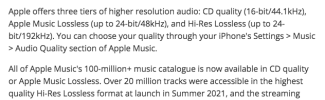
from 1999-2006, I digitized my entire collection of between 5-6k of CDs, converting them in either 256kbps or 320kbps files. I almost never listen to them anymore, as I find them rather fatiguing on my system. Instead, I stream from Apple Music, as most of their content is lossless, with an increasing amount of it hi-res lossless.
 
Back in the early 1980's two audio buddies and I invested in an ABX Comparator. What we found was that a lot of cables and devices sound different. There can be no argument there. We rarely agreed on what sounded best.

Please note: In my post I basically said that differences are easy to detect. However, it still comes down to what one prefers. Hence my LTLT.

What was most interesting to us was, my then wife had truly Golden ears. She could stand at the top of the steps leading to my man cave and consistently tell when a cable was changed. She taught me some things about listening. She was also the only woman I've ever met who played music at levels as loud as many men. Once while on a business trip I called home and she very tearfully said she had been playing music all day and the sound suddenly died After half an hour on the phone we figured out that she had blown the speaker fuses. It was something I'd never done. I was able to talk her through changing the fuses and she was good to go.

She got sort of upset when I traded in a pair of Maggy MG-3's for a pair of Acoustat Model 3's. She said the Aoustats sounded cold.

Would be interesting to dive in to I’m sure, but all a bit beside the point. In addition, how we listen after making changes, etc. can be a rather deep topic. All that aside, I, and most people I know, are about 50/50 for perceived changes persisting when listening ears-only. I enjoy new toys, but have no interest in the equipment merry-go-round when the impact to the signal isn’t what caused the perception.
 
Welcome to AK, first of all!! :) :hug: :) For "lossless", I tend to have FLAC files. Some of those I have utilize crazy bit-rates. I am not sure if I would want to utilize the DAC on a phone. While it does offer a measure of quality, it is certainly not the same or superior to a dedicated stand-alone DAC. I know that some here will disagree (and always due for the sake of a disagreement). I will admit, it is difficult at times, to hear the difference between 256K and 320K MP3 files. MP3, however, is capped at 15khz at the top end, and I believe 50 or 100 hz at the low end. Nonetheless, that quality of MP3 is typically quite acceptable to most. :)
Not entirely true. The upper frequency limit at MP3 depends on the sampling frequency. There is a research available that is really interesting. And VBR isn´t even covered here:

  • 1411 kbps> 20 kHz 1: 1
  • 320 kbps> 19,5 kHz 1: 4,4
  • 192 kbps> 18 kHz 1: 7,3
  • 160 kbps> 17 kHz 1: 8,8
  • 128 kbps> 16 kHz 1:11
  • 96 kbps> 15 kHz 1: 14,7
  • 64 kbps> 11 kHz 1:22
  • 32 kbps> 5 kHz 1:4
 
Back
Top Bottom