• The move to the new server is done. There are some software and database maintenance updates in process. This has us passing the hat around to help out. We appreciate any donations. Seriously, even a dollar helps. The payment page may be found here - https://www.audiokarma.org/support.html

Is it true what they say...

EMark

Active Member
I have some equipment that has not been used in 6 or 8 years, specifically The Akai tape deck as well as the KLH Transient noise eliminator and Dynamic noise filter. From reading alot of posts on AK, I don't think it is a good idea to just plug these units in. I recall reading a post or two that said equipment that has sat for a long time will benefit from being powered up with a Variac.
I believe the reason for this had to do with the electrolytic caps and low voltages will allow the caps to reform the reactive? oxide layer that make the caps work properly. Or some thing along those lines. My question then is this: Would a dim bulb tester be a suitable substitute for a Variac? I don't have a Variac and being a newbie, it will be a while before I will get one. (If ever). As always, I am grateful for any advice you guys can provide.
 
Register to hide this ad
I would have no qualms about plugging any of those particular components in directly from storage (I own the Burwen versions of the two processors BTW).

Receivers & power amps & tube components should be approached with more caution.

The reason people advocate the Variac is that bringing the voltage to the component up slowly theoretically allow caps to reform and prevent them from just blowing up, if they had degenerated to the point where that was a possibility. The dim bulb tester isn't going to do that, not in these relatively low wattage components anyway. The most it'll do is to slow the voltage ramp-up slightly but it's going to still put you at full or very close to full line voltage almost immediately. The point of the DBT is that devices with power components inside (amps, receivers) with shorts or other issues will current limit and avoid further damage, because the light bulb absorbs most of the current in the circuit.

You might pop the lid on the tape deck and check the belt condition first, though. If it's gone sticky, the last thing you want is to spin up the motor and have it wrap that gooey mess around everything in sight.

John
 
It's true, i bought an old turntable with electronic pitch control, i was curious to open it, and surprise, i found an leaking cap, and the others looking bad, i've replaced all. Must be careful.
 
i always give things a visual check first .then plug in utilising a power meter and observe current draw . if tube stuff i bring it up with a variac ,
 
ICs do NOT like variacs ... some have fairly close power tolerances and really don't like to see anything but.

Wouldn't hesitate to use one on tube and the more ancient solid state stuff, but I won't even try if I see anything beyond a simple transistor in the box.

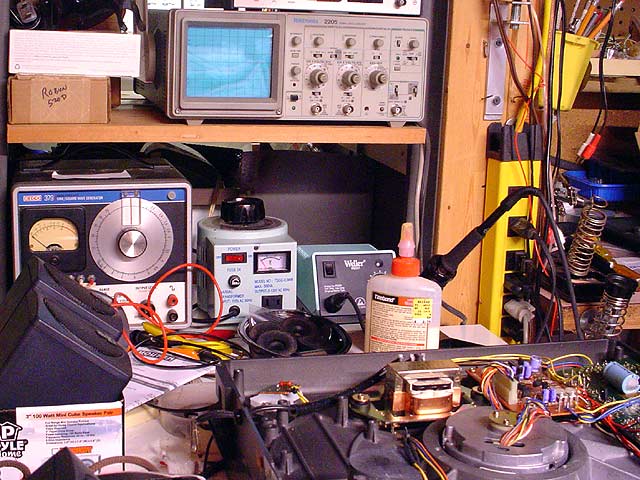
Here's mine ... wait ... I know it's in here somewheres ...

stereobench.jpg
 
Wow, whatta fast reponse...

Thank you John, Pete, etc for your usual good advice. I didn't expect such a fast response to my query. The Akai tape deck, yes, I did open it up first to just look around a bit. The belts looked OK and I didn't notice any obvious problems like leaking caps. Just wanted to know before I plugged it in.
SkiZo, nice workbench! I got tools up to here cause I used to do air conditioning and refrigeration and I am loath to call a repairman for anything that breaks in my house. I was studying the sticky about what tools are required to work on electronics. I am thinking about getting some test equipment, but funds are a bit tight now. Plus, I always try to justify buying a tool to see if I am gonna use it to bring in money. I find working on this stuff kind of relaxing, as well as mentally stimulating. So i'll see what the future brings. Thanks again, gentlemen!
 
Back
Top Bottom