• The move to the new server is done. There are some software and database maintenance updates in process. This has us passing the hat around to help out. We appreciate any donations. Seriously, even a dollar helps. The payment page may be found here - https://www.audiokarma.org/support.html

Is there really a audible difference between CD players?

Status
Not open for further replies.

PROJECT 2501

Active Member
Honestly guys...
Besides the build quality enabling the player to read dirty and damaged disks along with compatibility with modern equipment by way of various state of the art connection methods (i.e bluetooth, hdmi, etc) how does one justify the expenditure of thousands of dollars for a CD player when digital audio possesses no variances in its information and is lossless in quality no matter how its converted to audio..
I have never been able to hear even the slightest difference, good or bad, when comparing players of contrasting quality.

"But why are there so many people claiming to hear a clear and concise improvement in sound when using high end DACs and boutique CD players?"

I dont know why...
Digital audio is still just 1s and 0s that is either present or not. Black or white. On or off.
There is no spectrum to cross, no gray area of variation.
So is it placebo? Confirmation bias? Or simply a status symbol?

Or do I lack the necessary conditioning that only seasoned audiophiles with decades of experience have which allows them to decipher and appreciate the subtle improvements in sound quality offered by these unaffordable players?
 
Register to hide this ad
"But why are there so many people claiming to hear a clear and concise improvement in sound when using high end DACs and boutique CD players?"
Because such improvements exist.

Digital audio is still just 1s and 0s that is either present or not. Black or white. On or off.
There is no spectrum to cross, no gray area of variation.
We don't listen to digital bitstreams. We listen to those converted to an analog signal where the timing of the bits and the quality of the analog stage make a profound difference. In that respect, it is no different from comparing preamplifiers. Those with weak, noisy switch mode power supplies and high feedback op amps cannot begin to match those with stiff, linear power supplies using discrete devices devoid of "correction".

Or do I lack the necessary conditioning that only seasoned audiophiles with decades of experience have which allows them to decipher and appreciate the subtle improvements in sound quality offered by these unaffordable players?
It is certainly a case of exposure and understanding the nature of the kinds of differences you'll hear. With the modest Music Hall DAC 25.3 used in the garage system, I replaced the OPA2134/OPA2604 op amps with Burson FET modules. Just making that change alone was noticeable. Low level dynamics are improved. You hear phrasings and harmonic tails that were blurred with the chip based op amps. And upgrading the Raspberry PI based endpoint's power supply from a SMPS to a battery using a better DC cable made a difference. Lower noise reduced a false brightness that masked true musical information. And using a Canare star quad DC cable lowered inductance for improved dynamic control.

Yes, there are certainly cases where you are paying for cosmetics like units with backlit glass panels or over engineered aluminum panels affixed with counter sunk machine bolts.

A range of audible differences most certainly exist.
 
Last edited:
I live in Michigan where pot is legal. I don't like the stuff but my wife takes it for chronic pain. She says it makes the music in our listening room sound incredible. So, if you live in a state where pot is legal, you might try taking a few puffs before listening to your CD player. You may get a very cheap upgrade in sound quality. I am in no way recommending anyone develop a drug habit. I wish I could try this myself, but pot makes me feel crappy. You just have my wife's recommendation.
 
Older CD players with no or minimal buffering meant transport quality and stability was audibly significant -- it affected timing, and how many read errors occurred which in turn affected whether the player was forced to interpolate missing data or not -- and considerable variation in the quality and design of DACs meant significant audible differences between players.

There's less variation now, as buffering essentially eliminates the effect of physical differences in transports and DAC technology has become fairly standardised, but still enough variation in DAC implementations to make for audible differences.
 
I've had several CD players over the years but primarily I've played vinyl. The early players sounded edgy to me and the first significant improvement I noticed was the introduction of 1 bit machines. I was more or less happy for a number of years with an Hk HD7600 which is a 1 bit.

But even so, I became compelled to learn of a player with an even smoother sound. What I wound up with was a used multi bit Rega that to me, sounds closest to analog. At least within the realm of players I could afford and I say again that it was used. I'm sure there are many contenders when price becomes less and less of a factor.

It was too temperamental to keep, but another player I liked the sound of, I thought it distinctive, was a NAD 513 three disc changer. But it was weirder than the a Rega and not as reliable.

I have a number of Philips/Magnavox players with the much touted TD1541 and little or no over sampling. Cheap players granted, but none cut it for me.
 
I have a Technics,Sony,Denon single disc cdp's and a Toshiba cd/dvd player. They all have their own unique sound signature but the one I use as my main player is the Sony. I have had a couple of Sony's I did not like sound wise that I sold. So there are many variables at play. The Denon was a expensive player ten years ago it plays HDCD and SACD but the Sony at 1/4 the cost when new sounds better to me than the Denon. But to answer your question directly many will sound different mostly due to the analog output stage or poorly implemented DAC. You also must consider the interaction of the player,amplifier and speakers to.
 
The edge-y sound is mostly due to the opamps used, easily upgraded for vastly improved sound.
To the OP, whether you can hear the difference depends mostly on what music you listen to, the quality of the rest of your system, and whether you listen to live acoustic music, like classical, folk or jazz in an unamplified setting so you know what instruments sound like before recorded and processed.
 
My friend and I spent an afternoon comparing four disc players. There was a Soundesign from ~'88, a JVC from 2001, a Denon dvd player from 2006, and a Sony ES from the '90s. The msrps ranged from just over $100 to about $1000. We synced several copies of the same cd, enlisted the aid of his wife and listened blind.

We both thought the Sony was best, the Soundesign was worst and the JVC and Denon were about equal. The difference between best and worst was not large.
 
PJ2501: Well, if you'd ask me, I'd say it foremost depends on how much of a difference you'd expect. Personally I've noticed differences between my CD players, most so among the portables (and even one and the same PCDP can sound a bit different depending on the type of batteries/rechargeables I'd use and the charging state of these...) - but I'd call these differences quite subtle ones. So if you're expecting as significant differences as for example between different speakers or different phono cartridges, you usually rather won't hear such, because the differences between different CDPs rather are on "connoisseur level" in comparison.

Greetings from Munich!

Manfred / lini
 
I have never been able to hear even the slightest difference, good or bad, when comparing players of contrasting quality.
...
do I lack the necessary conditioning that only seasoned audiophiles with decades of experience have which allows them to decipher and appreciate the subtle improvements in sound quality offered by these unaffordable players?

I've got three players of similar age and original selling price that I've picked up at yard sales for $10-$30 and they each sound different from one another. And none of them perform nearly on par with the Rotel in my main system.

What players have you done a side-by-side comparison with, and what was the system you played them through?


~
 
Last edited:
I've had a few that sounded too "bright" for lack of a better word. "Shrill" might be more descriptive.
Some schooling might be in store for me but from my limited knowledge a CD player converts digital to analog by means of a DAC. There are many threads comparing these components, so that tells me they are not all equal.
Currently I bypass the DAC in one of my CD players and use the one in the preamp. The other one uses the inboard DAC. I think the one using the pre sounds better, but not by a huge margin. Then again the preamp is considered one of the finest available, while the CD player is middle-of-the road.
 
I suppose if we were talking about using several CDPs all with digital out capabilities, connected to the same DAC and front end then there wouldn't be a whole lot to tell them apart. As stated above, when you're talking about what we actually listen to, then if we are taking the already converted digital stream out of the analog output it will sound a whole lot different for each machine. I have two such players - an Arcam Alpha 5 and a Rotel RCD-950 - which both sound different despite using the same Philips TDA chips.
 
I think it all comes down to the DAC rather then build quality. Mostly cheap players do sound bad. But from mid to high end players sound mainly all good. Also is the sound better or just different based on various characteristics?
 
Yeah, logically, it should not make a difference, but it does. I even have transports that sound differently between them, so no DAC in the path. There is so much more going on that 1s and 0s.
 
When I replaced my Yamaha first generation SACD/DVD-Audio/CD/DVD player with an Oppo 95 a couple years ago, I instantly heard a difference. At first, the Oppo sounded "dull." Then after a short while, I realized that it wasn't dull at all and just didn't have the grainy/edgy sound of the Yamaha. I got used to this (welcome) difference very quickly.
 
If we could listen to digital bitstreams there might not be much of a a difference .. but music and ears are an analog phenomenon ..It's the conversion that gets ya ...
 
Last edited:
Yes, there most certainly is a difference in sound from various CD players.

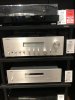
I like Teac CD players, especially for the price points but I would love to own this fantastic Yammi.

This one, below the fantastic Yamaha amp, yes I would like one of these.

Yamaha CDS 2100.

There's a reason the price is almost
$3,000.

5D6F5D9D-3916-4155-8E26-28EE71AEFBA2.jpeg
 
how does one justify the expenditure of thousands of dollars for a CD player when digital audio possesses no variances in its information and is lossless in quality no matter how its converted to audio.

That's not accurate. A CD player has to use massive error correcting algorithms to fix a rather steady stream of translation errors that occur on the fly. And then, there is the matter of design for the brick wall filters, then there is multiplexing verses two channels, and several other design choices which affect SQ for each design.

In short, CD playback is far from fool proof!
 
Honestly guys...
Besides the build quality enabling the player to read dirty and damaged disks along with compatibility with modern equipment by way of various state of the art connection methods (i.e bluetooth, hdmi, etc) how does one justify the expenditure of thousands of dollars for a CD player when digital audio possesses no variances in its information and is lossless in quality no matter how its converted to audio..
I have never been able to hear even the slightest difference, good or bad, when comparing players of contrasting quality.

"But why are there so many people claiming to hear a clear and concise improvement in sound when using high end DACs and boutique CD players?"

I dont know why...
Digital audio is still just 1s and 0s that is either present or not. Black or white. On or off.
There is no spectrum to cross, no gray area of variation.
So is it placebo? Confirmation bias? Or simply a status symbol?

Or do I lack the necessary conditioning that only seasoned audiophiles with decades of experience have which allows them to decipher and appreciate the subtle improvements in sound quality offered by these unaffordable players?
It's the A part of a DAC where things can get interesting.
 
Status
Not open for further replies.
Back
Top Bottom