• The move to the new server is done. There are some software and database maintenance updates in process. This has us passing the hat around to help out. We appreciate any donations. Seriously, even a dollar helps. The payment page may be found here - https://www.audiokarma.org/support.html

JBL L20T Crossover schematic/cap replacement

Vintageaudio123

AK Tropicalized Member
I just purchased a pair of very good and clean looking L20T's and they are on the way. I was wondering what is the consensus about replacing the electrolytic cap(s) in the crossover of this model, and was wondering if someone could provide either a schematic of the crossover or the value of the caps to be replaced so as to order them so they can hopefully arrive around the same time as the speakers.

Thank you.
 
Register to hide this ad
Service Manual for the L20T attached below.

Regards,
Gordon.


Thanks for the PDF.
Very useful indeed.

I had forgotten about the thread and did not check until today because the speakers arrived his week. Will be auditioning them this afternoon.
Somehow I never get the email notifications when new replies are posted to my threads, no matter what I have tried in both my server or here by tweaking the preferences.

Has anybody ordered the electrolytic caps? (4uF and 9uF) My usual source is Mouser but for the required 100V NP rating the closest value they stock is 10uF (no 9uF). And instead of 4uF it will have to be 4.7uF.
Both caps are 85-C and 20% tolerance regular NP electrolytic caps. Nothing better available.

I suppose I could try putting two 18uF regular polarized caps in series instead of 9uF NP. A 18uF 100V cap is available in Aluminum Organic Polymer type and 105-C 20% tolerance, but seems rather pricey (not sure why) at over $5 a piece compared to the NP types. Or I'd imagine could use two 50V rated regular electrolytic type caps in series since they will add up to 100V total, and the price will drop to $0.51 each with all the other specs being the same.

Any comments welcomed (or alternate cap sources suggestions).
 
I really like the L-20t and am looking for a set myself.
I have its big brother the L100t that I upgraded to the t3 crossover.

My suggestion, don't replace the caps with electroltics, rather go to metalized polypropylene caps. Your speakers use relatively small value caps (4uF and 9uF). You can pick up a set of Solens or even Daytons for little money. Mind you, there are boutique caps that you can obtain (very costly), but I doubt youd notice much of a difference over basic poly caps.

All my speakers are old (70's to 90's), I replaced the NPEs with film caps as part of my refurbishing effort.

If you do go with poly caps, allow them to break in. 3 hours makes a big difference in sound quality, I feel they continue to improve the more you play them.

Parts Express is a good source.
 
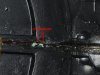
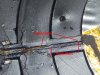
So plugged the speakers into the amp, and NO highs at all. Both tweeters dead. Woofers seemed ok. So another airhead that blew the tweeters, perhaps driving the amp into clipping and burned up the voice coils? No. I took the tweeters apart and turns out both tweeter voice coils look ok, but no continuity at the terminals. Then looked at the fine wires that connect the edge of the diaphragm to the terminals and both where open. There where at least one or even two spots where the wire had gone completely open circuit due to corrosion. Yes, very tiny spots of white-blue corrosion, think almost like battery acid corrosion. It seems to me these speakers where either stored in a high humidity environment (most probably because the four screws that hold the tweeter together look a bit rusty). But can humidity alone do this? I would think not, so perhaps somehow the glue that holds down those fine wires at some point due to the humidity reacted with the copper wires and caused the corrosion and eventually the complete breakdown of the wire. Anyone heard about something like this happening on other JBL 035TI tweeters?

Fortunately managed to repair both tweeters and they now seem to be sounding fine. In a bit will upload some pictures of the damaged tweeter wires and the result after the surgery.

The ebay seller is now saying that the speakers where "tested by a tech" and where found t be working fine. Yeah. He now wants me to send them back for a refund. 40 pounds box... yeah that will be easy and convenient.
 
Last edited:
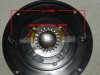
Here are some pictures of the corrosion damage and repair.

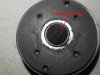
BTW the foam that is supposed to be under the titanium domes has almost completely degraded and very little is left in both tweeters. Guess I am going to need to get two of those as well.

Oh and one of the tweeters had a dent in the grille, so fixed that too.
 

Attachments

  • 01.Corroded_wire.jpg
    01.Corroded_wire.jpg
    68.1 KB · Views: 55
  • 02.Corroded_wire.jpg
    02.Corroded_wire.jpg
    79.7 KB · Views: 53
  • 03.Corroded_wire.jpg
    03.Corroded_wire.jpg
    149.7 KB · Views: 56
  • 04.Repaired_JBL_035TI_Tweeter_Wires.jpg
    04.Repaired_JBL_035TI_Tweeter_Wires.jpg
    91.7 KB · Views: 55
  • 05.Magnet_Polepiece_Rotted_Foam.jpg
    05.Magnet_Polepiece_Rotted_Foam.jpg
    109.7 KB · Views: 55
Last edited:
Hi thank you very much for the recommendation. I will definitively look into this and probably go with regular poly caps, and noted about the sound quality and having to break them in a bit.
Hope you find a nice set of L20T's and at the right price.

BTW what is the difference between the regular and the T3 crossovers? I'm guessing it might have a slightly different crossover frequency, rolloff, etc... anything else?

Thanks again.

I really like the L-20t and am looking for a set myself.
I have its big brother the L100t that I upgraded to the t3 crossover.

My suggestion, don't replace the caps with electroltics, rather go to metalized polypropylene caps. Your speakers use relatively small value caps (4uF and 9uF). You can pick up a set of Solens or even Daytons for little money. Mind you, there are boutique caps that you can obtain (very costly), but I doubt youd notice much of a difference over basic poly caps.

All my speakers are old (70's to 90's), I replaced the NPEs with film caps as part of my refurbishing effort.

If you do go with poly caps, allow them to break in. 3 hours makes a big difference in sound quality, I feel they continue to improve the more you play them.

Parts Express is a good source.
 
Last edited:
I really like the L-20t and am looking for a set myself.
My suggestion, don't replace the caps with electroltics, rather go to metalized polypropylene caps. Your speakers use relatively small value caps (4uF and 9uF). You can pick up a set of Solens or even Daytons for little money. Mind you, there are boutique caps that you can obtain (very costly), but I doubt youd notice much of a difference over basic poly caps..

Before trying Parts Express looked at Mouser again and found a 4.7uF 100V 10% Metalized Polypropylene cap. They don't have anything in 4uF or even 3.9uF

For 4.7uF 100V Wima is the ONLY available choice for these specs. Also no 9uF, closest value is 10uF, for which they have a very nice looking axial tubular CDE cap but its $35 a pop. The few other options (only 4) are an axial Nichicon, and two square style radial Wima, same series as the 4.7uF, and all priced at about $4-$6.

Do you think these Wima caps would be a good choice? I have attached the first page of the PDF datasheet of these caps, file name also includes the Mouser PN (not sure direct links to components are allowed here).
 

Attachments

Last edited:
After using these speaker for a couple of months now I have to say I totally love them, the sound is absolutely amazing specially for the small size.
 
Back
Top Bottom