• The move to the new server is done. There are some software and database maintenance updates in process. This has us passing the hat around to help out. We appreciate any donations. Seriously, even a dollar helps. The payment page may be found here - https://www.audiokarma.org/support.html

JBL L300

The schematic indicates that the 2235H is a positive woofer, positive to the red and negative to the black will extend the cone out. Although I haven't tried it on mine, ... you can hook a 9v battery up to the terminals to test this. Many of the older woofers were reversed, hooking up the same way will pull the cone in. In monitors it seems that this change was made on drivers around the early '90s, for example the 4412A had a positive woofer and IIRC the 4412 has a negative one.

You should notice however that in the L300 the 077 tweeter is wired out of phase.

I also see some speakers where the horn mid / tweeter is wired out of phase, likely to compensate for the delay in the long horn (although this is not the case with the L300s' mid-horns).
 
Even the schematic is less than helpful. :(

View attachment 1385959
No, actually that shows you EXACTLY what is going on with the original drivers.
Presume RED is positive and Black is Negative. (via the inputs)
Consider each driver has its own "leg" of the crossover circuit.
Notice how the HF leg (2405) at the bottom in installed with flipped polarity!
This is generally done to give a sharper crossover between legs of the circuit.

Seems to me my 4341 4way monitor design had the woofer flipped relative to the mid-bass and other drivers.
I have never owned a pair of L300s, but I know JBL did do this with some of their earlier systems.

L300-xover.png
 
Then, in an effort to increase the intrigue, we must ask the following additional question:

Aside from the proper wiring if the individual drivers and the wiring if the crossover leads to the speaker terminals, "what is the proper way to hook up external speaker wire to the rear terminals on the L-300??

Ready to lose your minds?? First of all, SaturationPt stated that according to the schematic, the 2235 woofer is positive, yet in this JBL corporate paper, it is listed as negative. My 4435 speakers I have seen listed in places as positive. In this same JBL paper, it is listed as negative!:

http://www.jblpro.com/pub/technote/tn_v1n12b.pdf


Further information for straining one's brain is listed below:

https://reconingspeakers.com/faq/how-to-understand-jbl-reverse-polarity/

http://www.audioheritage.org/vbulle...ity-on-JBL-Speakers-When-Did-It-Start-and-Why

http://audiokarma.org/forums/index.php?threads/polarity-on-jbl-speaker.313340/

http://audiokarma.org/forums/index.php?threads/jbl-4435-polarity.755925/
 
That is an interesting document valve, and I notice that the 2405H (pro version of the 077) is also negative. Unfortunately the horn driver is not listed.

Is the L300 a 2235 (not listed) or a 2235H (listed)? In some speakers the polarity changed from the Alnico to the newer versions.
 
The horn driver is the eternal 2420 1" horn driver, with the long exponential horn.
The 2420 driver was used in many systems of that era.

Polarity does not matter if its the only pair of speakers in the room (for the most part, not really an arguing point).
However, I ran my 4341s as Front mains in a room full of OTHER (newer) JBL speakers.
In that instance, I ran the Monitors BACKWARDS relative to the other speakers I had for center, sides and sub.

My 4341s had 2235s as woofers, 2123s reconed as 2122s for midBass, 2425s (slighty newer versions of the 2420s) and 2405 slots on tops.
 
Last edited:
The horn driver is the eternal 2420 1" horn driver, with the long exponential horn.
The 2420 driver was used in many systems of that era.

Polarity does not matter if its the only pair of speakers in the room (for the most part, not really an arguing point).
However, I ran my 4341s as Front mains in a room full of OTHER (newer) JBL speakers.
In that instance, I ran the Monitors BACKWARDS relative to the other speakers I had for center, sides and sub


Each and every time I think I have even a peripheral understanding of a particular subject, I am proven incorrect, and rather conclusively at that...
 
Agreed, polarity of the speaker to amp really doesn't matter provided the L&R speakers are both hooked up with the same polarity to keep them in phase. Normal / convention is to hook red to red and black to black (or common on some amps).

Regarding the question however of polarity on the woofer: This becomes more complicated as the question is regarding installing a 2235 in an L300. If it is an L300 the original woofer (according to JBL) should be the 136A (or 136H in the L300A). The task then is to decide whether the original woofer was a positive or negative woofer, and whether the 2235 is a negative or positive (the 2235H is listed in the link above, not the 2235 Alnico in question). If the replacement woofer is the same polarity as the original, go by the schematic above. If not, reverse the woofer wires.

Do not assume that the 2235 and 2235H are the same, JBL did sometimes change polarity of woofers when they updated them.

Are your other drivers original?
 
Last edited:
I am not that worried about absolute polarity, as you are correct @hjames , that is not an arguing point. That issue is easy enough to change at the posts on the rear of the cabinet.

You are also correct hjames that the crossover schematic does show that the 077 polarity is reversed in the crossover, therefore the color code of the wiring should be correct. That is what I would expect them to do, to reduce confusion later. (now) :)

@SaturationPt the woofers i have are 2235H which is supposed to be a negative polarity. I can verify this later today using my own drivers.

The original woofers that would have been used in these is the 136A, an AlNiCo magnet. This older woofer would have been a negative polarity. That should match the 2235H according to the documents. Again, I can verify that the polarity is positive or negative later today.

The rest of the drivers are original, but the tweeters were removed for cleaning purposes. I was very careful to reattach the wires correctly when reinstalled.
 
Woofers are the easiest speaker to check/ see polarity with a 1.5v battery AAA, AA, C or D cell. With + to +, does the cone move out or away when you briefly touch Neg to Neg?
 
Woofers are the easiest speaker to check/ see polarity with a 1.5v battery AAA, AA, C or D cell. With + to +, does the cone move out or away when you briefly touch Neg to Neg?
I will check when I get time this evening. By the way, would you make all the letters in the title of this thread a capital please? Thank you.
 
See http://www.firstwatt.com/pdf/art_l300.pdf

Nelson Pass wound up flipping the polarity, but was on the fence about it:

Initially I worked with variations around the original in-phase wiring of the midrange, but I found it difficult to construct a filter which was flat at 1 KHz and also sounded as good as I wanted. I think the difficulty revolved around the distance time delay of the midrange, which can be clearly seen in a MLSSA pulse (that is to say there are two of them – one from the woofer and tweeter and another from the midrange). Finally I began working with the midrange phase flipped. This is where I had to choose between faults. There is simply not an ideal complementary match between the character of these two drivers. After some more experimenting, I worked up my best compromise - a midrange high pass network which is different in the details and response curve, but delivers most of the warmth, intimacy and articulation I was looking for. This is where the instruments have a “float in the air quality” that takes the performance out of the box and into your room.
 
Fascinating (and yet to me baffling) addition to the discussion Zonk! There was a time that I was certain that polarity was either correct or incorrect. Now I have a firm grasp on the fact that I have no idea what it means or entails, how to utilize it or to partially modify it correctly, or to cause it to work largely (yet perhaps not entirely) in my favor!! I find myself at the point that I am virtually prepared for unconditional surrender surrender...
 
See http://www.firstwatt.com/pdf/art_l300.pdf

Nelson Pass wound up flipping the polarity, but was on the fence about it:

He doesn't mention it in the text, but if you look closely at his schematic you'll notice that he flipped the mid and the tweeter.

I don't know about the 077 tweeter, but I do know that the 2405 (Pro version) is a negative speaker.

As it is common to see horns like the long mid in the L300 reversed to compensate for the time delay / distance from the other drivers, I had wondered if it is a positive or negative driver.
 
Sorry guys, we had dinner guests that stayed lateish and I haven't time to check the woofers this evening. I will try to make it a priority tomorrow evening.
 
Last edited:
This has been on my mind.

Last night I was thinking: why would you flip both the mid and tweeter as Nelson Pass did in his modification? This is the same as flipping the woofer!

So I started to look at his changes to the network. Passive crossovers' biggest damage is that it can cause delay (phase shift), typically as it gets closer to the crossover, the more severe (hurting timing/imaging). The higher the order of the crossover (more complex electronically) the more delay / phase shift it can have.

In the mid and woofer, Mr. Pass (IMO one of the greats of audio, filters, transformers, etc.) did little, his narrative told of how difficult it was to improve on an already good design. He mostly changed the crossover point, but not a complete re-design of those filters. Also some impact on attenuation.

The high-pass however originally included two inductors and a capacitor, which Nelson Pass reduced to a single capacitor high-pass, a much simpler ((lower order) crossover which although its slope will be less, so would be its effect on delay at the crossover point. It also means that the HF and MF will need to blend more over a wider frequency range, phase shift there can cause a horrid shrillness.

So he experimented and auditioned, and felt that the HF / tweeter was perhaps a bit out of phase, decided to try reversing the tweeter phase. This (in my humble far beneath Mr. Pass in knowledge and experience observation) can very well be because the changes that he made in the high-pass changed the timing to the tweeter at the crossover point that it no longer crossed transparently, and therefore changing the tweeter's polarity is only appropriate with the new crossover design.

Mid phasing is a whole different set of variables with its long horn not being time-aligned with the LF and HF drivers, I'll probably spend a lot of time figuring that out when I complete my L300 clone build.
 
:no: Wish I had me a set of L300's.. Just can't seem to find a set within my budget! But I have some L-250TI's to keep me content :bigok:

Nice set and they are well on the way of becoming great. Glad to see them rescued
 
OK.

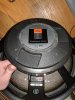
I have pulled one of my 2235H from the L300s and can now say with absolute certainty that they are indeed negative polarity. Red terminal to battery positive causes the cone to suck in, toward the magnet.

Since it really kinda scares me to remove the woofers as they are quite heavy and the foam is fragile I recommend anyone that is thin/small enough place their left arm through the port and hold the magnet while loosening screws and removing the woofer. This seemed to work great for me.

While I am in there I will verify the other connections in the cabinet.
 
I agree with Jeffery. L300s would be a great score, if they were in excellent condition. But because you’d have to maybe replace the drivers...and maybe rebuild the crossovers, they could be expensive to restore.
 
I agree with Jeffery. L300s would be a great score, if they were in excellent condition. But because you’d have to maybe replace the drivers...and maybe rebuild the crossovers, they could be expensive to restore.
Oh but so very worth it. You may not realize it, but this thread has been going (on and off) for over 3 years.

BTW, all the drivers are correctly connected, as near as I can figure it. The solid color wire is running to the positive (red) terminal of each driver. And vice versa for the negative (black) terminal which has the color/stripe wire.
 
Back
Top Bottom