• The move to the new server is done. There are some software and database maintenance updates in process. This has us passing the hat around to help out. We appreciate any donations. Seriously, even a dollar helps. The payment page may be found here - https://www.audiokarma.org/support.html

JBL L60T - the red headed stepchild?

wu6fiend

Well-Known Member
I've owned a pair of JBL L60T speakers since new in 1987. Over a year ago, I put them up for sale, on consignment, at a local vintage stereo store. They are in very good condition, complete with original boxes, packaging, and owners manual. Not one offer. They will now be returning to my basement storage room.

I've long understood that the L60T, out of all the other members of its family, is the most unloved. There's a couple of obvious reasons: it is only a two way, and it is a large speaker, which means it occupies practically the same real estate as its bigger (and much more respected) brother, the 3-way L80T. (At the time, I would have bought the L80Ts, but they were considerably outside my paltry student budget.)

But the L60T also is a very nice-sounding speaker, well built and attractive to look at, and as such IMO offers a lot of value.

I guess I will just keep them, as I cannot in good conscience part out a perfectly good set of speakers just for the sum a few components could bring on a certain auction site.

Anyone else own/have owned the L60T, and have an opinion to share?
 
Register to hide this ad
I have a set I played with a few years back. They seem to suffer from a hole in the middle, which is why I sold off the tweeters and have kept the cabs and woofers for an Econowave project, which I may get to this winter.

They impressed me and Kegger with the bottom end they had out in the garage when we were tweaking my Altec Valencias. It was good enough to set them aside for a look at later.
 
Last edited:
I am a huge fan of the 035ti/035tia tweeter, but asking it to reach down to 2500hz is asking a lot. That is what it is crossed over at in the L60T. In the L80T & L100T it's crossed over at 4500hz! The later L3, also a 2-way with the same tweeter and an 8" woofer, is crossed over at 3000hz. Slightly higher, and I do believe it is better, even though it still shares the heritage of being the least popular speaker of it's series.

Another small issue is the L60T being 6ohms, as opposed to 8ohms. Shouldn't be a problem really, but I bet it was a factor in them being less popular when they were new.
 
I am a huge fan of the 035ti/035tia tweeter, but asking it to reach down to 2500hz is asking a lot. That is what it is crossed over at in the L60T. In the L80T & L100T it's crossed over at 4500hz! The later L3, also a 2-way with the same tweeter and an 8" woofer, is crossed over at 3000hz. Slightly higher, and I do believe it is better, even though it still shares the heritage of being the least popular speaker of it's series.

Another small issue is the L60T being 6ohms, as opposed to 8ohms. Shouldn't be a problem really, but I bet it was a factor in them being less popular when they were new.

The L7 and L5 are both rated 6-ohm so I doubt that makes any difference. Sure wouldn't to me. And the L3 is 8-ohm so that pretty much shoots that theory! :D

The problem with the L60T is it just doesn't sound that great—compared to the rest of the line. I like the L20T better, and actually might prefer the L1 to the L3, but the L3 still beats the pants off the L60T.

Doesn't mean the OP can't enjoy them for what they are which is very nice speakers that just don't quite live up to the rest of their family. If it weren't for the Internet no one would be able to look up the opinion of the JBL loudmouths and you'd have had your sale! Of course I have no idea what the OP or the consignment shop were asking for them. Unrealistic expectations may have played a part in the no-sale outcome. :dunno:
 
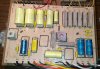
It still seems odd to me that they used an electrolytic for the tweeter in this one and they used film for the rest of the line.

If you put in a film cap it will make the tweeter sound much better. :thmbsp:

http://www.jbl.com/images/media/L60T ts.pdf

EDIT: IMHO, Swapping out all those electrolytics with these films will put you a step ahead. :yes:

http://www.erseaudio.com/Products/PEx250v/6uF-250-volt-Metallized-Polyester-Mylar-Film-Capacitor

no affiliation.

JBL%2BL60t%2Bcrossover.jpg
 
Last edited:
IMHO, the L60T is one of those speakers that could GREATLY be improved, by converting to an Econowave setup. The 8x8 JBL PT Waveguide and a good horn driver would be my go-to in a pair of those. No more hole in the middle!

Regards,
Gordon.
 
IMHO, the L60T is one of those speakers that could GREATLY be improved, by converting to an Econowave setup. The 8x8 JBL PT Waveguide and a good horn driver would be my go-to in a pair of those. No more hole in the middle!

Regards,
Gordon.

Yep.

I've had a set of these up in my attic for about 5 years and dragged one down to play with as I have the Econowave setup for my Bozaks at hand. After about a 2 minute wire swap, I had the L60T playing with the standard Econowave crossover, the Pyle 612 horns and the Dayton D250P drivers I'm using with the Bozaks.

It sounds much better...:yes:

Unfortunately, the Bozak betters the L60T, so I won't be pursuing the L60T project, but would probably have if the Bozaks weren't already part of the competition. The bigger drivers and cabs just have a much more solid bottom.

That being said, I certainly WOULD recommend the Econowave path to anyone with a set of these speakers. Flip the crossovers and the 035TI tweeters and you'll get a nice chunk of change towards the conversion to a much nicer sounding speaker.
 
Last edited:
A couple of thoughts on the L60T's

I've had a number of speakers over the years including a number of JBL pairs, the L100, L80, L110, L40 and the 4411. Of all of these, my favorites have been the L60T's. I consider them to be the California version of the classic British two-way. I've just had them refoamed and they have regained their focus. It's only paltry money for what I consider a beautiful sounding set. Three things I have found absolutely necessary for them to be at their best. First they need air space around them, both behind and at their sides. Proper height is the second consideration. I use Target brand stands to elevate the tweeter to the level of the ear in my listening room's "sweet spot". These two things done, I toe them in slightly and am extremely happy with them. Those that view them as bookshelf speakers often skip this last step. I listen to classical music almost exclusively and they have a wonderful but not overblown bass extension. So cherish those old classics that you have so economically.
 
I have two pairs of L40T3's, which I believe used the same drivers as the L60T, and not sure about the crossovers. The L40T3's sound better than the L20T and I really like them.
 
I sold the crap out of L60Ts in the day. Easier drive than the L80/L100, but as noted, the mids were the weak spot. A bit of toe in helped quite a bit since it was more a dispersion issue than a "not playing it" issue.

As noted, the L3 did take care of some of the shortcomings of the L60, same driver complement, but angled baffle and updated crossover. However, both of these speakers were "red headed stepchildren" as noted in another post. I preferred the L20 and the L80, and in the later line, the L1 and the L5. The L7 could do nice things if you fed it and put it in a large room, but IHMO lacked the balance of the other two.

I still own a pair of L1s that make it out every now and then. They are fun, but quite unrefined in the company they currently keep here.
 
As noted, the L3 did take care of some of the shortcomings of the L60, same driver complement, but angled baffle and updated crossover. However, both of these speakers were "red headed stepchildren" as noted in another post. I preferred the L20 and the L80, and in the later line, the L1 and the L5. The L7 could do nice things if you fed it and put it in a large room, but IHMO lacked the balance of the other two.

The 708G-1 driver in the L3 is also the mid-bass driver in the L7 and the LF in the L5. Not the same as the 116H-1 in the L60T. I have the L80T/3, L1, L3, L5, and L7 (among others) and there's no way anyone would ever choose the L1 or L5 over the L7 if they had room to put the big boys!

The L5 is an awesome speaker for what it is but the power and ability to lose itself in the room is what I like about the L7. I've never agreed with those who decry the placement issues with the L7. I have two pair and you can just drop them in any room and they'll own the room, as long as you don't aim the side-firing twelves at your audio shrine. You can put them out in a room and even walk around them without losing the soundstage. They're all great but the L7 is exceptional!
 
I've owned a pair of JBL L60T speakers since new in 1987. Over a year ago, I put them up for sale, on consignment, at a local vintage stereo store. They are in very good condition, complete with original boxes, packaging, and owners manual. Not one offer. They will now be returning to my basement storage room.

I've long understood that the L60T, out of all the other members of its family, is the most unloved. There's a couple of obvious reasons: it is only a two way, and it is a large speaker, which means it occupies practically the same real estate as its bigger (and much more respected) brother, the 3-way L80T. (At the time, I would have bought the L80Ts, but they were considerably outside my paltry student budget.)

But the L60T also is a very nice-sounding speaker, well built and attractive to look at, and as such IMO offers a lot of value.

I guess I will just keep them, as I cannot in good conscience part out a perfectly good set of speakers just for the sum a few components could bring on a certain auction site.

Anyone else own/have owned the L60T, and have an opinion to share?


I had bought a pair in 1986 still own them re-foamed twice since then. They still sound awesome.
My other speakers are Bose 901, Bose 601 (a project yet to complete), Mission 765 and B&W 601.
 
I still have my L60Ts, as I couldn't sell them. And I note with interest, there have been a couple pair locally on CL, for between $200 - $250 Can (which today equals $157 - $196 USD). Despite repeated re-listing, no sale. Both appear to be in very good condition. So that shows how little the L60T is worth. So when my wife says "why don't you get rid of those things?" I just say, "Apparently, they aren't worth hardly anything at all."
 
I'm a fan of the JBL Lxxt series.
I have a pair of the L100t's the I've upgraded to the t3 crossover.

I just missed buying a set of L60t's for $125 from a used stereo shop in Seattle.
Too bad the borders is closed, Surrey isn't too far from where I live in WA state.
 
It still seems odd to me that they used an electrolytic for the tweeter in this one and they used film for the rest of the line.

If you put in a film cap it will make the tweeter sound much better. :thmbsp:

http://www.jbl.com/images/media/L60T ts.pdf

EDIT: IMHO, Swapping out all those electrolytics with these films will put you a step ahead. :yes:

http://www.erseaudio.com/Products/PEx250v/6uF-250-volt-Metallized-Polyester-Mylar-Film-Capacitor

no affiliation.

JBL%2BL60t%2Bcrossover.jpg

JBL used electrolytic's only on the LF, MF and UHF drivers on the 250Ti's as well. I cant imagine they didnt have a reason for this..maybe one day we will know.

upload_2021-2-9_11-4-29.jpeg
 
I still have my L60Ts, as I couldn't sell them. And I note with interest, there have been a couple pair locally on CL, for between $200 - $250 Can (which today equals $157 - $196 USD). Despite repeated re-listing, no sale. Both appear to be in very good condition. So that shows how little the L60T is worth. So when my wife says "why don't you get rid of those things?" I just say, "Apparently, they aren't worth hardly anything at all."
They seem to consistently be worth the value of the tweeters. Cabinets generally get tossed and there's not much of a market for the other driver.
 
Last edited:
I have a pair of L20T s


Without a schematic I will have to guess, and my guess is that they're not in the signal path.

I think so..I never got a clear answer on what "in the signal path" means. My thinking is that the caps with green arrows are "in path"..and the red arrows that point to the caps I mentioned are "not in path". So in path would be any component ALL of the signal has to pass through. Correct?

upload_2021-2-12_11-11-36.jpeg
 
Agreed. Red is not in the signal path, green is. In my (now distant) filter design experience the design / type of (capacitor) component in the signal path (green arrows) typically has far more infuence on the signal, than a component that is simply clamping or out of the signal path (red arrows).

Or in other words: changing the green arrow capacitors' type has the potential to affect the sound more than does changing the red arrow capacitors. If you change from an electrolytic (JBL, Greg Timbers' choice) to a film cap in those locations you might change the sound, but that doesn't mean improve.

My opinion? Greg's first love and some of his greatest talent (go ask on the LH site, maybe he'll answer?) was networks. He has talked about how he liked designing (crossover) networks, had pretty free-reign on the 250Ti as evidenced by the massive amount of money spent on these crossovers (relative to pretty much anything else JBL produced for the domestic market before and after). Most capacitors are film, quality inductors, quality circuit-board, Monster Cable interconnects, I think it's a pretty big claim that for some reason he had to cut corners on six capacitors in this design to save maybe $1.00 per speaker (considering JBL's buying power maybe less). So if that wasn't the motivation to installing EL caps instead of film caps in these six locations that leaves three possibilities (understanding that this design went from one of the most talented and experienced Speaker Designers of the time through all of the testing and auditioning to production):

1) These six capacitors didn't have any measurable influence on the SQ and were therefore selected as electrolytic capacitors

2) These six capacitors did have measurable/perceivable influence on the SQ and the electrolytic capacitors provided a better sonic result than film caps in these positions

3) Greg Timbers didn't know any better, made poor choices and it's a good thing experimenters here know better and can hear better than all of JBL's $millions in laboratory equipment, measurement equipment, and experienced people involved in the listening / validation testing at JBL.

Choose one of the above, I choose #2, maybe #1.

I know that electrolytic to film swaps are viewed as a general improvement across the board (pun intended) here at AK, and only a few of us question the modifications as an "improvement" without substantial testing and understanding of the original choice, in the end it is your choice and they are your speakers.
 
Last edited:
Back
Top Bottom