


creator12
New Member
Hello!
Over the course of the last couple of years I have been split between two systems that were both primarily made up of Yamaha components.
My first system at home contained a Yamaha R-100 receiver, K-2000 cassette deck, Genesis 1+ speakers, ADC Sound Shaper One Ten MK.II, and a Dual CS-5000 turntable with an Ortofon 2M Blue cartridge.
My second system at my apartment near school was made up of a Yamaha R-50 receiver, NS-6 speakers, and a P-300 turntable with a Grado GF-3 cartridge. Eventually the P-300 turntable at school was replaced with a Technics SL-1200 MK.II which then had a Ortofon 2M Blue cartridge added on.
When I eventually made it back home for quarantining and online classes, I decided that I wanted to keep both my turntables (as I was graduating and no longer had any need for two seperate systems), but I needed a new piece of equipment to allow for the usage of both in my singular system. I initially tried to use a phono switch box which would allow for two turntables through a single phono port, but I found that the amount of electrical noise in the background was overwhelming and instead went for replacing my receiver.
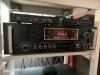
I decided to look for a piece of equipment that was built throughout the 80s (to match the rest of my equipment) that preferably would maintain most of the functionality of my Yamaha R-100, but with the ability to build on for future system upgrades. After about a month of research, I came across the MAC 4100, 4200, and 4300V. I immediately focused on the 4100 and 4200 as both supported dual phono ports, however the industrial design of the 4200 won me over.
I then went through eBay and found a MAC 4200 with a starting bid of $800 that was listed as being in "Tested" condition. It also appeared to be in pretty good shape physically. Thanks to Bidnapper I was able to get it for a little around $1,175.00 before shipping and taxes, which brought the price to $1,280.99.
Over the course of waiting for a couple days, I researched quite a bit more into the history of the MAC 4200. Through Audiokarma I learned that it had an extremely low production run and a history of potential battery problems through the AM/FM tuner which came down to the usage of three rechargeable AA NiCad batteries. Beyond this I was happy to learn that the 4200 had been built in McIntosh's factory in NY and generally had a good reception online as a quality receiver.
Once I received my receiver at the beginning of the week and started my testing, I discovered that my unit had succumbed to the same problem with the rechargeable batteries. Again, thanks to Audiokarma, I was able to read into posts from 2009 and 2019 that dealt with the replacement process for the batteries.
I am no expert in electronics, so I was incredibly happy to see that it was just a matter of pulling out the old batteries and removing dried battery acid with isopropyl alcohol in the battery slot. I used Living Accents Ni-Cad AA 1.2 volt Solar Rechargeable Batteries from Ace Hardware (https://www.acehardware.com/departm...ctrical/batteries/specialty-batteries/3909728) as a replacement for the original Sanyo batteries.
Over the last 24 hours I have had no problems with the new batteries and now my receiver is completely functional. I've only used it for a couple days but already I prefer this to the R-100. The only two functions I lost from the R-100 in switching over was the usage of a remote control and the ability to save 10 stations instead of 6 stations. In my opinion, it is a small price to pay now that I could connect an additional turntable and set of speakers (2 sets to 3 sets).
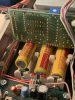
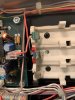
I have included pictures of the battery slot if anybody needs them for future work on their MAC 4200. I will post my full setup soon to show how it changed from the R-100 to the MAC 4200.
-J


Over the course of the last couple of years I have been split between two systems that were both primarily made up of Yamaha components.
My first system at home contained a Yamaha R-100 receiver, K-2000 cassette deck, Genesis 1+ speakers, ADC Sound Shaper One Ten MK.II, and a Dual CS-5000 turntable with an Ortofon 2M Blue cartridge.
My second system at my apartment near school was made up of a Yamaha R-50 receiver, NS-6 speakers, and a P-300 turntable with a Grado GF-3 cartridge. Eventually the P-300 turntable at school was replaced with a Technics SL-1200 MK.II which then had a Ortofon 2M Blue cartridge added on.
When I eventually made it back home for quarantining and online classes, I decided that I wanted to keep both my turntables (as I was graduating and no longer had any need for two seperate systems), but I needed a new piece of equipment to allow for the usage of both in my singular system. I initially tried to use a phono switch box which would allow for two turntables through a single phono port, but I found that the amount of electrical noise in the background was overwhelming and instead went for replacing my receiver.
I decided to look for a piece of equipment that was built throughout the 80s (to match the rest of my equipment) that preferably would maintain most of the functionality of my Yamaha R-100, but with the ability to build on for future system upgrades. After about a month of research, I came across the MAC 4100, 4200, and 4300V. I immediately focused on the 4100 and 4200 as both supported dual phono ports, however the industrial design of the 4200 won me over.
I then went through eBay and found a MAC 4200 with a starting bid of $800 that was listed as being in "Tested" condition. It also appeared to be in pretty good shape physically. Thanks to Bidnapper I was able to get it for a little around $1,175.00 before shipping and taxes, which brought the price to $1,280.99.
Over the course of waiting for a couple days, I researched quite a bit more into the history of the MAC 4200. Through Audiokarma I learned that it had an extremely low production run and a history of potential battery problems through the AM/FM tuner which came down to the usage of three rechargeable AA NiCad batteries. Beyond this I was happy to learn that the 4200 had been built in McIntosh's factory in NY and generally had a good reception online as a quality receiver.
Once I received my receiver at the beginning of the week and started my testing, I discovered that my unit had succumbed to the same problem with the rechargeable batteries. Again, thanks to Audiokarma, I was able to read into posts from 2009 and 2019 that dealt with the replacement process for the batteries.
I am no expert in electronics, so I was incredibly happy to see that it was just a matter of pulling out the old batteries and removing dried battery acid with isopropyl alcohol in the battery slot. I used Living Accents Ni-Cad AA 1.2 volt Solar Rechargeable Batteries from Ace Hardware (https://www.acehardware.com/departm...ctrical/batteries/specialty-batteries/3909728) as a replacement for the original Sanyo batteries.
Over the last 24 hours I have had no problems with the new batteries and now my receiver is completely functional. I've only used it for a couple days but already I prefer this to the R-100. The only two functions I lost from the R-100 in switching over was the usage of a remote control and the ability to save 10 stations instead of 6 stations. In my opinion, it is a small price to pay now that I could connect an additional turntable and set of speakers (2 sets to 3 sets).
I have included pictures of the battery slot if anybody needs them for future work on their MAC 4200. I will post my full setup soon to show how it changed from the R-100 to the MAC 4200.
-J


