• The move to the new server is done. There are some software and database maintenance updates in process. This has us passing the hat around to help out. We appreciate any donations. Seriously, even a dollar helps. The payment page may be found here - https://www.audiokarma.org/support.html

Just Ordered a Pair of the New, Class-AB Topping B100 Monoblocs...

Are you interested in the new, Class-B Topping B100 Monoblocs?

  • Yes, absolutely!

    Votes: 4 25.0%
  • No, not at all.

    Votes: 9 56.3%
  • Maybe, but it depends (please provide detail)...

    Votes: 3 18.8%

  • Total voters
    16

EddNog

Active Member
Hoping to get them soon. Seller (Apos) says they're in stock (JUST released this morning), but in their China warehouse, so have to wait for them to make their way over to me here in New Jersey. Am excited to see how these compare to my current setup (Class-D Fosi ZA3s running one per speaker in Stereo mode, rolled with Burson V7 Vivid op-amps). These will be my first Class-B speaker amps, so very curious to see how they sound compared to the Class-D Fosis. I also have access to a pair of Class-D Fosi V3 Monos rolled with Sparkos SS3602 op-amps for comparison if need be (gave them to my dad in New York).

Will be driving a pair of KEF LS50 Metas that are supplemented down low by an SVS SB-3000 subwoofer. I feel like I use very little of the power generated by the Fosi amps, so the lower (rated) power Topping B100s should still be sufficient drive. They do have three different gain settings to play with, too.

Anyone else looking into or ordered a pair of these yet? Would love to keep everyone's impressions and experiences here in one thread if possible.

-Ed

EDIT: Class-AB amended to Class-B due to Topping's blunder
 
Last edited:
Register to hide this ad
Whats the max distortion specs for mono at full output? You would be surprised at how high distortion can be before you can even hear it.
 
Don’t need the extra power and stereo mode has lower rated distortion.

-Ed
Dependent on the equipment(speakers) all we need is one watt..
I have to assume you have truly exceptional hearing.. based on Fosi's specs, under .006% thd+n.. amir's review showed in mono mode thd+n at .018..
Whats the max distortion specs for mono at full output? You would be surprised at how high distortion can be before you can even hear it.
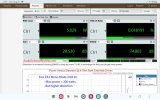
Amir's review re: thd+n

Screenshot_20240827_175121_Chrome.jpgScreenshot_20240827_175152_Chrome.jpg
 
Whats the max distortion specs for mono at full output? You would be surprised at how high distortion can be before you can even hear it.
Dependent on the equipment(speakers) all we need is one watt..
I have to assume you have truly exceptional hearing.. based on Fosi's specs, under .006% thd+n.. amir's review showed in mono mode thd+n at .018..

Amir's review re: thd+n

View attachment 3283775View attachment 3283776
Now where did I ever say I could hear the difference? The fact remains that I don’t have a use for the extra power, but reduced distortion is always nicer. Do you guys somehow disagree? Even if so, I’m happy to disagree.

-Ed
 
Now where did I ever say I could hear the difference? The fact remains that I don’t have a use for the extra power, but reduced distortion is always nicer. Do you guys somehow disagree? Even if so, I’m happy to disagree.

-Ed
No, I don't disagree at all. I was just curious about the distortion specs in mono vs stereo. I wasn't suggesting whether you could hear the difference or not. Sorry if it came off that way.
I just added that it takes a lot more than you would think before you notice distortion. I found this out using a distortion analyzer. I was surprised at how high it had to get before my ears noticed it.
A small tube amp I built is rated for 5% distortion at its full 5.5wpc output.
It just isn't noticable really. The amp is in a second system used for near field listening and even with 1% or so distortion at lower volumes the amp sounds very nice.
 
No, I don't disagree at all. I was just curious about the distortion specs in mono vs stereo. I wasn't suggesting whether you could hear the difference or not. Sorry if it came off that way.
I just added that it takes a lot more than you would think before you notice distortion. I found this out using a distortion analyzer. I was surprised at how high it had to get before my ears noticed it.
A small tube amp I built is rated for 5% distortion at its full 5.5wpc output.
It just isn't noticable really. The amp is in a second system used for near field listening and even with 1% or so distortion at lower volumes the amp sounds very nice.
Oh yes that’s for sure. I never noticed distortion per se when using the tube buffer mode in my Freya+ preamp even though I knew that, technically, it was there.

-Ed
 
Well now Topping came back and corrected themselves stating that it’s Class-B and now my thread title looks like ass.

IMG_4145.jpeg
 
Is it a class B chip amp then? Or does it use discrete outputs I wonder.
I would expect it to acually be Class A/B though?
I did work on a SS amp a couple years ago that had a separate class A chip amp that would switch to a discrete class B amp for higher volumes.
That's kind of the exception though.
 
Is it a class B chip amp then? Or does it use discrete outputs I wonder.
I would expect it to acually be Class A/B though?
I did work on a SS amp a couple years ago that had a separate class A chip amp that would switch to a discrete class B amp for higher volumes.
That's kind of the exception though.
I was not even aware that Class-A or Class-B chip amps were a thing. Granted, Topping states that this amp uses some sort of proprietary design they call, "T'ang-ku-la," which relies on triple (negative) feedback (among other things) to achieve its performance. Now that doesn't necessarily mean it is fully discrete (not something I see claimed anywhere), but it also seems difficult for a company of this size to actually engineer and produce (or contract out) microchip designs. And of course this is not to say they didn't simply have a proprietary implementation of someone else's amp chip, either.

-Ed
 
I wonder if triple negative feedback, to achieve low distortion numbers presumably, has an actual negative affect on the sound quality?
 
I saw a review by Tharbarmar of the Topping 200 monoblocks and it was generally positive except he felt the power supplies might be holding it back somewhat.
 
I saw a review by Tharbarmar of the Topping 200 monoblocks and it was generally positive except he felt the power supplies might be holding it back somewhat.
Yeah…I don’t think the B200 uses the same architecture/technology as B100, which has more in common with A70 Pro. B200 shares more with LA90 Discrete.

-Ed
 
I was not even aware that Class-A or Class-B chip amps were a thing. Granted, Topping states that this amp uses some sort of proprietary design they call, "T'ang-ku-la," which relies on triple (negative) feedback (among other things) to achieve its performance. Now that doesn't necessarily mean it is fully discrete (not something I see claimed anywhere), but it also seems difficult for a company of this size to actually engineer and produce (or contract out) microchip designs. And of course this is not to say they didn't simply have a proprietary implementation of someone else's amp chip, either.

-Ed
I'm always interested in new designs and topologies.
 
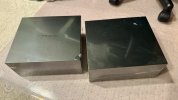
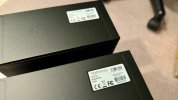
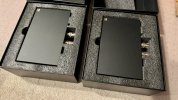
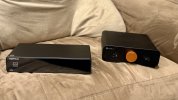
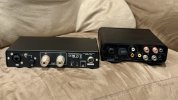
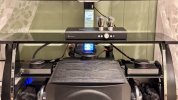
They’ve arrived! Got them hooked up and playing but too busy to get time to properly blend my subwoofer in yet. Included comparison pics with ZA3. The quality seems to be another level with some components like the speaker binding posts being WAY nicer. Interesting to see the power supplies connect to the amplifier with aircraft connectors, a change coming from all my experiences with amps from Douk and Fosi.

IMG_4201.jpeg

IMG_4202.jpeg

IMG_4203.jpeg

IMG_4204.jpeg

IMG_4205.jpeg

IMG_4206.jpeg

IMG_4207.jpeg

IMG_4209.jpeg
Please excuse the doorstops—I need them to keep the amps from sliding around due to tension from the cables (I’m not some kook who thinks they somehow have an effect on the sound).

-Ed
 
Back
Top Bottom