• The move to the new server is done. There are some software and database maintenance updates in process. This has us passing the hat around to help out. We appreciate any donations. Seriously, even a dollar helps. The payment page may be found here - https://www.audiokarma.org/support.html

JVC (Victor) K2 Interface Technology - A blast from the past?

SimplySound

Kent Engineering & Fondry
Or could JVC's technology be another gateway to the future?

A lot has been written over the last few years in the realm of Digital Recording/Playback Technology around the 'Time Domain'. There are many who feel this is where the original Redbook CD's got it wrong. They focused exclusively on expanding the dynamic range and improving the SNR by capturing a much improved frequency range. But in the process there was a lack of understanding around the impacts of digital processing within the time domain.

That is beginning to change in many ways, but are we just going back to the future? Back in the early 90's JVC-Victor in Japan began creating the K2 Integration process that eventually resulted in the development of XRCD's. These are effectively Redbook CD's that are mastered in 20 or 24bit formats with 128kHz sampling, but they also tried to adjust for distortion in the time domain. Many feel they are some of the better sounding RBCD's, so maybe JVC Victor was on to something!

So what is the future of K2? Well, JVCKenwood still maintains the K2 Technology. And they are promoting a technology called 'Exofield' for Head-Fi. So, don't know where this may go, but I myself always find it interesting to follow along!
 
Last edited:

Register to hide this ad
As a reference to the early days of the JVC (Victor) K2 Technology, I found this post to be of interest detailing the chips used and it also provided some interesting links.
 
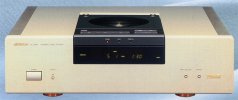
There is definitely something in Victor's K2 processor. Victor also made great transports, incuding what many regard as the best off the shelf RBCD transport mech ever made - the XL-Z900 used in the Reimyo CDP-777 (and XL-Z900 cd player) which also used JVC's 'Extended k2' processor, a D/A converter with 24 bit/705.6kHz data rate and 24-bit/176.4kHz processing with 4 x oversampling, 117db S/N ratio and 0.003% THD. Not bad specs for 2004.

I owned a JVC XL-Z1050 cdp which I ran as a CDP for 16 years, then ran it as a transport with the legendary Vimak DS-1800Mk2 dac. That cdp had excellent build quality for it's price point, a very good Victor transport, JVC's K2 anti-jitter circuit, a proprietory JVC single bit dac chip and was part of the "Super Digifine" series. That player sounded quite resolving, smooth, quiet and nailed the midrange. To sum up it's sound in one word, i'd say "natrual". I would have loved to have owned the Reimyo, but I wasn't complaining about the XL-Z1050.

Btw, this page covers the history of JVC's K2 interface. JVC have continually developed that technology since 1987. So hopefully XRCD24 and K2HD Pro Mastering carry the torch until the next generation of K2 technology arrives.

1707242730696.jpeg
1707243359289.jpeg
 
Last edited:
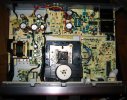
Yeah, it seems that the JCE4300 chip was the magic sauce! The JVC XL-Z1050 is listed with (JVC - JCE4501 - JCE4300 - YM3414) in the Dutch references.

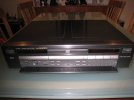
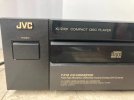
It also looks like the JVC XL-Z551/552 used it as well (JVC - JCE4501 - JCE4300 - SM5840DP)

What I found a bit interesting is the JVC XL-Z331 lists just the JVC - JCE4302A. Not sure if this is the same type of chip or not. The Z331 deck does not promote the 'K2 Technology', but has some description of what perhaps is a variation? Very strange!

Bottom-line, I'm going to keep and eye out for a Z551/552! Seems they may be had pretty cheap!

JVC s-l1600.jpg
 
Last edited:
Hey @Bodhi1 ... you've probably seen this review of the JVC XL-Z1050, but thought I'd throw it in here for posterity.

Thanks for posting the link. I've actually never seen that review before, so i'll read it tonight over a cup of tea to see if the reviewers findings mirror my own. Btw here is a good review fyi. That player gave me 17 years of pleasure. It had very good build qaulity, nice casework and was smooth, transparent and natural sounding. As such it's weak points were easily forgiven...especially at it's pricepoint. But time has moved on, and my current Vitus SCD-025Mk2 spinner is considerably better than my old JVC XL-Z1050. The Vitus just sounds better across the board as you'd expect given the 2 decades since the JVC was released, and considerable price difference. It sounds more analogue, resolving and natural; and the bass is much better.

JVC's K2 interface was designed to reduce jitter. Vitus achieve that goal firstly through brute force. As you can see from the pics below, the Vitus's transport is a heavily modified Philips CD Pro2LF transport mounted on a heavy milled aluminium base, which is then decoupled at 4 points from the chassis. This greatly reduces errors reading disc information, and takes the burden off the error correction system within the drive. Secondly, they use sample rate conversion to minimise jitter, achieving a sample rate of 384kHz thanks to the Engineered Q8 sample rate converter module. The Q8 is a stereo synchro-upsampler which first upsamples standard 16 bit/44.1kHz redbook cd's to 24 bit/384 kHz through true extrapolation, then sends the signals to the two AD1955 dac chips. And thirdly Vitus uses a very accurate master clock measuring 24,576 MHz +/-5ppm, suggesting similar performance to MSB's top Femto 33 clock.
 

Attachments

  • 1707820228998.jpeg
    1707820228998.jpeg
    135.2 KB · Views: 12
  • 1707820273407.jpeg
    1707820273407.jpeg
    132.5 KB · Views: 11
  • 1707820299183.jpeg
    1707820299183.jpeg
    73.3 KB · Views: 12
Last edited:
I posted this over in the SACD vs XRCD thread. It looks like the JCE4302A was a further development of the JCE4300. This chip, which has been referred to as the 'magic sauce' for the K2 Technology, controls the noise filtering (shaping) and clock timing within the K2 Chip Set. The JCE4501 was the actual DAC chip which was able to convert 20bit content.

In with this mix of components was the Yamaha YM3414. It is defined as a; "sound generator IC designed for use in various electronic applications. This IC is part of the Yamaha YM series of sound generators and is a popular option for creating sound effects in musical instruments and other electronic devices."

I assume what they were doing is using this chip to provide the sound elements to do their 'noise shaping'. My guess anyway.

 
Last edited:
I have an XL-Z1011 in storage, incase my transport/DAC dies, great player for the money. Been meaning to sell the matching amp for a while, as I'll doubt I'll need it again
 
I bought an XL-Z1050 new back in the day because it sounded better than anything else I could find at the time (still works great today). The retiming circuit is a big deal as far as the sound goes. Back then, I was in the semiconductor business and dealing with most of the major Japanese audio equipment companies. In the early days of digital audio, people were still trying to figure out how the technical parameters influenced sound. One thing that was not fully realized early on was the affect of jitter. Upon further investigation, it was found that there were some folks that could detect jitter down in the 10ns range according to one R&D manager I spoke with in Japan.
 
Yeah, it seems that the JCE4300 chip was the magic sauce! The JVC XL-Z1050 is listed with (JVC - JCE4501 - JCE4300 - YM3414) in the Dutch references.

It also looks like the JVC XL-Z551/552 used it as well (JVC - JCE4501 - JCE4300 - SM5840DP)

What I found a bit interesting is the JVC XL-Z331 lists just the JVC - JCE4302A. Not sure if this is the same type of chip or not. The Z331 deck does not promote the 'K2 Technology', but has some description of what perhaps is a variation? Very strange!

Bottom-line, I'm going to keep and eye out for a Z551/552! Seems they may be had pretty cheap!

View attachment 3110665
Regarding the Z331/Z335, I stumbled across this thread while looking for a suitable matching CD for the AX-V1050:
A lot of interesting information about the JCE4302A and the quite remarkable performance of it. I do have a Z331 incoming now due to this :)
 
Back
Top Bottom