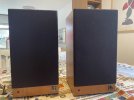
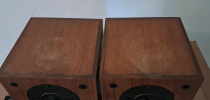
Yes, avoid sanding. The cabinets are made of veneered chipboard and the veneer is not thick enough to withstand sanding.
The white marks, to me, indicate that the moisture that was left from whatever was put on there dissolved the stain originally applied, so it's not really a matter of removing white spots but "filling" the white spots with some tint of stain to bring them close to the surrounding tint.
As these are 40+ years old and obviously not well taken care of, I would expect lots of dirt to be present on the surfaces. This layer needs to be removed. I have found that 70-90% alcohol is mild enough to not damage the texture yet potent enough to clean. I would use a (small) fist sized cotton ball impregnated with alcohol to wipe the surface many times, at least while dark black/grey much is left on the cotton. Takes plenty of cotton to go through it.
As the surface cleans, you get a better view of the actual color / discoloration you have to work with. And you need to clean the surfaces before applying any kind of new finish.
I would also try paint stripper, starting with the bottom side. These days they are not really potent but do work well for removing varnish/oil/dirt. Goes much faster than alcohol, but I would also wipe it down with alcohol after treating it with paint stripper, to get it cleaner and remove remnants of stripper.
Using oxalic or even "peroxide" (H2O2) (dilluted) would uniformly remove the stain, be it added or native to the veneer. I have seen veneer and actual wood treated like that ending up almost vanilla white, like dry bones. Useful if you want to completely alter the tint, but I feel it's too far a journey to take.
Once the surface is clean you can choose an appropriate stain to match the unaffected area and I would use either a thick brush to "dry brush" the affected areas or rug and then wipe it. Repeatedly, in small tone "enhancements". Takes some time, but that's how it should be done. Experienced furniture restorers can achieve tone correction in 2-3 passes, us lesser folks have to put up with many more.
I have finished similar era loudspeakers from KEF (supposedly same kind of veneer/texture) both with bees wax and with matte urethane hardwood varnish. The latter, I used a sponge roller and took small amounts of varnish and many thin layers that I worked with the roller across the surface repeatedly, until the surface looked dry. Then let to cure for a couple of hours. Did 4-5 hands per day for two days. Very light sanding with 240 finishing paper between passes, just to rough up the surface, not take out the previous layer.
The end result with beeswax is nice and becomes nicer after a few weeks. Varnish looks equaly nice done this way because it doesn't get glossy and mirror finish like. They are both resistant to water stains, but the varnish treated surfaces are a bit more resistant. I had to redo my KEF 104 after 8-10 years - they suffered from stains caused by my lovely dog's saliva.