• The move to the new server is done. There are some software and database maintenance updates in process. This has us passing the hat around to help out. We appreciate any donations. Seriously, even a dollar helps. The payment page may be found here - https://www.audiokarma.org/support.html

KEF's Uni-Q Driver... a full range/coaxial/single point source speaker???

hnash53

Super Member
KEF has developed a Uni-Q driver, and I am wondering, do these speakers perform/function like full range or coaxial or single point source speakers? Is there some kind of crossover used... and if so, what is being "crossed-over"?

The LS50s and the "Q" series have the Uni-Q driver as the only driver in the cabinets.

However, I've not read much if any language about these being full range, etc. But seems that they are indeed a full range speaker. Is that correct?

Thanks.
 
Register to hide this ad
KEF has developed a Uni-Q driver, and I am wondering, do these speakers perform/function like full range or coaxial or single point source speakers? Is there some kind of crossover used... and if so, what is being "crossed-over"?

The LS50s and the "Q" series have the Uni-Q driver as the only driver in the cabinets.

However, I've not read much if any language about these being full range, etc. But seems that they are indeed a full range speaker. Is that correct?

Thanks.
They are a two-way design with a concentrically mounted tweeter. Yes there is a crossover in there, it is the music signal that is being crossed over, highs to the tweeter, lows to the mid-woofer. Some would describe them as co-axial, others would say point-source but none would correctly describe them as "full-range". By nature of their design they lack the bottom couple of octaves, this is understood (by most, some folks just don't get this at all). Blend in a subwoofer or two and you're all set.
 
I bought a pair of C75's. Unfortunately, one tweet was bad (common failure) and I failed to source one in 5 years of trying. Found a smaller one they used in another, put IT in, and as expected, sound was unbalanced. I sold them in a yard sale to a guy who was tickled to death.

What I did hear on the good one was very promising.
 
I bought a pair of C75's. Unfortunately, one tweet was bad (common failure) and I failed to source one in 5 years of trying. Found a smaller one they used in another, put IT in, and as expected, sound was unbalanced. I sold them in a yard sale to a guy who was tickled to death.

What I did hear on the good one was very promising.
They've come a long way since then of course and those were the low-end of the line. The new tech is leaps and bounds ahead of the old stuff. If you ever get a chance to, give a listen to the Blade and/or Blade II speakers, they are quite impressive (as is the sticker price).:)
 
OK... terminology is an issue here... but don't want to go and drown it that. But I've heard all three... single-point source, coaxial, & full range all kinda meaning the same thing. I'm ok with that even if it's not technically correct.

I've had some vintage speakers... EPI 150s... that had separate woofers and tweeters, but the only "crossover" was a capacitor... again, terminology-wise, some might not call that a crossover... but not going there. And I have a pair of coaxial speakers that have the tweeter mounted right in front of the woofer and again, like the 150s, just a single capacitor wired in between the woofer and tweeter. Is that a crossover? A coaxial? And wouldn't it be "full range"?

Alright... got that out of me. Seems the Uni-q driver is a single point source kind of speaker... and its specs in the Q300 KEF model indicate 42Hz to 40KHz. Doesn't seem to be all that lacking in bass... but I might be wrong.

I've been listening to some coaxial speakers lately and the sound is quite pleasing to me and in looking around, I saw these KEF Q300s and the single point design resemblance. But maybe there's no real resemblance.

Thanks for the comments... and for any others.
 
Semantics. What you are calling full range is really just a single driver speaker like a fostex or lowther. One speaker run full range in that it has no crossover. They operate as a point source since one driver is doing all the work. The Kef uni-q are coaxials, they have two drivers mounted concetrically. Tweeter inside the woofer and they most certainly do have a real crossover. They function as a point source as well in that all the sound is still coming from a single location.
 
OK... terminology is an issue here... but don't want to go and drown it that. But I've heard all three... single-point source, coaxial, & full range all kinda meaning the same thing. I'm ok with that even if it's not technically correct.

I've had some vintage speakers... EPI 150s... that had separate woofers and tweeters, but the only "crossover" was a capacitor... again, terminology-wise, some might not call that a crossover... but not going there. And I have a pair of coaxial speakers that have the tweeter mounted right in front of the woofer and again, like the 150s, just a single capacitor wired in between the woofer and tweeter. Is that a crossover? A coaxial? And wouldn't it be "full range"?

Alright... got that out of me. Seems the Uni-q driver is a single point source kind of speaker... and its specs in the Q300 KEF model indicate 42Hz to 40KHz. Doesn't seem to be all that lacking in bass... but I might be wrong.

I've been listening to some coaxial speakers lately and the sound is quite pleasing to me and in looking around, I saw these KEF Q300s and the single point design resemblance. But maybe there's no real resemblance.

Thanks for the comments... and for any others.
Even a single capacitor would constitute a crossover. Too many people confuse "full-range speaker" with "single driver speaker" so it does beg to be specific when discussing these things. If the axis of the two drivers are common then it is indeed a "co-axial" speaker.
 
I think you nailed it prighello. I have a pair of LS-50s. I used them in one of my living areas for a while. Even with a sub, they were a bit lean in the mid bass for my taste. I now have them about six inches from the wall in the near field at my computer desk. No port correction. I now enjoy them thoroughly. They are so clear, they dynamics are musical and the mid bass is just how I like it. I am using a Bel Canto Integrated (ice powered) for amplification and it is a great match.
 
There are others who manufacture drivers with a tweeter mounted in the choke. Uni-q is the patented name kef uses for their. If full range is defined as going down to 20hz, nope, not full range if the Uni-q is the only driver in the cabinet.
 
If "full range" were to be correctly defined as 20Hz to 20kHz then damned few of the world's speakers would qualify for inclusion in the category. Despite the information being available for all to see, the debate rages on. :dunno:
 
Thanks for the attempted clarifications of these terms, and also thanks for informing me of the Uni-Q driver.

I sure wish I could give those drivers a try. As mentioned, I have some no-name coaxials that sound awesome inside some tiny boxes, and am considering going the full range/coaxial/point source route. They sound good and when accompanied by a subwoofer, the sound is awesome.
 
Thanks for the attempted clarifications of these terms, and also thanks for informing me of the Uni-Q driver.

I sure wish I could give those drivers a try. As mentioned, I have some no-name coaxials that sound awesome inside some tiny boxes, and am considering going the full range/coaxial/point source route. They sound good and when accompanied by a subwoofer, the sound is awesome.

I recall seeing the basic uni-q drivers for sale on the web a few years ago. Zaph got ahold of some and measured them; should be on his site. As for the LS-50 drivers, from what I've read one needs a serial number from an LS-50 to buy one. If you want coax's for diy I know Seas makes a pretty decent one.
 
I don't understand the confusion at AK over the term full range ( aka wide band ) speakers. No single speaker covers the full frequency range but FR's cover more than conventional speakers.

Other forums like Audio Circle and diyaudio have specific forums and picture galleries devoted to full range speakers and they all feature single drivers.
 
I don't understand the confusion at AK over the term full range ( aka wide band ) speakers. No single speaker covers the full frequency range but FR's cover more than conventional speakers.

Other forums like Audio Circle and diyaudio have specific forums and picture galleries devoted to full range speakers and they all feature single drivers.
I don't really understand it either, seems that it's maybe just a few very vocal holdouts that just refuse to grasp the concept. :dunno:
 
Again, terminology is confusing. "Speakers" is loosely used to refer to individual drivers, and also the term is used for the whole thing... driver+cabinet+crossover. "No single speaker covers...." If you are really meaning "driver" instead of "speaker" that statement might be true. But most "speakers" (cab+drivers+xover) indeed DO cover the full frequency range of 20Hz to 20KHz (and higher sometimes is reported). AudioNirvana full range drivers DO claim to cover the entire spectrum.

It sounds like we need to be more precise and specific and use the terms correctly so that this "confusion" you guys have brought up might get cleared up.

Coaxial speakers (cab+drivers+xover) are full range and cover the entire frequency spectrum. The drivers in a coaxial speaker are the tweeter and mid-woofer, right?... and the little capacitor in a coaxial speaker constitutes the xover, right?

"...but FR (speakers) cover more than conventional speakers." Nope. FR "drivers" cover more than conventional "drivers." Right? That's what you mean, right?

And thanks, too, for suggesting diyAUDIO. Registered there today. Good resource.

I don't understand the confusion at AK over the term full range ( aka wide band ) speakers. No single speaker covers the full frequency range but FR's cover more than conventional speakers.
 
Again, terminology is confusing. "Speakers" is loosely used to refer to individual drivers, and also the term is used for the whole thing... driver+cabinet+crossover. "No single speaker covers...." If you are really meaning "driver" instead of "speaker" that statement might be true. But most "speakers" (cab+drivers+xover) indeed DO cover the full frequency range of 20Hz to 20KHz (and higher sometimes is reported). AudioNirvana full range drivers DO claim to cover the entire spectrum.

It sounds like we need to be more precise and specific and use the terms correctly so that this "confusion" you guys have brought up might get cleared up.

Coaxial speakers (cab+drivers+xover) are full range and cover the entire frequency spectrum. The drivers in a coaxial speaker are the tweeter and mid-woofer, right?... and the little capacitor in a coaxial speaker constitutes the xover, right?

"...but FR (speakers) cover more than conventional speakers." Nope. FR "drivers" cover more than conventional "drivers." Right? That's what you mean, right?

And thanks, too, for suggesting diyAUDIO. Registered there today. Good resource.
I absolutely dispute your claim that "most speakers", and we're talking systems here, cover 20Hz to 20kHz, it just ain't so. It's a pipe dream. Yes, there are examples but they are without a doubt in the distinct minority. By the way, we are not going to include bullshit claims such as 6dB or 12dB down at 20Hz.

No where, and I mean no where on Audio Nirvana's website do they make the claim that any of their speakers cover down as low as 20Hz. and the claimed upper limit is "almost 20kHz".
 
Last edited:
I think you nailed it prighello. I have a pair of LS-50s. I used them in one of my living areas for a while. Even with a sub, they were a bit lean in the mid bass for my taste. I now have them about six inches from the wall in the near field at my computer desk. No port correction. I now enjoy them thoroughly. They are so clear, they dynamics are musical and the mid bass is just how I like it. I am using a Bel Canto Integrated (ice powered) for amplification and it is a great match.
I tried using my LS50s as computer desk speakers with a Peachtree Nova as an amp, but they were driving me nuts. I'm not sure why. Anyway, I think they sound better on stands as stereo speakers. Right now I'm trying them has left and right speakers for surround sound system. I might buy a few more to complete the five channel set up. So far, I'm impressed.
 
I absolutely dispute your claim that "most speakers", and we're talking systems here, cover 20Hz to 20kHz, it just ain't so. It's a pipe dream. Yes, there are examples but they are without a doubt in the distinct minority. By the way, we are not going to include bullshit claims such as 6dB or 12dB down at 20Hz.

By "most speakers," I am simply meaning what is quoted by speaker manufacturers. Almost every one says "20 Hz to 20 KHz," no? That's what I'm saying here. That's all. As for the dB up/down, I don't even know what that means. If you want to argue, please argue with the manufacturers, not with me. Cheers:beerchug:.

My point was simply saying to use the terminology more accurately so that anybody reading will be more likely to understand.

I'm not nearly as concerned with the 20-20,000 Hz range of a driver/speaker as I am about how it sounds. I am 63 years young, wear two hearing aids, and am sure that I cannot hear to 15 KHz... most likely a LOT less. But I have definitely been able to tell the difference in sound between my cheapie full range coaxials and the Polk TSi200s that are gathering dust at this moment. And I like how the coaxials sound. Must be something about that "single point source."

Thanks for all the comments.
 
A coaxial driver (or speaker) generally has two drivers (a woofer and a tweeter) mounted on the same axis. The crossover is as simple or as common as the designer (or user) of the device wishes it to be. The frequency range a coaxial driver covers will depend on many things, not the least of which being the Fs (free-air resonant frequency) of the woofer, the enclosure or baffle in/on which the driver is mounted, interaction with the power amplifier (especially if the output impedance of the amp is relatively high), frequency contouring circuitry, etc.

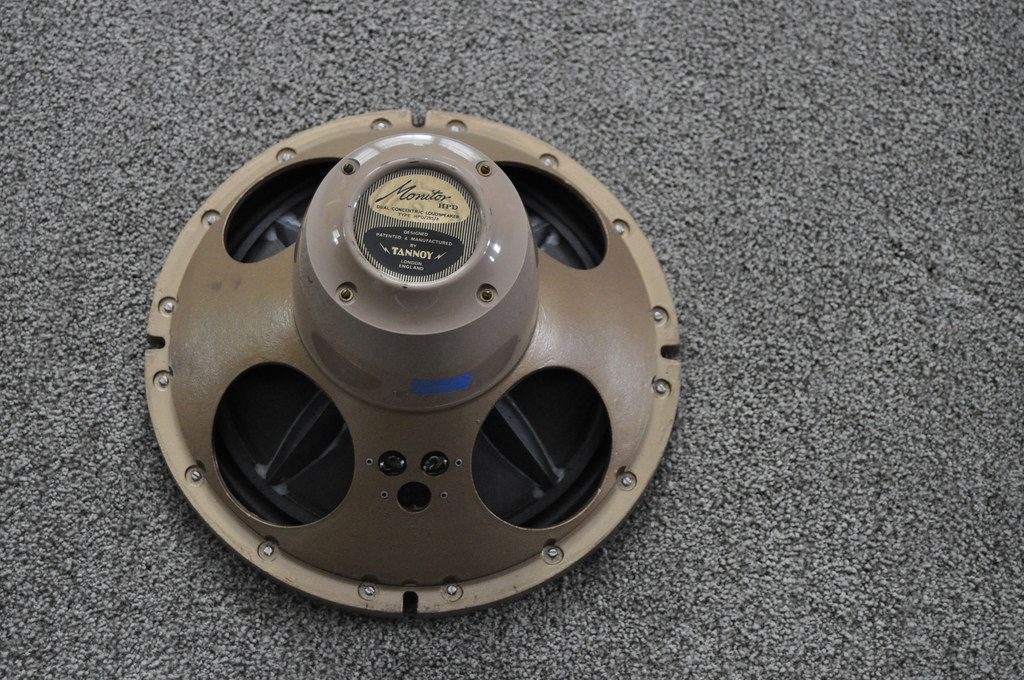
Here're a couple-three-four fairly nice coaxes.

DSCN5839 by Mark Hardy, on Flickr
DSC_5736 by Mark Hardy, on Flickr
016 by Mark Hardy, on Flickr
15TRXBfront by Mark Hardy, on Flickr

That last one actually includes a "whizzer" cone (see below) in an attempt to improve the midrange response and/or dispersion, and might be called a "triaxial" or even "three way" speaker by many folks (mostly in advertising and marketing departments)!

... here are somewhat cheezier coaxes :)

6201-2front by Mark Hardy, on Flickr
celestas by Mark Hardy, on Flickr
DSC_0194 by Mark Hardy, on Flickr
 
I tried using my LS50s as computer desk speakers with a Peachtree Nova as an amp, but they were driving me nuts. I'm not sure why. Anyway, I think they sound better on stands as stereo speakers. Right now I'm trying them has left and right speakers for surround sound system. I might buy a few more to complete the five channel set up. So far, I'm impressed.

007... wow LS50s as computer speakers? I'll bet that they DO sound better as stereo speakers!!!
 
Back
Top Bottom