• The move to the new server is done. There are some software and database maintenance updates in process. This has us passing the hat around to help out. We appreciate any donations. Seriously, even a dollar helps. The payment page may be found here - https://www.audiokarma.org/support.html

Kenwood KA-6000 modifications

Hi, I know this is an old thread but does anyone know about replacing the 4000uf cap with the 15000uf cap? I noticed it mentioned and wondered if it caused any problems?
Your question was already answered, in post #10 on this thread. If you absolutely need to replace the main filter cap, I personally wouldn't go all the way up to 15,000µF. As stated before, such a massive increase in capacitance will add stress to the transformer and rectifier diode bridge. Given the 20% tolerance range of modern elcaps, I think it's a decent rule of thumb to not go over double the original value.

There doesn't seem to be many (if any at all) options for capacitors that match the diameter of the original. I have found a couple that will still require some solution for mounting.

5600µF: https://www.mouser.com/ProductDetail/KEMET/ALF70C562DF100?qs=wnTfsH77Xs5JGBZHnbueEA==

6800µF: https://www.mouser.com/ProductDetail/Cornell-Dubilier-CDE/381LL682M100N062?qs=Cb2nCFKsA8r8a/CYjizTtQ==
 
Last edited:
Your question was already answered, in post #10 on this thread. If you absolutely need to replace the main filter cap, I personally wouldn't go all the way up to 15,000µF. As stated before, such a massive increase in capacitance will add stress to the transformer and rectifier diode bridge. Given the 20% tolerance range of modern elcaps, I think it's a decent rule of thumb to not go over double the original value.

There doesn't seem to be many (if any at all) options for capacitors that match the diameter of the original. I have found a couple that will still require some solution for mounting.

5600µF: https://www.mouser.com/ProductDetail/KEMET/ALF70C562DF100?qs=wnTfsH77Xs5JGBZHnbueEA==

6800µF: https://www.mouser.com/ProductDetail/Cornell-Dubilier-CDE/381LL682M100N062?qs=Cb2nCFKsA8r8a/CYjizTtQ==
Thanks for the information. I was just wondering if Sir Byrd did power up his unit with the 15000uf cap and what the results were.
 
Not necessarily. It could be an issue. I have not tried tripling the capacitance value of the main power supply capacitor on a Kenwood KA-6000. If you install the 15,000µF capacitor in your Kenwood and it works out fine without any negative side effects, then you can post this as a worthwhile modification. My point in the earlier post was that there is not always a free lunch when installing larger capacitance value capacitors in a power supply.

The other coupling and bypass capacitors in the amplifier feedback loop are:

C173, C273 located on the underside of the chassis.

C327, C328, C921, C922, C919, C920, C923, C924 all located on the MAIN AMP “UA1343K1” board.

The three smaller clamped capacitors are power supply capacitors.
Hi tcdriver, I'm kind of hoping you are still watching this very very old thread. It is not nearly as old as my KA-6000! Or me. These two things are very close in age.

Anyway, I'm working on my KA-6000 and keep referring back to this thread, and some others that you chime in on. I'm trying to follow the schematic and identify all the caps in the "signal path", and/or coupling capacitors. I guess my first question is if these two things are one and the same?

But more specifically... you mention C327/C328, but I'm assuming you mean 927/928 since they are on the amp board. I know, I know, you wrote this 16 years ago.

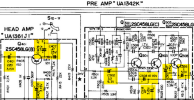
Moving on... I'm trying to come up with the "seven coupling capacitors per channel between the input of the tone amp and the output of the high pass 40Hz" in your first post. I'm counting more. I've hightlighted what I think are coupling capacitors and come up with nine (9). Which ones are not? C702/C704?

I 1764469828519.png


Then I come to the main amp board and have the following questions...

Wouldn't C907 be a coupling cap?
C927 runs to ground. See above I thought maybe a typo but if you meant C927/928 in your post then I would like to understand why this is listed as coupling cap?
C171/C271 aren't these the big coupling caps? Maybe I'm not understanding their role.
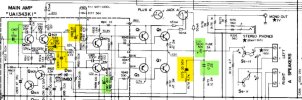
1764470120256.png

I'm researching capacitors for restoration of my KA-6000 and keep reading about ones to use in the "signal path" and also for "coupling caps" so I'm trying to learn that before I continue down more rabbit holes seeking opinions on which is best. That's covered in many other threads and just need to decide, but I'm trying to understand better how to read a schematic and understand these terms.

Anyone with any insight I would great appreciate your input.

Thanks.
Marc

 
To better understand the coupling, try overlaying the DC voltages

C702/704 are not coupling caps. They are probably part of the filter circuit. .22 is too small to couple without significant signal impact.
 
C171 is an output cap. Essentially it is a coupling cap, but bigger to accommodate the additional energy needed for the speaker circuit
 
C171 is an output cap. Essentially it is a coupling cap, but bigger to accommodate the additional energy needed for the speaker circuit
Thank you, Semanon. Very helpful so far. Looking at it now and it's starting to come together in my mind I think. Basically it looks like most if not all CAPs with a listed voltage, even if kind of low such as 3.15V, are either in the signal path or a bypass cap, is that correct? So in the head-amp, C401, C409, C405, C407? and Pre-amp C502, C508, C522, and C526? Its seems all the other caps are very small and non-polarized and I can drop a small film cap in there to replace either ceramic or mylar. Let me know if I'm on the right track. Thanks again!

1764525860910.png
 
The only caps that I usually replace are electrolytic caps. I will replace values up to 3.3 uF with film (if they fit) and everything else with e-caps bumped up one step in voltage (3 to 6, 10 to 16, etc).

The other thing to consider is replacing the 2sc458 transistors with KSC-1845. Replacing these has always lowered my noise floor.

Because of the odd gain staging of the KA-6000, some folks have found the 1845 caused odd issues, but they worked well for me.
 
Back
Top Bottom